
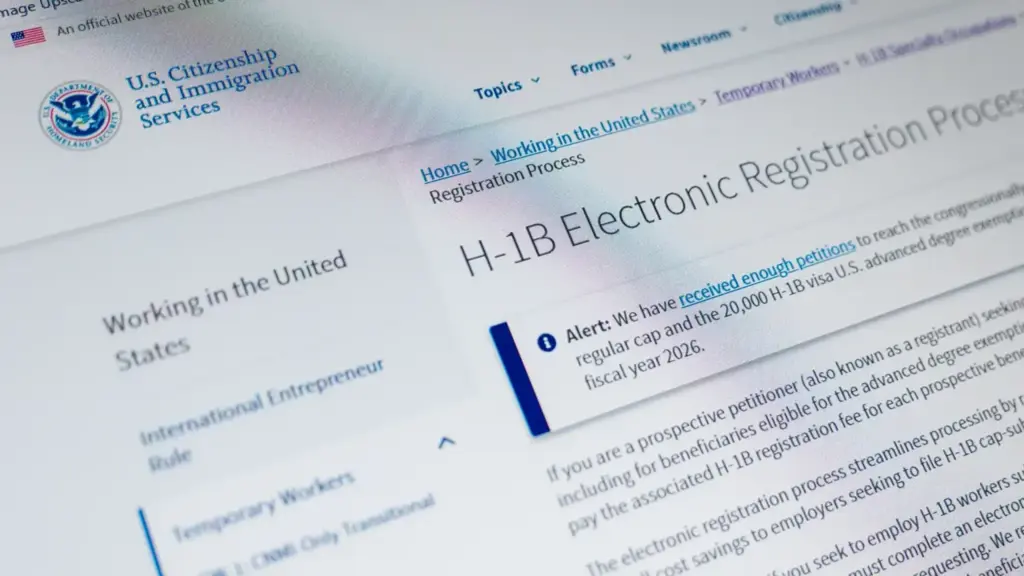
Since 2017, foreign nationals employed on the most popular work visas — including Polish citizens on H-1B (specialty occupation), L-1 (intracompany transfer), or E-2 (investors and their key employees) — who were laid off or left their jobs had up to 60 days (or until the end of their status validity, whichever was shorter) to sort out their situation: find a new sponsor, apply for a change of status, or pack their bags and depart the country legally. During this time, they were not formally considered out of status, even though they were not working.
What DHS is precisely proposing
The Federal Register published a proposal on September 11, 2026, to remove the regulation 8 CFR 214.1(l)(2) (91 FR 57807, doc. 2026-18631, DHS Docket USCIS-2026-0364, RIN 1615-AD22). DHS wants to return to the rules in place before 2017: a foreign national who stops meeting the conditions under which they obtained status (i.e., stops working for the sponsoring employer) would be considered out of status immediately the day after employment terminates — without any grace period unless they have another legal basis for staying.
The 60-day period was introduced in 2016 (the so-called AC21 rule, 81 FR 82398), taking effect on January 17, 2017. It was intended to make it easier for highly skilled workers to change employers and give companies time to complete recruitment formalities. DHS now argues that the rule has “disconnected” a foreign national’s status from the basis on which it was granted and that administering it is too time-consuming: according to data provided in the justification, from October 2017 to May 20, 2026, USCIS officials had to evaluate the application of this period in more than 1.9 million applications and petitions.
Who will be affected and how much it may cost
The proposal covers everyone in E-1, E-2, E-3, H-1B, H-1B1, L-1, O-1, and TN status — which means practically every Polish citizen working in the US on an employer-specific work visa, plus their spouses and children on dependent statuses. DHS estimates in its analysis that a group of approximately 3,795 people per year could suffer a loss of income because they would have to search for a new job from outside the U.S. rather than locally. For individuals against whom USCIS would initiate deportation proceedings (Notice to Appear), DHS estimates the costs of simply attending a hearing at $204.43–$300.53 per person. H-1B and O-1 employers remain obligated to cover return travel costs if they terminate an employee before the end of their status validity period and the employee chooses to leave.
This is not yet in effect — but it is worth preparing
Key caveat: this is merely a proposed rule (notice of proposed rulemaking), not a finalized regulation. DHS is accepting public comments until November 10, 2026, and the rule will only take effect after the final version is published — usually a few months after the consultation closes, provided it is kept in its current form at all. Today, the 60-day grace period is still in effect.
For Polish citizens on work visas, the practical takeaway is already clear: do not delay in reacting to a job loss. If the proposal takes effect, upon termination or contract cancellation, you will need to have a new sponsor or another basis of stay prepared practically overnight, rather than within two months. This is a good time to establish a Plan B in advance with your employer and attorney in case of job loss, especially with a visa renewal or petition extension deadline approaching.
This material is for informational purposes only and does not constitute legal advice. This is a proposed rule currently undergoing public consultation — decisions regarding a specific professional and immigration situation should be consulted individually with an immigration attorney.
Employees and investors on H-1B, L-1, or E-2 visas can find support from Polish immigration attorneys in the Polish Pages directory.