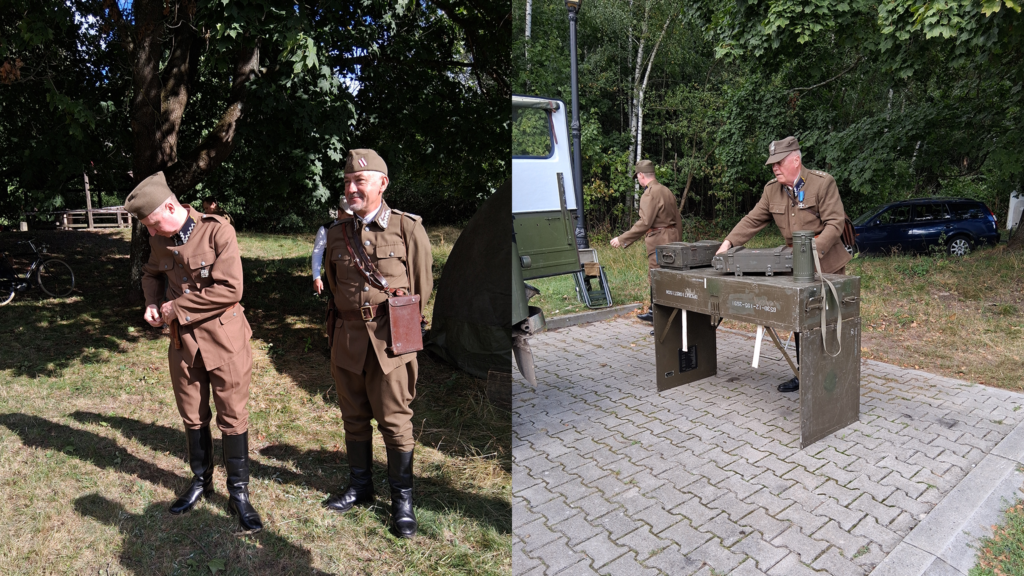
This battle is referred to as the Polish Thermopylae. Despite the massive disproportion of forces between the Polish defenders—commanded by Border Protection Corps (KOP) Captain Władysław Raginis—and the German forces commanded by General Guderian, this battle long remained a little-known episode of World War II.
September 7th
On September 7, reconnaissance units of the 10th Panzer Division approached Wizna. They quickly routed the Polish platoon of horse scouts from the 135th Infantry Regiment and captured Wizna through this maneuver. The following day, offensive operations by subunits of the “Lőtzen” Fortress Brigade began on the outskirts of Giełczyn. General Guderian was dissatisfied with the progress of Army Group North and feared that Polish forces would withdraw from Warsaw and, after regrouping behind the Bug River, be capable of further resistance. He proposed that the XIX Corps strike the Poles by assaulting Wizna in the direction of Brześć. That very day, the corps—consisting of a panzer division and two motorized divisions—moved toward Wizna.
On September 9
On September 9, General Guderian reached the positions held by the 10th Panzer Division and saw for himself that the German reports about breaking through the defense were untrue. The German infantry crossed the river, but did not reach the Polish fortifications. Despite a day-long artillery barrage and the operations of the German air force the previous day, the units of the 10th Panzer Division were unable to advance. Before noon, following a two-hour artillery bombardment, German infantry supported by tanks charged the Polish positions. From the unventilated shelters, it was impossible to fire due to the smoke, so the weapons were moved out into the trenches. Lieutenant Stanisław Brykalski was killed near one of the Polish guns; he, along with Captain Władysław Raginis, had sworn an oath before the battle that he would not surrender his position alive. The Poles repelled successive waves of the German assault, but Guderian soon noticed the shortcomings of the Polish anti-tank defense. At that moment, the Poles had only 20 rounds of ammunition left. Despite this, the Polish defenders managed to destroy a dozen or so tanks.
The same day….
On the afternoon of September 9, General Heinz Guderian changed his tactics. From then on, tanks drove up to individual bunkers, cutting off communication between Polish strongpoints, after which the isolated shelters were surrounded and captured by German infantry. Around 6:00 PM, the Kurpiki shelter, deprived of machine guns and ventilation, was surrendered by Captain Wacław Szmidt. The Germans captured successive fortifications, but by dusk they had failed to take them all.
The next day
At dawn on September 10, the Germans launched another attack, and the last to fall was Captain Raginis’s shelter on Strękowa Góra. During the fighting, a German parlementarian appeared at the Polish shelter, giving Raginis an ultimatum: either the bunker surrenders, or the Polish prisoners taken during the battle will be shot. Given that most of the defenders were wounded to varying degrees and ammunition was running out, after an hour of thought, Captain Władysław Raginis ordered his soldiers to leave the shelter, and he blew himself up with a grenade. The defense of the Wizna sector, despite the clear disproportion of forces of which the Polish defenders were aware, was significant. It allowed Guderian’s troops to be delayed for two days, during which time the Warsaw Army was formed, consisting of remnants of Polish troops gathering to defend the capital from various parts of the country. Many Polish units also gained time to withdraw in an orderly fashion to Romania. Soon, Guderian captured Brześć, where on September 22 he accepted the German-Soviet victory parade.
The editorial staff of „Dziennik Polonijny” thanks the „Świętokrzyski Mountains Soldiers” Historical Reconstruction Association.