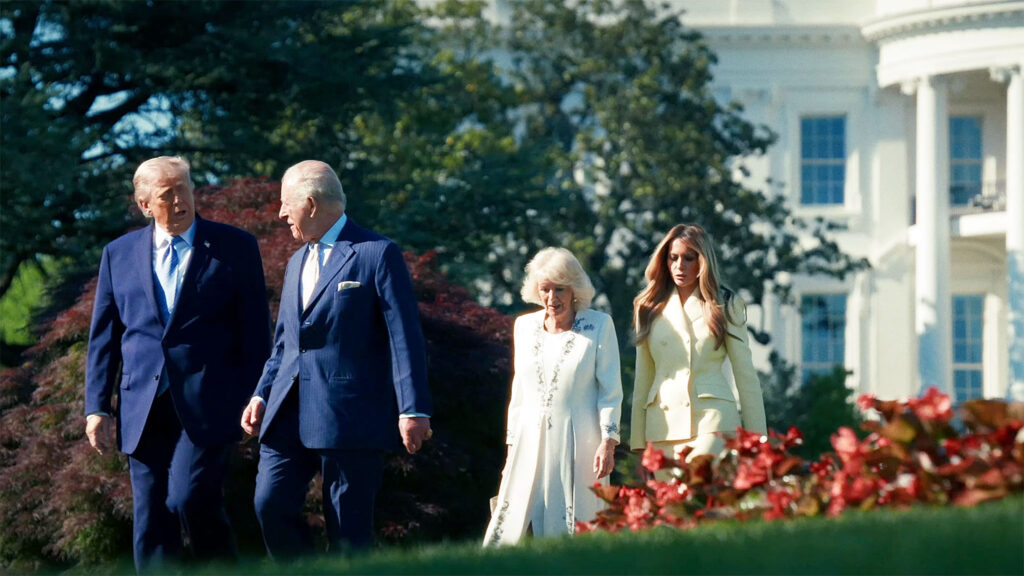
The visit takes place at an exceptionally tense moment: after Saturday’s shooting during the White House Correspondents’ Association Dinner, amidst US-UK disputes over the war with Iran, and against the backdrop of the 250th anniversary of American independence – the anniversary of a nation born from rebellion against the British Crown. The full text of the speech has not been publicly revealed beforehand, but British media report that Charles will speak about democracy, history, security, economy, and the resilience of the British-American alliance.
What exactly will happen
Tuesday’s program begins in the morning. A full welcome ceremony on the South Lawn of the White House: a twenty-one gun salute, a parade of honor by the US Army Old Guard Fife and Drum Corps, the anthems of both nations performed by the Marine Band orchestra, a review of troops involving nearly five hundred soldiers from all six branches of the US armed forces – a historic first such review during a state visit. Afterwards, a presentation on the Blue Room balcony, exchange of official gifts, signing of the guest book at the White House.
In the afternoon, around 3:00 PM Eastern American Time – the Capitol. An address to a joint meeting of both houses of Congress. Speaker of the House of Representatives Mike Johnson, Senate Majority Leader John Thune, Senate Minority Leader Chuck Schumer, and House Minority Leader Hakeem Jeffries – all four congressional leaders extended a formal invitation to Charles in early April. “The address will provide a unique opportunity to share your vision for the future of our special relationship and reaffirm our alliance at this pivotal moment in history,” they wrote. The invitation quoted Queen Elizabeth II’s 1991 speech – Charles’s mother – in which she spoke of a shared “spirit of democracy.” Symbolically and strategically: congressional leaders want Charles to refer to these words.
In the evening – a state dinner in the East Room of the White House. Evening attire, long format, full protocol. Donald and Melania Trump as hosts, Charles and Camilla as guests of honor, dozens of ministers, senators, lobbyists, and business people. The menu, guest list, and topics of conversation – all confidential until the evening.
1991 versus 2026 – the same Capitol, two worlds
On May 16, 1991, when Elizabeth II stood before Congress, the Cold War was drawing to a close. The Berlin Wall had fallen a year and a half earlier, and a unified Germany had existed for seven months. Poland had its first non-communist government in decades and was preparing for its first fully free parliamentary elections. The Soviet Union formally still existed, but its days were numbered – Białowieża was six months away. Elizabeth II then spoke of a shared “spirit of democracy,” individual freedom, the consent of the governed, and the rule of law – words to which congressional leaders referred in this year’s invitation to Charles III. The British-American “special relationship” was then in ideal form.
Thirty-five years later, things are different. British-American relations are strained. Trump publicly criticizes Keir Starmer’s government for refusing to participate in US-Israeli military actions against Iran, which began in February 2026. When Trump was evacuated from the Washington Hilton hotel on Saturday evening after Cole Tomas Allen fired shots, Starmer called Trump on Sunday, conveying relief and support after the “shocking scenes.” The call was courteous, but the conversation took place in the shadow of tensions surrounding Iran. Buckingham Palace had to urgently consult with the White House on Sunday whether the visit should proceed at all.
When Elizabeth II spoke in 1991, British Prime Minister Margaret Thatcher had just left office, but that era was still ongoing. The Reagan-Thatcher model of the “special relationship” was exemplary. Today, that model no longer exists. Charles stands before Congress in an era where Trump has openly said that Article 5 of the North Atlantic Treaty might be “negotiable,” where Europe does things without America – like the 90 billion euro loan for Ukraine from frozen Russian assets approved on Friday – and where the States are fighting wars that the British do not want to join.
What Charles might say (and what he probably won’t)
The British monarch does not engage in politics. This has been the Palace’s fundamental rule for over a hundred years. Every word Charles says is pre-agreed with Downing Street, meaning Keir Starmer’s government. Spontaneity would mean unpredictability, and unpredictability is when things can go wrong. British commentators expect Charles to address US-UK tensions indirectly, without direct criticism of the Trump administration.
What does this mean in practice? Firstly – Charles will likely emphasize values common to both countries: democracy, the rule of law, freedom of the press. These are topics to which Trump has no convincing answer after Saturday’s incident and his attack on Jimmy Kimmel. Secondly – Charles will probably mention the “special relationship” as something that transcends individual leaders. In other words: you do not belong to Trump, we do not belong to Starmer, this relationship is bigger than all of us. Thirdly – there will be a mention of the military’s role, probably in the context of joint historical operations. This will be a subtle reminder that the British fought alongside Americans in all the great wars of the twentieth century, and the current tension around Iran is an exception, not the rule.
What will Charles almost certainly not say? He will not speak broadly about his brother. Andrew Mountbatten-Windsor, formerly Prince Andrew, was arrested by British police in February 2026 on suspicion of abuse of public office in connection with revelations concerning the Jeffrey Epstein case. Andrew was later released during the investigation and denies the charges. Earlier, in October 2025, Buckingham Palace announced a formal process to remove his style, titles, and honors. The matter remains a shadow over the royal family, and Congressman Ro Khanna of California called on Charles to address it during the visit. However, there are no indications that the monarch will do so in his speech to Congress.
The Polish context that no one will connect today
It is worth noting something that will not resonate in the mainstream. When Elizabeth II spoke in 1991 about the “spirit of democracy,” American congressmen with Polish surnames sat in Congress – Marcy Kaptur from Ohio, Dan Rostenkowski from Illinois, Henry Nowak from New York. They listened to the Queen, whose family had hosted the Polish government-in-exile in London before the war. These were times when Poland was just returning to Europe, and the Polish diaspora was an important electorate in the industrial Midwest of the States.
Thirty-five years later, the Congressional chamber looks different. Marcy Kaptur is still there – she is the longest-serving woman in the history of the House of Representatives, a congresswoman from Toledo, of Polish descent. But apart from her, the Polish diaspora’s presence in Congress has shrunk. The Rostenkowski generation has passed. The second and third generations of the Polish diaspora have assimilated, the political machine of Chicago, which produced congressmen of Polish descent, has crumbled. Today, as Charles III speaks to Congress, the Polish diaspora in America listens to this speech with increasingly less representation in the chamber. This is a consequence of a process that no one planned – but which has occurred.
And at the same time, across the Atlantic, the Polish community looks different. After the emigration wave of 2004, over 760,000 people with Polish passports live in England and Wales alone according to the 2021 census, and in the entire United Kingdom, this number exceeds 800,000. In the United Kingdom, the memory of Polish airmen in the Battle of Britain, including Squadron 303, remains an important element of Polish-British relations. The British Polish diaspora is younger in terms of migration and more first-generation, while the American one is much more numerous but more dispersed and more strongly assimilated. Charles’s Tuesday address to Congress will not change these two dynamics, but it will highlight them.
What to expect after zero hour
Charles will speak for about twenty minutes – that’s what British media, including The Guardian, report as the planned duration of the address. Speaker Mike Johnson will introduce him, applause on welcome. As with similar addresses by guests of honor, the reactions of the chamber – applause, standing ovations, moments of silence – will themselves be politically commented on. Charles will stick to the prepared text. He will not deviate from the script. The Palace will not allow it.
The speech will then be analyzed by all newsrooms worldwide. Every sentence will be weighed. Every choice of words. Did Charles use the word “alliance” or “friendship”? Did he speak of “leaders” or “nations”? Did he mention Russia, or did he remain silent about it? Did he refer to his mother’s 1991 speech directly, or only with allusions? We will be answering these questions in the States for the next few days. The Polish diaspora on both sides of the Atlantic will too.
After the address, Charles returns to the White House for the state dinner. On Wednesday, he flies to New York – the 9/11 Memorial, a community project in Harlem, celebrations of Winnie the Pooh’s centenary. On Thursday, he returns to Washington, officially bid farewell, and departs for Bermuda, where on May 1 and 2 he will make his first visit to a British overseas territory as monarch. The state visit ends where it began – under the British flag, but in the middle of the Atlantic. Symbolically perfect. But that’s another story, for another day.
Today, the Congressional chamber. Today, one British monarch, one American Congress, one speech. The whole world will read between the lines. The Polish diaspora along with the rest.
Kamil Brzozowski, poland.us
Charles III before the US Congress – Tuesday, April 28, 2026 | Format: address to a Joint Meeting of Congress | Time: approximately 3:00 PM EDT, according to the House of Representatives schedule | Speech duration: approximately 20 minutes | First such address by a British monarch since Queen Elizabeth II’s speech on May 16, 1991 | Invited by: Mike Johnson (R-LA, Speaker of the House), John Thune (R-SD, Senate Leader), Chuck Schumer (D-NY), Hakeem Jeffries (D-NY) | Ceremonial welcome on the South Lawn: 21-gun salute, US Army Old Guard Fife and Drum Corps parade, anthems performed by the Marine Band, review of ~500 soldiers from 6 branches of the US armed forces (with 300 in Pass in Review – a historic first during a state visit) | Evening: state dinner in the East Room of the White House | In the background: US-UK tensions over the war with Iran; the case of Andrew Mountbatten-Windsor, arrested in February 2026 and released during the investigation; titles being removed since October 2025 | Further in the program: Wednesday New York (9/11 Memorial, Harlem, Winnie the Pooh centenary), Thursday farewell and departure for Bermuda (May 1–2, Charles’s first visit to a British overseas territory as monarch) | Polish diaspora statistics for context: over 760,000 people with Polish passports in England and Wales according to the 2021 census, over 800,000 in the entire United Kingdom; approx. 8.6 million people of Polish descent in the USA according to the 2020 census; Marcy Kaptur (D-OH) – longest-serving woman in the history of the US House of Representatives, of Polish descent | Based on materials from The Guardian, CNN, Washington Post, Roll Call, Al Jazeera, RTÉ, BBC, AP, CBS News, ONS, U.S. Census Bureau, Wikipedia, and official communications from the US Congress and Buckingham Palace
Read also: British monarch visits descendants of rebellious subjects – full context of the visit | Shots at the White House Correspondents’ Dinner
Read more on Poland.us.