
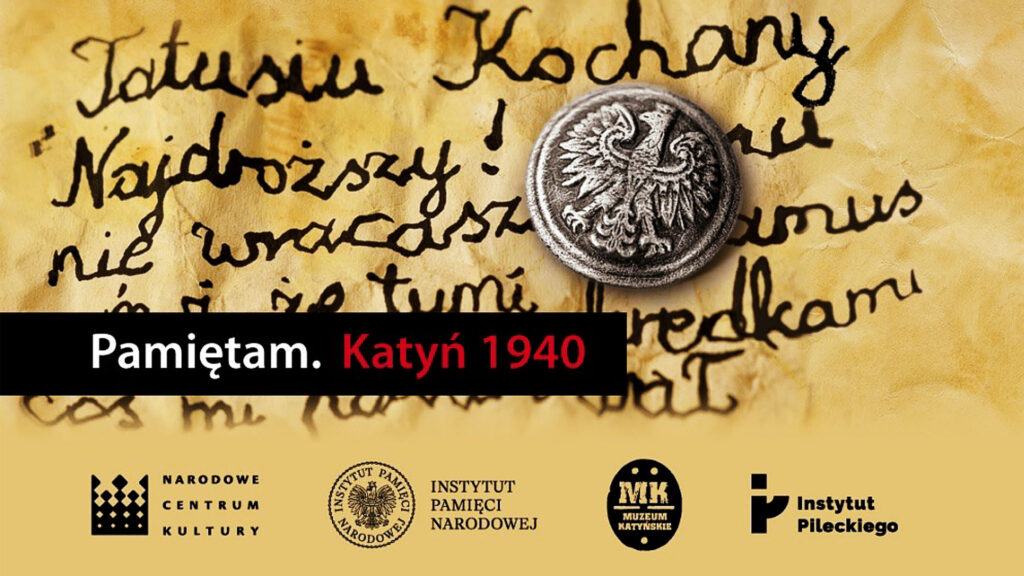
The symbol of the campaign is a pin – a replica of a military uniform button, referencing Zbigniew Herbert’s poem “Buttons”. It is a sign of remembrance for the victims of the Katyn massacre and an expression of opposition to the falsification of one of the most tragic chapters in Polish history. The campaign organizers are: the National Centre for Culture, the Katyn Museum, the Pilecki Institute, and the Institute of National Remembrance.
The Pilecki Institute in New York is actively participating in this social and educational campaign.
As part of the “Wear the Button of Remembrance” initiative, pins will be available to visitors at the Pilecki Institute’s headquarters at 92 Greenwich Street, New York, NY 10006, on the following days:
- April 9–10, 2026, from 10:00 AM to 4:00 PM
- April 11, 2026, from 4:30 PM to 7:30 PM
Pins will also be distributed on Friday, April 10, 2026:
- on Manhattan Avenue in Greenpoint from 9:30 AM to 11:15 AM
- at Krakus Senior Center, 176 Java Street, from 11:15 AM to 11:45 AM
- in the vicinity of the World Trade Center in Manhattan from 2:00 PM to 4:00 PM
The Pilecki Institute also invites you to a screening of Andrzej Wajda’s film Katyn, which will take place on Saturday, April 11, 2026, at 5:00 PM at the Institute’s headquarters at 92 Greenwich Street, New York, NY 10006. The film will be presented in Polish with English subtitles. Admission is free.
The Katyn Massacre
In the spring of 1940, by order of the highest authorities of the Soviet Union, the Soviets committed genocide against nearly 22,000 Poles. Among them were professional officers of the Polish Army, policemen, reserve officers, doctors, teachers, lawyers, civil servants, artists, and scientists. The graves of the victims were discovered in Katyn, Kharkiv, Mednoye, and Bykownia. The truth about these events was forbidden in the Polish People’s Republic. Although the USSR admitted to committing the Katyn massacre in 1990, Russia has now returned to spreading lies about the Katyn crime. Those responsible for this crime have not been judged internationally.
Katyn Button: campaign and social-educational action “Pin the Button of Remembrance”
The Katyn Button is an element of the social and educational campaign “I Remember. Katyn 1940” initiated in April 2007 by the National Centre for Culture. This was the period preceding the premiere of Andrzej Wajda’s film “Katyn”.
– The Katyn Button in the form of a pin is a replica of an artifact found in the death pits, a silent witness to the crime, which today connects generations – says Michał Kosiorek, deputy director of the NCK. – We encourage everyone to pick up pins at designated points across the country and abroad. We invite reenactment groups and local memory centers to join the action and distribute the symbolic buttons. Every person who pins on a Katyn Button becomes an ambassador of remembrance for the victims of the Katyn massacre – emphasizes the deputy director of the NCK.
The continuation of the long-standing campaign takes on particular significance in recent years, in the context of Russian aggression against Ukraine and the spread of anti-Polish rhetoric.
As Dr. Rafał Kościański, IPN spokesman, explains, “we are currently witnessing the return of the Kremlin’s imperial policy, including the return of Russian propaganda to the narrative that the Katyn massacre was committed by the Germans.”
– A symbol of this process is the removal in 2025 by Russian authorities of Polish military symbols from cemeteries in Mednoye and Katyn: the Order of Virtuti Militari, with which Poland honored the victory over the Russians in 1792, and the September Campaign Cross, commemorating the German-Soviet aggression of 1939 – says Dr. Rafał Kościański.
Given the limited access to places of remembrance, the need to cultivate symbolic space and restore memory through symbolic gestures becomes particularly vital.
– For several years, we have not had access to the forests in Katyn, Mednoye, and Kuropaty; access to the cemeteries in Bykownia and Kharkiv is difficult – emphasizes Sebastian Karwat, head of the Katyn Museum. – We cannot pay due tribute to our Heroes at the place where their bodies were laid. In a symbolic way, the Katyn Museum now fulfills this function as a place where the memory of the victims of the Soviet murder 86 years ago is still alive. – he adds.
Victims of the Soviet Crime
The symbolic pins will be accompanied by plaques with silhouettes of twenty selected victims of the Katyn massacre, whose stories will be recalled in an information campaign carried out, among others, on social media. One button represents one human story, suddenly interrupted and falsified for many years.
– From the beginning of its existence, the Pilecki Institute has been tasked with commemorating the victims of totalitarian systems, which is why our involvement in the “Pin the Button of Remembrance” campaign, which is part of the educational and social campaign “I Remember. Katyn 1940”, is a natural step in fulfilling this mission – explains Karol Madaj, acting director of the Pilecki Institute. – In this way, we want to focus on the memory of a specific person, their passions, family, and merits for the Republic of Poland. By distributing button replicas in Warsaw, Berlin, and New York, we remind everyone that behind each of the 22,000 victims lies a personal tragedy. Internationalizing this memory is our duty, especially now, when Russian imperialism once again threatens Europe. The crimes in Bucha show that totalitarian mechanisms have not faded into the past, which is why the voices of the Katyn victims must resonate particularly loudly today – adds Karol Madaj.
“Pin the Button of Remembrance” Campaign
On April 11-13, as part of the “Pin the Button of Remembrance” campaign, pins can be obtained, among other places, at the Katyn Museum in Warsaw, at Kordegarda – the NCK gallery on Krakowskie Przedmieście, at IPN branches and delegations throughout the country, and from April 10 at the Pilecki Institute in Warsaw (Sienna 82 and Dom Bez Kantów Gallery) and its branches: in Augustów – at the House of Remembrance of the Victims of the Augustów Roundup, as well as in Berlin and New York, and at branches of the Public Library in the Wola District of the capital city of Warsaw, the Pilecki Family Home Museum in Ostrów Mazowiecka, and the Raszyn Cultural Center.
Educational Package
An important element of the project is an educational package aimed at schools, prepared jointly by the partners. It will include, among other things, a mini-series “Relay Race” telling the story of a young man searching for traces of his great-grandfather murdered in Katyn, as well as an audiovisual material “I Saw with My Own Eyes” – Józef Mackiewicz’s account illustrated with photos from the Katyn Museum’s collections, and a virtual exhibition “Unremembrance” – an artistic story about the fate of Poles imprisoned in Soviet gulags.
The campaign “I Remember. Katyn 1940” is an expression of concern for historical memory and responsibility for the truth. In the face of contemporary attempts to undermine it, it constitutes an important element in building a conscious civic community – in Poland and beyond its borders.
CALENDAR OF EVENTS
- Workshops titled “Katyn Investigation” at regional National Education Offices and IPN Delegations | Białystok | Częstochowa | Gdańsk | Gorzów Wielkopolski | Katowice | Kielce | Koszalin | Kraków | Lublin | Łódź | Olsztyn | Opole | Poznań | Rzeszów | Szczecin | Warsaw | Wrocław (organizer: Institute of National Remembrance)
- Warsaw, April 9: Meeting at Dom Bez Kantów titled “Before Extermination. The Situation of Polish Prisoners of War in Soviet Camps in Kozielsk, Starobielsk, and Ostashkov” – lecture by Piotr Kolanek, Violin concert by Kamila Wąsik-Janiak (organizer: Pilecki Institute)
- Warsaw, April 10: Screening of the film “Where Strawberries Grow” (dir. A. Ferens) and debate “I hope to return to you soon” at the Pilecki Institute headquarters at Sienna 82. The meeting will be attended by experts and researchers dealing with the Katyn massacre and archival studies: Prof. Dr. hab. Anna Drążkowska, Dr. Dominika Siemiańska, Karol Kalinowski, Dr. Jerzy Rohoziński (organizer: Pilecki Institute)
- New York, April 10-11: Distribution and information campaign at the Pilecki Institute in New York, on the streets of Greenpoint, at the Krakus Senior Club (Polish-Slavic Center), and in the vicinity of the World Trade Center (organizer: Pilecki Institute)
- Augustów, April 11: Button distribution campaign at the House of Remembrance of the Victims of the Augustów Roundup along the route of this year’s TrekTour 2026 rally among participants and interested individuals (organizer: Pilecki Institute)
- Warsaw, April 11: Screening of the film “Katyn” (dir. A. Wajda) at the Pilecki Institute headquarters at Sienna 82 (organizer: Pilecki Institute)
- New York, April 11: Screening of the film “Katyn” (dir. A. Wajda) at the Pilecki Institute in New York (organizer: Pilecki Institute)
- Warsaw, April 12: Ceremonies at the Katyn Museum
Solemn commemorations of the 86th anniversary of the Katyn massacre with the participation of Families of the Katyn victims, opening of a new temporary exhibition (organizer: Katyn Museum) - Warsaw, April 12: XIX Katyn March of Shadows, which will pass through the streets of Warsaw (organizer: Historical Group “Radosław Grouping” Association)
- Warsaw, April 13: Button distribution campaign at the Kordegarda gallery on Krakowskie Przedmieście 15 – an event accompanying the exhibition “Meridian 21” opened on April 9 referencing the work of Józef Czapski – a prisoner of the Starobielsk camp who escaped death in Katyn. Czapski left the USSR with Anders’ Army and dedicated a significant part of his later life to fighting for the disclosure of the truth about the Katyn massacre and commemorating its victims (organizer: National Centre for Culture)
- Augustów, April 13-16: Educational campaign in the form of lessons and meetings in friendly educational institutions (organizer: Pilecki Institute)
- Berlin, April 13: film screening and debate commemorating the Katyn massacre. The central theme of the meeting will be Józef Czapski. The meeting will begin with a screening of the documentary film “Józef Czapski – Witness of the Century 1896–1993”. This will be followed by a discussion about Józef Czapski in the context of Katyn and other individuals who managed to avoid the fate of those murdered by the NKVD. Speakers will include: Thomas Urban, German journalist and historian, and Richard François Aeschlimann – Swiss author of a book about Józef Czapski. The event will be combined with a distribution campaign in the vicinity of the Brandenburg Gate (organizer: Pilecki Institute)
- Warsaw, April 14-27: educational week at Dom Bez Kantów with “Katyn Investigation” workshops for high school students and 8th-grade primary school students – Krakowskie Przedmieście 11 (organizer: Pilecki Institute)
- Warsaw, April 15: historical debate on the Katyn lie at the Central History Stop, Marszałkowska 107 (organizer: Institute of National Remembrance)