Back then, there was no war in Ukraine, no Trump, no assassination attempt on the president 48 hours prior. This week, everything on that list is present. And between these two state visits – the one in 2007 and today’s – the Polish diaspora in the United States has changed just as much as the entire country. And no one is talking about it today.
Four Days, Three States, One Promise
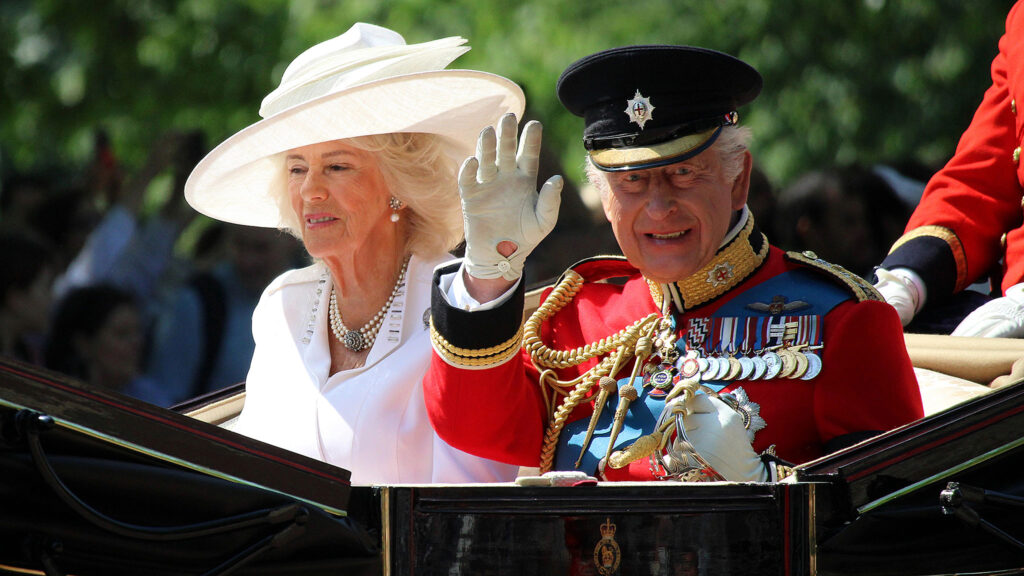
Charles III and Camilla were welcomed at Joint Base Andrews by the US Chief of Protocol, Monica Crowley, and British Ambassador Christian Turner. From the airport, they went directly to the White House, where Donald Trump and Melania Trump greeted them under the South Portico. A brief tea in the Green Room, a tour of the newly expanded beehive on the South Lawn, followed by a garden party at the British Ambassador’s residence – that was the first day. On Tuesday, the main event: a full welcome ceremony with a twenty-one gun salute, a military parade, and the King’s address to a joint session of the US Congress. In the evening – a state dinner.
On Wednesday, the monarchs will travel to New York. There, the King and Queen will visit the 9/11 Memorial, a community project in Harlem, and participate in an event celebrating the centenary of Winnie the Pooh. On Thursday – Virginia: Appalachian cultural performances, a visit to a national park dedicated to nature conservation and indigenous communities, and separately, the Queen’s visit to a horse stud farm. To conclude the 250th anniversary of American independence – a return to London.
This is, as Buckingham Palace put it, “the most important foreign visit of the current reign.” Trump in 2025 was in the UK for an unprecedented second state visit to Charles III. Now he is returning the honor. But honorably – in difficult times. US-British relations have been creaking in recent months. Prime Minister Keir Starmer and Trump publicly argued about the war with Iran. Trump criticized London for refusing to participate in American military actions against Iran. Americans have not forgotten.
Saturday’s Bullet and Thursday’s King
The most difficult question of this visit arose on Saturday evening, April 25. Cole Tomas Allen passed through a metal detector at the Washington Hilton hotel and fired shots. Trump was evacuated. In the ballroom were the president, vice president, administration members, officials, and hundreds of journalists – all were quickly led out. No one was killed, but one Secret Service agent was hit in the chest – his vest saved his life. Buckingham Palace urgently consulted with the White House on Sunday. The decision was made on Sunday evening: the visit would proceed as planned, but with a higher level of security. According to Buckingham Palace, the King was relieved to hear that the president, first lady, and guests were unharmed. Charles and Camilla privately conveyed their condolences to the Trumps.
British commentators described this visit as particularly diplomatically risky – taking place just after a shooting involving the US president and amid transatlantic tensions. Everything the King and Queen say has been pre-arranged with Downing Street. Zero improvisation. Zero spontaneity. Spontaneity would mean unpredictability, and unpredictability is when things can go wrong. The monarchy doesn’t do that. A British monarch in America, after an assassination attempt on the American president, cannot stumble. Every word is weighed, every gesture checked.
The symbol has already been set. Camilla, descending the plane’s steps, wore a “Union Jack and Stars and Stripes” brooch – platinum, with rubies, emeralds, and diamonds. It was originally given to Elizabeth II by New York Mayor Robert F. Wagner during the Queen’s first state visit to the USA in 1957. Camilla wore it again today, as if to remind: we, the British, are with you. Just as we were with you when you erected the Lincoln Memorial.
250 Years of Astonished Independence
The context of this visit seems absurd if you stop to think about it. Charles III is a descendant of George III – the monarch against whom the American colonies rebelled. Since George III, 9 of his successors have sat on the British throne, including Charles III. These colonies declared independence on July 4, 1776, citing the “tyranny” of that very George III as the reason. For over 160 years after the declaration of independence, no British monarch visited the United States. The first was George VI in 1939 – Elizabeth II’s father – whom Franklin Roosevelt invited to strengthen relations before the outbreak of war with Hitler. The first garden party at the British Ambassador’s residence took place then. The same one Charles is at today.
250 years is not much for a country, but a lot for a relationship. Colonial grievances and imperial ambitions transformed into a “special relationship,” first spoken of by Winston Churchill in 1946 during a speech in Fulton, Missouri. This relationship, like everything in geopolitics, has its waves. During the Reagan-Thatcher years, it was at its peak. Under Obama-Cameron, it dimmed. Under Trump-Johnson, it was hot again. Under Trump-Starmer – it’s strange. The British didn’t want to get involved in the war with Iran. The Americans wanted them to. There is tension. And it is in this tension that Charles is to address Congress on Tuesday. He is to speak of friendship, values, common roots. And between the words, probably also that without the British, the States will not win what they are currently pursuing. Subtly, because the monarchy does not politicize. But everyone in the room will understand.
And Where Are We in This Story?
Here is a moment that will not appear anywhere in the major American media today. From the perspective of the Polish diaspora, this visit is a story from both sides of the Atlantic, in which Poles are the most numerous forgotten side. Over eight hundred thousand people born in Poland live in the United Kingdom – after the emigration wave of 2004, the British Polish community became one of the most numerous foreign communities on the Isles. In the United States, according to 2020 census data, about eight million six hundred thousand people declare Polish ancestry. Together – over nine million Poles on both sides of the “special relationship.” This number is larger than the population of many European countries.
Charles III has personal relationships with the Polish diaspora. He has met with Polish veterans from the UK many times, including pilots from Squadron 303. As Prince of Wales, he visited Polish communities in the Isles. British memory of Polish airmen, especially Squadron 303 and other Polish pilots of the Battle of Britain, remains an important element of Polish-British relations – and Charles is one of the British royals who most deeply understands this history. The royal couple knows who Poles are in their country.
But in the United States, their visit seems to overlook Poland. The program does not include any Polish diaspora element. This is understandable – four days, three states, every gesture planned. But this absence says something. Firstly – that the American Polish diaspora, although significantly more numerous than the British, is now more dispersed and assimilated, while the Polish community in the UK – younger in terms of migration and more first-generation – is culturally more visible. Secondly – Polish identity in America after two generations of assimilation is no longer a priority for royal planners to emphasize. They will visit Virginia, they will visit Appalachia, they will visit indigenous communities. They will not visit Greenpoint, Jackson, or Hamtramck.
This is a moment worth noting. The next time a British royal couple lands in America, those who built Detroit, Chicago, Buffalo, Pittsburgh, and Hamtramck may no longer be on the list of “communities to honor.” And without the Polish diaspora, these cities would be completely different. This is not a complaint. This is an observation. The American Polish diaspora must fight for its own visibility. We won’t bring the King to Greenpoint, but we can at least remind Greenpoint that it exists.
Bees, Pooh, and the War Under the Table
Programmatically, the visit looks sweet. Tea party at the White House. Bees on the lawn. The centenary of Winnie the Pooh in New York – this is an event that many readers will find curious, but in fact, it is a subtle British comment: Pooh is an English bear, by A.A. Milne, from 1926, but adapted for the screen by Disney. We are celebrating the centenary in America. British culture, American business, British monarch – everything meets in a small room in Manhattan, where children sing songs. This is soft power in its purest form.
Camilla will separately visit representatives of organizations fighting domestic violence. This has been her long-standing cause for over ten years. In the American context – this is a topic that the Trump administration tends not to highlight. The Queen will do it for them. Very British. Very monarchical.
And one more thing that will probably play out behind the scenes but won’t be widely reported in the media: the King’s brother, Andrew Mountbatten-Windsor, has been the subject of interest from Democrats on the US House Oversight Committee for months regarding his relationship with Jeffrey Epstein. This is a leaden topic for the Palace. The royal family has withdrawn Andrew from public life, but Americans are still demanding explanations. The matter casts a shadow over every royal visit to the USA. Charles in Washington cannot ignore that his brother’s name keeps coming up in questions from American congressmen. These are the piquant paradoxes of the modern monarchy.
Why This Matters
Charles III’s visit is important for three reasons that other media today cannot connect. Firstly – it shows that despite Trump’s American isolationism, the “special relationship” still exists. The British can warm it up even in a difficult moment. Secondly – it shows that symbolism still matters. In the age of social media, deepfakes, and shootings at press dinners, Camilla’s 1957 brooch is more authentic than 90 percent of online content. Thirdly – it shows that the United States, despite all crises, is still a place where kings of the world come. Even after an assassination attempt. Even after the war with Iran. Even after Trump.
The Polish diaspora has its place in this. We just have to fight for it ourselves. Charles remembers us in London. In Washington, he won’t see us. But we can remind each other – that we are the largest forgotten side of this “special relationship.” After the British and Americans, we are the third largest force within this story. Only no one writes about it. Maybe it’s time to start.
Kamil Brzozowski, poland.us
State Visit of Charles III and Camilla to the USA – April 27–30, 2026 | First state visit by a British monarch to the USA since May 2007 (Elizabeth II with G.W. Bush) | First state visit of Charles III to the USA as King | Second state visit hosted by Trump, first in his second term | Reason: 250th anniversary of US independence | Itinerary: Washington (27–28), New York (29), Virginia (30) | Highlights: tea party at the White House, garden party at the UK Ambassador’s residence, ceremony with 21-gun salute and King’s address to a joint session of Congress (April 28 – first such address by a British monarch since Elizabeth II in 1991), state dinner at the White House, 9/11 Memorial, Winnie the Pooh centenary in New York, national park in Virginia and 250th anniversary program | Camilla’s brooch: “Union Jack and Stars and Stripes,” gifted to Elizabeth II by New York Mayor Robert F. Wagner in 1957 | Security: heightened after Saturday’s shooting at the Washington Hilton (April 25) | Statistics: over 800,000 Polish-born individuals in the UK, approx. 8.6 million people declaring Polish ancestry in the USA according to 2020 census | Background: US-UK tensions over the war with Iran; Andrew Mountbatten-Windsor and Epstein case still of interest to Democrats on the Congressional Oversight Committee | Based on materials from CNN, NBC News, AP, Al Jazeera, BBC, Axios, People, Town & Country, ONS, U.S. Census Bureau, Wikipedia, and official communications from Buckingham Palace and the White House
Read also: Shots Fired at White House Correspondents’ Dinner | Allen Charged with Attempted Assassination of Trump
Read more at Poland.us.