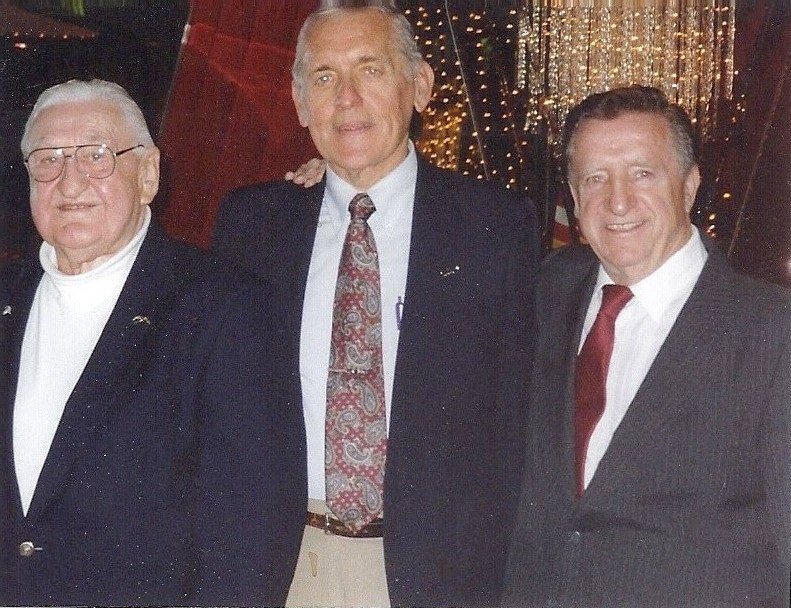
It came as little surprise that an American of Polish heritage like Gabreski was the one to earn this special designation in the war.
Fighting for the cause of America’s freedom was sufficient motivation for him to excel at his remarkable skill at operating a P-47 Thunderbolt and shooting down the pride of Nazi Germany’s air force – the highly efficient warplanes of the Luftwaffe. By the time the war ended, he had downed 28 of them and destroyed 3 more on the ground. In the Korean war that followed, he was credited with 6½ more enemy kills.
But for this talented American pilot his friends nicknamed “Gabby,” there was an additional cause that drove him. As the son of Polish immigrants who came to America and settled down in Oil City, PA, it was also a bit of payback for the barbaric brutality with which the Luftwaffe carried out Adolf Hitler’s cruel order to “kill without mercy and compassion, men, women and children of Polish derivation and language.”
Gabreski originally was stationed at Pearl Harbor when the Japanese attacked in 1941. Because he spoke Polish, the U.S. later transferred him to the European Theatre and assigned him to fly with the Polish pilots who joined England’s RAF and performed so effectively in the 1940 Battle of Britain.
After learning some of the techniques these Polish pilots used against the Luftwaffe, “Gabby” was assigned to his own U.S. squadron where he began to put those skills to good use and compiled his amazing air statistics.
After the Korean war, Gabreski lived on New York’s Long Island and became an executive at Grumman Aerospace followed by a term as head of the Long Island Railroad.
He was later named honorary member of the Polish American Congress Downstate N.Y. Division.
Contact: Frank Milewski
(516) 352-7125
[email protected]