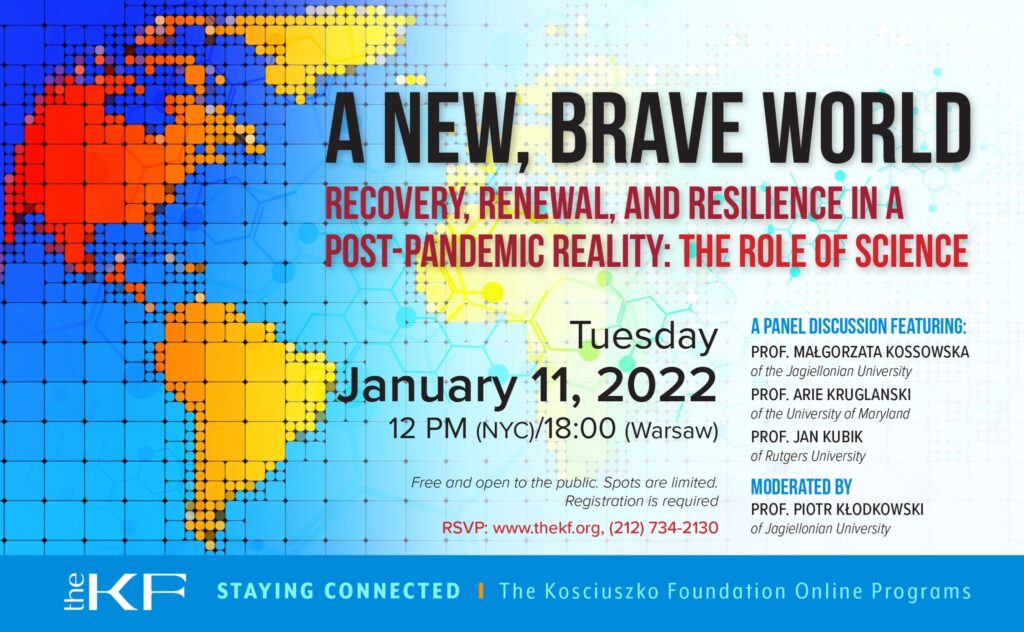
A webinar discussion featuring:
– Prof. Malgorzata Kossowska of the Jagiellonian University
– Prof. Arie Kruglanski of the University of Maryland
– Prof. Jan Kubik of Rutgers University
and
Moderator: Prof. Piotr Klodkowski of the Jagiellonian University
The COVID-19 pandemic, being a global phenomenon, can take a terrible toll all around the world. Still, we know now that fatality rates vary significantly across continents and countries. And while symptoms of the disease, its course, and medical consequences are likely to be virtually the same worldwide, as are the recommended treatments and pharmaceuticals, other factors can differ to a remarkable degree. These include the means of communicating risk, the reasons provided to justify government measures, and even people’s responses to the pandemic. These variations depend on the cultural and social or religious milieu because, while all these differences do enrich our world, they also create barriers in the communication and then decision-making processes, which may (or may not) lead to unexpected consequences.
Thus, being aware of those differences aids in the design of appropriate messages for a selected target group, which may constitute a greater or lesser proportion in societies characterized by cultural and religious heterogeneity. The experienced and knowledgeable panellists will discuss the potential social, cultural and psychological implications of the COVID-19 pandemic, focusing on Poland, Europe and the United States. They will attempt to explain how much a pandemic is not only a medical phenomenon, but also a psychological, social and cultural phenomenon.