Details were released on Friday, Nov. 20, by Poland’s Ministry of National Defense, the Chancellery of the Prime Minister and the president’s National Security Bureau. Defense Minister Władysław Kosiniak-Kamysz briefed reporters in Warsaw with Lt. Gen. Ireneusz Nowak, the armed forces’ operational commander.
Where the objects came down
- Nowy Lipowiec (Biłgoraj County) – according to the Prime Minister’s office and the National Security Bureau, a Kh-101 cruise missile.
- Rudnik nad Sanem (Nisko County) – according to preliminary findings, a second missile, found in a wooded area.
- Mołodycz (Jarosław County) – according to preliminary findings, parts of a jet-powered drone scattered over a large area of fallow farmland.
Kosiniak-Kamysz said no one in Poland was injured and there were no reports of damage to critical infrastructure. The sites were secured by Defense Ministry units, police, firefighters, the Military Gendarmerie and intelligence services, including military counterintelligence.
How the military responded
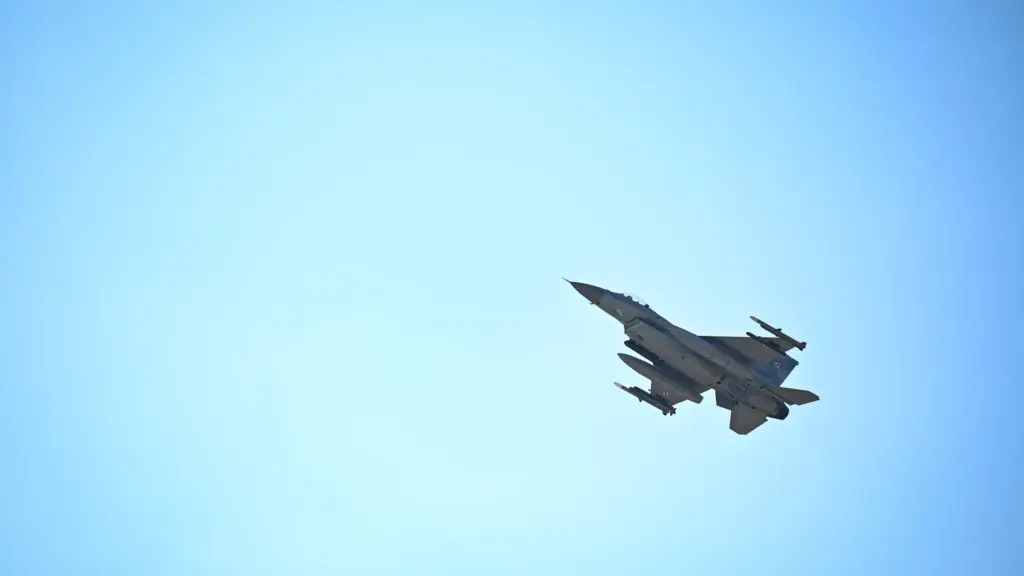
According to the defense minister, Polish F-16s and Swedish Gripens were in the air throughout the night, with a Dutch air force tanker aircraft on hand for the pilots. A Saab airborne early warning aircraft operated in the area of the Podkarpackie and Lubelskie provinces. Patriot batteries around Rzeszów’s Jasionka airport and near Świdnik were activated, along with the Poprad and Pilica+ systems. Helicopters and three Territorial Defense Forces brigades also took part.
Kosiniak-Kamysz called the Russian strike on Ukraine one of the largest since the start of the full-scale war. In his view, the timing was not accidental: on the same day, troops from the Coalition of the Willing were holding the KOALICJA 26.2 exercise at the Nowa Dęba training ground. He said he would ask NATO for additional forces and assets for Operation Eastern Sentry.
What the prime minister and the president’s office said
Prime Minister Donald Tusk said there was no room for doubt that what fell on Polish soil came from Russia, and that it appeared to be an intentional Russian provocation. The Prime Minister’s office added that a possible link to the military exercises remains a hypothesis at this stage. Tusk spoke with NATO Secretary General Mark Rutte and European leaders and announced talks on strengthening NATO’s eastern flank.
Bartosz Grodecki, head of the National Security Bureau, said President Karol Nawrocki had been kept informed since the early morning hours and that the bureau had sent a representative to the scene. Tusk described cooperation with the president’s office on security matters as flawless.
NATO’s response
Rutte wrote on X that he had spoken with Tusk “about the grave violations of Polish airspace overnight.” He added: “NATO jets were scrambled in response. We stand in solidarity with Poland and will continue to strengthen our ability to deter and defend.”
The official statements this report is based on do not include a response from Russia.
At a glance
- Three objects came down in Poland during the night of Nov. 19–20; officials say they came from Russia – a Kh-101 missile and, per preliminary findings, a second missile and a drone.
- Locations: Nowy Lipowiec, Rudnik nad Sanem and Mołodycz. No one was hurt.
- Prime Minister Tusk said it appeared to be an intentional provocation; the defense minister will ask NATO for more forces.
Sources: Ministry of National Defense (gov.pl, Nov. 20, 2026, in Polish), Chancellery of the Prime Minister (gov.pl, Nov. 20, 2026, in Polish), National Security Bureau (bbn.gov.pl, Nov. 20, 2026, in Polish), NATO Secretary General on X (Nov. 20, 2026).
Download the PolishPages app:
App Store
Google Play