Prof. Camila Krysicka-Janniger, MD, a dermatologist certified by the American Board of Dermatology, sees patients in Wallington, New Jersey, and speaks Polish and English. She treats skin diseases, evaluates moles and lesions suspicious for cancer, and diagnoses and treats venereal diseases. Appointments: 973-472-5044.
A dermatologist who speaks Polish
A rash that has lasted for weeks, itchy patches, a new mole on your back. These problems are easier to discuss in the language you think in, especially when you need to describe symptoms precisely and understand the doctor’s instructions. Prof. Camila Krysicka-Janniger, MD, runs a dermatology practice on Main Avenue in Wallington, New Jersey, and speaks with patients in Polish or English.
According to the practice, Dr. Krysicka-Janniger has more than 30 years of experience and is a Diplomate of the American Board of Dermatology. She is a Professor of Dermatology and Section Chief at Rutgers University New Jersey Medical School, a section editor of the dermatology journal Cutis, a member of 10 editorial boards of scientific journals, and the author of four books and monographs, 40 book chapters and 170 scientific articles.
What skin conditions a dermatologist treats
Dermatology covers diseases of the skin, hair and nails. Patients see a dermatologist for acne, rosacea, psoriasis, atopic dermatitis, hives, fungal infections of the skin and nails, warts or excessive hair loss, among other problems. Many of these conditions are chronic: symptoms come back, and treatment focuses on keeping them under control and finding a skin care routine that does not irritate the skin.
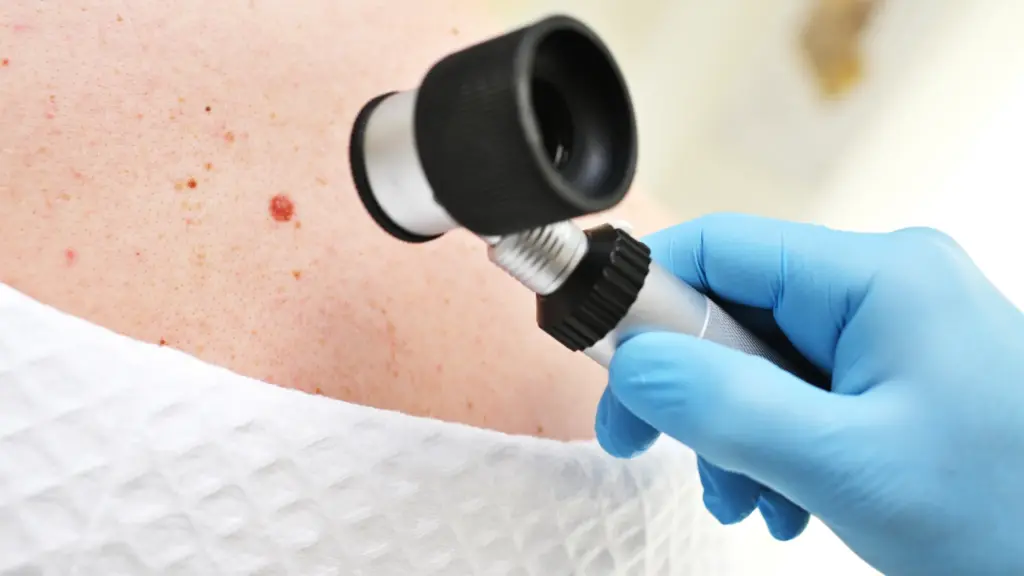
A visit starts with questions about your symptoms, medications, family history and the skin care products you use. Then the doctor examines the skin, sometimes with a dermatoscope, a lighted magnifier that shows the structure of a lesion. If the picture is not clear, the doctor may order tests, such as a skin scraping for fungus, a culture or a biopsy, in which a small piece of skin is removed and examined under a microscope.
Moles and skin cancer: when to get checked
Skin cancer is the most commonly diagnosed cancer in the United States. The most common types are basal cell carcinoma and squamous cell carcinoma; melanoma is less common but more dangerous. Lesions found early are usually easier to treat, so it helps to check your own skin from time to time, including your back and scalp, with a mirror or the help of someone close to you.
When evaluating moles, doctors use the ABCDE rule: asymmetry, irregular border, uneven color, a diameter larger than about 6 mm (although melanoma can be smaller), and evolution, meaning a change in appearance over time. A spot that bleeds, itches or has not healed for several weeks is also a reason for concern. These signs do not automatically mean cancer, but they are a reason to see a dermatologist. The risk is higher in people with fair skin, many moles, sunburns in childhood or a family history of melanoma.
Venereal diseases (STIs): discreet care without embarrassment
The practice in Wallington lists skin and venereal diseases, which includes sexually transmitted infections that cause symptoms on the skin and mucous membranes. Examples are genital warts caused by HPV, genital herpes and syphilis, whose early sign may be a painless sore, followed later by a rash. Some infections cause no symptoms for a long time, so after a risky contact it is better to get tested than to wait. If the exposure was less than 72 hours ago, ask a doctor or an emergency room about HIV post-exposure prophylaxis (PEP).
Patient health information is confidential, and a conversation in Polish makes it easier to describe symptoms and understand the instructions, including those that concern a partner. Treatment is chosen by the doctor after a diagnosis; using creams or antibiotics on your own without an examination can mask symptoms and make the diagnosis harder.
How to prepare for your visit
Before your first visit, call the office to ask about an appointment and whether the practice accepts your insurance. Some health plans, especially HMOs, require a referral from a primary care physician. Bring your insurance card, a photo ID, a list of your medications and the names of the creams and skin care products you use. For rashes that come and go, photos taken with your phone during a flare-up can be very helpful.
This article is for information only and does not replace medical advice. Sudden, widespread skin changes with fever, facial swelling or difficulty breathing need urgent medical help (911).
More on Poland.us
We also write about the work of Prof. Camila Krysicka-Janniger in these articles: dermatologic procedures: removal of skin lesions, Botox and fillers and skin allergies: rashes, hives and eczema.
Contact
The dermatology practice of Prof. Camila Krysicka-Janniger, MD, is located on Main Avenue in Wallington, New Jersey, close to Garfield, Passaic and Clifton. Appointments: 973-472-5044. The doctor speaks Polish and English.
More information and a contact form: Camila Krysicka-Janniger, MD on Polish Pages.