According to NBC News, Democrats have already secured a majority in the new Senate, so Alaska and Mississippi will only decide how large it is. Both races, however, highlight something that gets lost in election-night coverage: every state counts its votes under its own rules. Those differences matter to Polish American voters in New York, New Jersey and Illinois as well.
Mississippi: who leads and what is left to count?
The race pits Republican Sen. Cindy Hyde-Smith against Democratic District Attorney Scott Colom, with independent Ty Pinkins also on the ballot. On Friday morning, according to the AP, Colom led by just under 2,000 votes, about 0.2% of ballots cast. Mississippi last elected a Democratic senator in 1982.
Two groups of ballots remain:
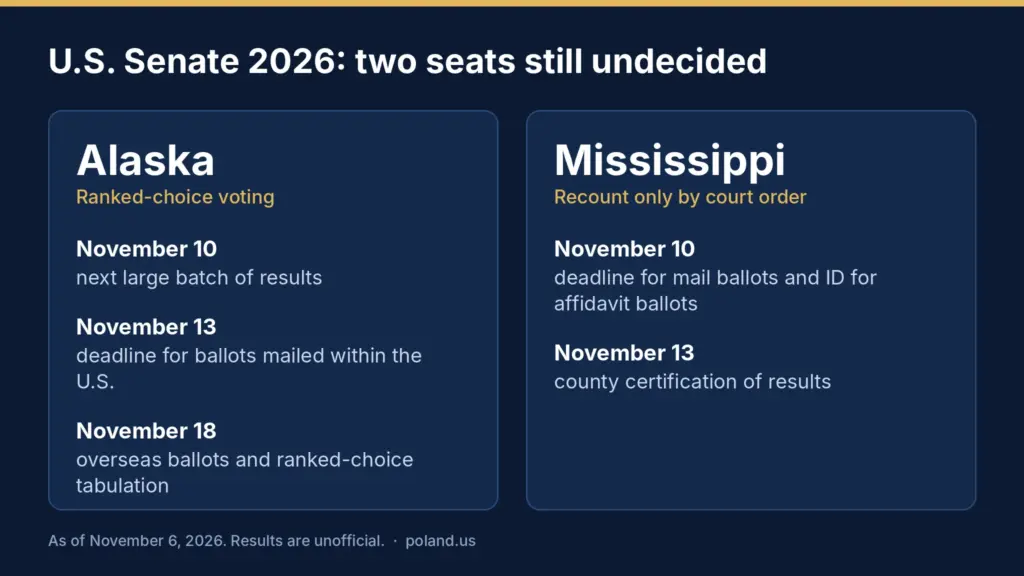
- mail ballots sent by Election Day, which the state accepts through Tuesday, November 10;
- affidavit ballots (provisional ballots) – cast, among others, by voters without an acceptable photo ID, who have until November 10 to show one, and by voters listed as inactive, whose ballots county officials review.
Estimates vary: the Colom campaign puts affidavit ballots at 10,000 to 15,000, while the state Republican Party chairman estimates about 20,000 uncounted ballots in total. Counties have 10 days to certify results, which means by November 13.
Why will there be no recount in Mississippi?
State law provides for neither an automatic nor a requested recount. The Mississippi Secretary of State’s office has confirmed that a candidate cannot ask for one and that a close margin does not trigger one, which puts Mississippi among very few states without such rules. A losing candidate can contest the result or specific ballots in court, and only a court can order a new count. There is also the Senate itself: Article I, Section 5 of the U.S. Constitution makes each chamber of Congress the judge of its own members’ elections. Lawyers for Sen. Hyde-Smith have formally asked state officials to separate, secure and preserve all affidavit ballots.
What would happen in New York with a margin this close?
New York would require a recount. Under state Election Law § 9-208, there must be a full hand recount when the margin is 20 votes or fewer or 0.5% or less, or under 5,000 votes in a contest with one million or more ballots cast. Mississippi’s margin of about 0.2% would fall within that threshold.
Alaska: an election where order on the ballot matters
In Alaska, Republican Sen. Dan Sullivan faces former Democratic Rep. Mary Peltola. On Wednesday morning, Peltola led in first-choice votes by about 600 (48% to 47.7%). A second candidate with the same name, retired teacher Dan J. Sullivan of Petersburg, Alaska, received 1.7%.
Alaska uses ranked-choice voting. Voters rank the candidates, and if no one tops 50% of first choices, the lowest finishers are eliminated one by one and their ballots move to each voter’s next choice. A preliminary Alaska Beacon analysis of Wednesday’s ballot data found that Sullivan would gain more of those redistributed votes. The final result, however, depends on ballots that have not yet been opened.
Alaska’s calendar:
- November 10 – the next large batch of results (early and absentee ballots);
- November 13 – deadline for ballots mailed from within the U.S. (10 days after the election);
- November 18 – deadline for overseas ballots and the ranked-choice tabulation, if no candidate tops 50%.
If Peltola wins, she will be the first Alaska Native to serve in the U.S. Senate and the first Democrat to win a Senate race in Alaska since Mark Begich in 2008.
New Yorkers already know ranked-choice voting
Alaska’s system is familiar to Polish New Yorkers. Since 2021, New York City has used ranked-choice voting in primaries and special elections for city offices, including mayor, public advocate and City Council. The difference is that New York does not use it in November general elections, while Alaska does, including for Congress.
A June Supreme Court ruling: mail ballots may arrive after Election Day
Mississippi is still counting through November 10 partly because on June 29, 2026, the U.S. Supreme Court, by a 5–4 vote in Watson v. Republican National Committee, upheld the state’s rule that a ballot mailed by Election Day counts if it arrives within five business days. The Court noted that roughly 30 states count at least some ballots that arrive after Election Day. For Polish American voters, the state grace periods are:
- New York – 7 days after the election,
- New Jersey – 6 days (144 hours after polls close),
- Illinois – 14 days.
In each of these states, the ballot must be postmarked on or before Election Day.
The Alaska and Mississippi Senate races at a glance
- Mississippi: Colom (D) leads Hyde-Smith (R) by about 0.2%; ballots through November 10, certification by November 13; a recount only by court order.
- Alaska: Peltola (D) leads Sullivan (R) by about 600 first-choice votes; new results November 10, ranked-choice tabulation November 18.
- Senate: according to NBC News, the Democratic majority is settled; these two states decide its size.
- New York: a margin like Mississippi’s would trigger a mandatory hand recount.
As of Friday, November 6, 2026, 12:00 PM ET. Figures are unofficial and may change. Sources: Associated Press, NBC News, Mississippi Secretary of State’s office, Alaska Division of Elections, Alaska Public Media, Alaska Beacon, U.S. Supreme Court decision in Watson v. RNC, New York State Election Law § 9-208.
For everyday matters in the U.S. handled in Polish – from attorneys to accountants – see the Polish Pages business directory.
Get the PolishPages app: App Store and Google Play
AP and Associated Press are trademarks of The Associated Press. Poland.us is not affiliated with or endorsed by The Associated Press.