Vatican News / Andrea Tornielli
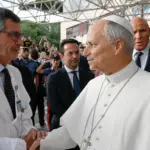
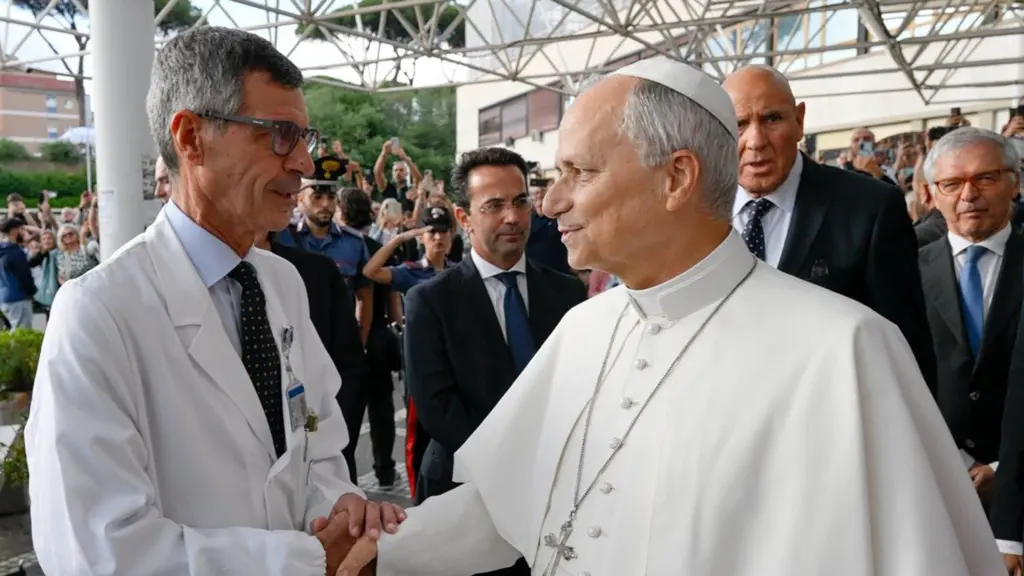
“I would say there are no medical contraindications to taking this journey.” Professor Stefano Margaritora, the surgeon who performed lung surgery on Leo XIV on Tuesday, October 13, assures XYZ media that from a medical standpoint, the Pope is capable of handling the demanding trip to Latin America scheduled for November 6–17.
Margaritora is a professor of thoracic surgery at the Catholic University of the Sacred Heart in Rome and heads the Thoracic Surgery Clinic at the Agostino Gemelli University Polyclinic.
Professor, first of all, how is Leo XIV feeling?
At the time of his discharge from the hospital, the Pope’s health was very good. Blood test results were completely normal, and his heart was functioning flawlessly. Following the surgery, the remaining part of the lung is expanding at the expected rate. Overall, therefore, his condition is good.
Could you tell us how the lung adenocarcinoma was discovered?
The malignant lung tumor in the Pope was discovered quite accidentally, which unfortunately happens quite often. During routine abdominal imaging scans, a small lesion was noticed at the base of the lung, visible in the obtained images.
This is nothing unusual, because abdominal imaging scans usually show the lower parts of the lungs as well. After all, the diaphragm is shaped somewhat like a parachute. However, if this small lesion had been located slightly higher up, it certainly would not have been noticed.
What does the experience the Pope went through in recent weeks teach us? How important is prevention?
Prevention is of immense importance. The Pope belongs to the group of people whose lung cancer is discovered entirely by chance – not as a result of preventive screening, but during diagnostics conducted for other reasons.
For example, someone falls out of a tree, ends up in the emergency room where an X-ray is taken, and incidentally, it turns out there is a lesion in the lung. The same thing happens during other examinations performed for various reasons.
This is why it is so important for people, especially those in high-risk groups, to undergo regular preventive screenings. This applies not only to cancers for which widespread screening programs already exist, such as breast cancer or colorectal cancer, but also to lung cancer.
Unfortunately, this cancer, especially in its early stages, shows no symptoms. We saw this in the case of the Pope, who had no respiratory complaints and felt perfectly fine.
How would you describe the procedure performed? Was it a complicated operation?
I would be dishonest if I presented this operation as exceptionally complicated just to attribute some heroic feats to myself.
In reality, it was a routine procedure. In similar cases, when a lung tumor reaches a certain size, it is necessary to remove the entire lobe in which it is located. In the Pope’s case, this was the lower lobe of the right lung. From this point of view, therefore, it was a routine operation.
Are you satisfied with the outcome of the operation, Professor?
Yes, very much so. I can say that the surgery went without any complications. That is always what we hope for before any procedure, although unfortunately not everything always goes so smoothly…
Are you satisfied with the course of recovery, Professor?
Yes, we are truly very pleased with it. The Pope poured his heart and all his strength into his post-operative recovery, showing the determination typical of the most motivated patients after this type of procedure.
Thanks to this, he needed very little help from us. His strong will to regain his fitness as quickly as possible translated into progress in his recovery. His attitude was admirable in every respect.
Can you predict how long the recovery will take? Will the Pope manage to regain his strength before the trip to Latin America?
If I were assessing his condition just like any other patient, I would say that after this kind of surgery, it takes about two weeks to fully recover physical fitness.
Since almost a week has already passed since the procedure, I think that in about ten days the Pope should completely return to his strength.
As for the long journey involving airplane flights, which is scheduled to take place in roughly three weeks, I would say there are no medical contraindications to undertaking it.
What did it mean to you – as a human being, a doctor, and a believer – to lead the team that operated on the Pope?
Operating on the Pope was a deeply personal experience for me, one that I cannot even describe. Of course, I had a human being in front of me, because the Pope is indeed a human being, but at the same time, I was well aware that he is not an ordinary person. Pope Leo has such an extraordinary charisma that it would be difficult to treat him like any other patient.
I was undertaking the surgery of a Pope who, for the first time – at least in modern history – was undergoing a procedure for a malignant tumor. From what we know, this had never happened before.
I was aware that the eyes of the entire world were focused precisely on us. After all, this is not about a head of state, but about the leader of a community of the faithful scattered all over the world, and media interest is immense.
Therefore, an operation that is routine from a medical point of view is not routine at all from a human point of view.
I was therefore accompanied by contradictory feelings. On the one hand, I kept telling myself: “You are going to perform an ordinary operation, the kind you have done a thousand times in your life,” and on the other hand, I had the awareness: “For the first time, you are performing such an operation on a Pope.”
May I ask what you said to the Pope right before anesthesia?
When the Pope entered the operating room, we all positioned ourselves around him somewhat like in an amphitheater: myself, my colleagues, the anesthesiologists, and the operating room staff.
The Pope is an extremely simple-mannered and cheerful person. He looked around, saw all of us, and I told him: “Your Holiness, behold our dream team – our dream team.”
He smiled and… we began preparations for the anesthesia.
Professor, what kind of patient was Leo XIV during his stay at the Gemelli Polyclinic?
Pope Leo was the ideal patient. I am not saying this to flatter him. He truly did not cause the slightest problem for the team taking care of him. And I say this regardless of who he is – he could just as well have been an ordinary, anonymous patient.
Always calm, always smiling, he hardly complained at all, even though he certainly felt pain that, despite all applied methods, cannot be completely eliminated.
He followed all our recommendations regarding diet and physiotherapy. He quickly got back on his feet and always did even a little more than we asked him to.
On the second day after the surgery, we turned around and saw him arranging chairs in the chapel himself. We told him: “Your Holiness, we are here, we can do that.” And he replied: “It’s fine, since I can do it, I’m doing it.”
What more can I say? He was truly an ideal patient.
I would also like to thank all the staff, the entire team of the Gemelli Polyclinic who participated in caring for the Pope.
Let us never forget that in a hospital, behind the work of the surgeon and the anesthesiologist, there are also operating nurses, other operating theater staff, laboratory technicians, and radiology technologists who came every day to perform X-rays for the Pope.
There are also physiotherapists and representatives of many other medical professions who are usually not mentioned, and whom I would like to acknowledge on this occasion.
I also want to thank from the bottom of my heart the authorities of the Gemelli Polyclinic Foundation and the Rector of the Catholic University of the Sacred Heart for the trust they placed in me and for making it possible to take part in this truly extraordinary experience.