
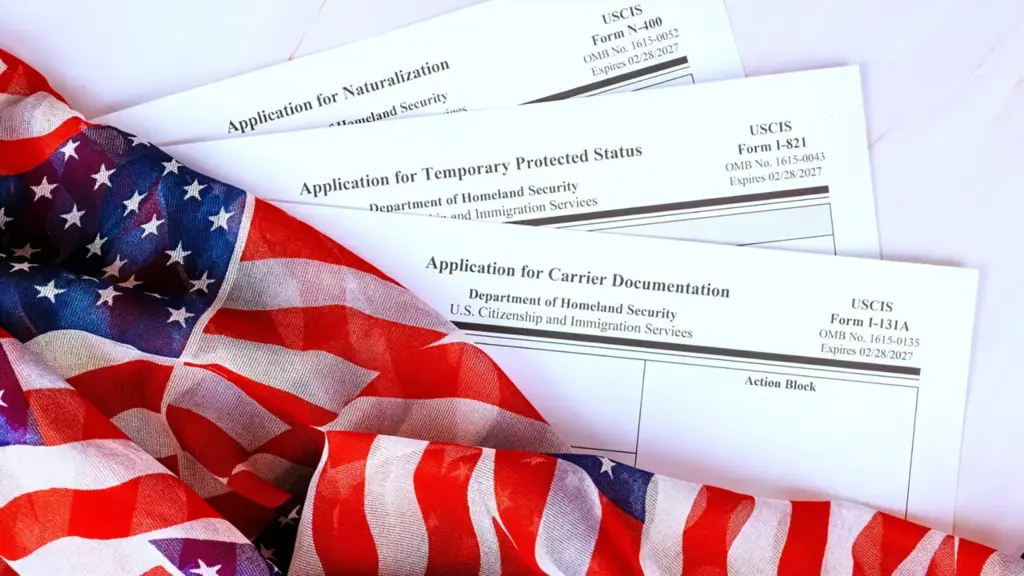
Starting August 5, 2026, USCIS may deny an immigration application immediately, without prior issuance of a Request for Evidence (RFE) or a Notice of Intent to Deny (NOID)—if required evidence is missing at the time of filing. The new guideline (Policy Alert PA-2026-05) applies to applications filed or pending as of that date.
For years, the agency’s practice was lenient: if something was missing from the file, the officer would first ask, and only then—in the absence of a response—deny the application. On August 5, 2026, U.S. Citizenship and Immigration Services (USCIS) published an update to its Policy Manual, returning to a more rigorous approach: application completeness must be the rule from day one, rather than something that can be submitted later upon request.
What exactly Policy Alert PA-2026-05 changes
The updated guideline affects three aspects of adjudication: evidentiary standards, Requests for Evidence (RFE), and Notices of Intent to Deny (NOID). USCIS has clarified the distinction between initial evidence and additional evidence, between primary evidence and secondary evidence, and the weight given to affidavits submitted when an original document is missing.
The most important practical change: if an applicant fails to attach required initial evidence to the application or fails to demonstrate eligibility at the time of filing, the officer may (but is not required to) deny the case immediately—skipping the RFE or NOID stage. The agency notes that RFEs are not disappearing and will still be issued, especially in more complex employment-based cases, but they are no longer a guaranteed step in the procedure.
Shorter deadlines and the end of the overseas mail bonus
Regulations still establish maximum response deadlines: up to 12 weeks for an RFE and up to 30 days for a NOID. However, practice is changing—the officer no longer has to grant the maximum timeframe and may shorten it if deemed appropriate in a given case.
The additional 14-day grace period that USCIS previously added to deadlines for notices sent to addresses outside the United States has also been eliminated. Now, the general regulatory rule applies—only an additional 3 days for mail delivery, regardless of whether the address is in the U.S. or Poland. This is significant for Polish nationals handling visa or immigration cases from Poland—the response time is effectively shortened.
It has also been clarified that a partial response to an RFE or NOID will be treated as a request for a decision based on what was actually submitted—without the possibility of supplementing documents in subsequent rounds.
What this means for Polish applicants submitting petitions to USCIS
The change applies to all types of applications—from employment petitions and green card applications to naturalization. There is one practical takeaway: the application must be submitted complete the first time, with full documentation proving eligibility, instead of counting on the agency to ask about missing items anyway. If a required original document—such as a birth certificate from a Polish civil status registry office—truly cannot be obtained, USCIS expects this to be explicitly explained in the application along with appropriate secondary evidence or an affidavit.
If an RFE or NOID is received nonetheless, the deadline should be checked immediately upon receipt and documents should be gathered without delay—especially since the agency may grant less time than before, and the additional buffer for mail delivery has disappeared for international correspondence.
Before putting an application in an envelope or submitting it to the USCIS portal, it is worth verifying its completeness against the specific form instructions:
- whether originals or certified translations of documents from a Polish civil status office (birth certificate, marriage certificate) are attached,
- whether an explanation of the fact and secondary evidence or an affidavit are attached in the absence of an original,
- whether the form is signed and paid in accordance with the current USCIS fee schedule,
- whether evidence regarding relationships, employment, or qualifications matches what the specific form instructions require—not just what seems “sufficient.”
This material is for informational purposes only and does not constitute legal advice. Assessing what evidence is required in a specific case and how to respond to a USCIS notice requires consultation with a licensed immigration attorney.
When submitting applications to USCIS—from filling out the initial form to responding to a notice—it is wise to work with someone who knows these regulations inside and out; Polish immigration attorneys can be found in the Polish Pages directory.