
Immediately after Mass
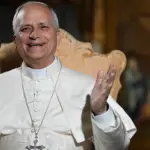
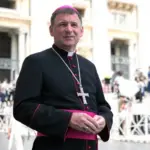
The opening of this exhibition took place immediately after Holy Mass, celebrated in St. Florian’s Church within the Cistercian Abbey Complex in Wąchock, to which the Editorial Board of “Dziennik Polonijny” was also invited. The liturgy was celebrated by Father Prelate Zbigniew Kępa.
Special prayer
During the opening of this exhibition, a special prayer for the beatification of these clergymen was also concelebrated. This ceremony had a special dimension, as the Association for the Memory of Katyn Chaplains honored Cezary Brymora, president of Brymorex company and sponsor of printing posters for the aforementioned exhibition, with the VINCTIS NON VICTIS medal. As we know, this award was presented by the President of the SPKK Board, Łukasz Stefaniak, assisted by members of the Association: Filip Chrzanowski and Marek Sokołowski.

Great-grandson of Mr. Tadeusz
It is worth emphasizing here that the aforementioned Cezary Brymora is the grandson of senior police officer Tadeusz Brymora, a pre-war State Police officer murdered by the Soviets. The Vinctis non victis medal refers to the Latin maxim meaning: “Conquered, but not vanquished.”
Gathered guests
The opening of the exhibition was attended by pilgrims and representatives of the local community, representatives of the Board of the Independent Trade Union of Border Guard Officers at the Vistula Border Guard Unit with chairman Robert Lis, and members of the General Karol Ziemski Historical Education Society.
The crime of genocide from 1940
As we know, the Katyn Massacre, which took place in the spring of 1940, is one of the most tragic chapters in 20th-century Polish history. Among nearly 25,000 Polish citizens ruthlessly murdered by the NKVD was a specific group of chaplains of the Polish Army. As we know, these were chaplains of various denominations who, after the USSR’s aggression against Poland, ended up in POW camps in Kozielsk, Ostashkov, and Starobielsk. Despite numerous prohibitions, these chaplains provided religious services to their fellow prisoners in the internment camps, wholeheartedly lifting their spirits. The Soviets, of course, considered them an element extremely dangerous to the communist system, which is why their death was inevitable.