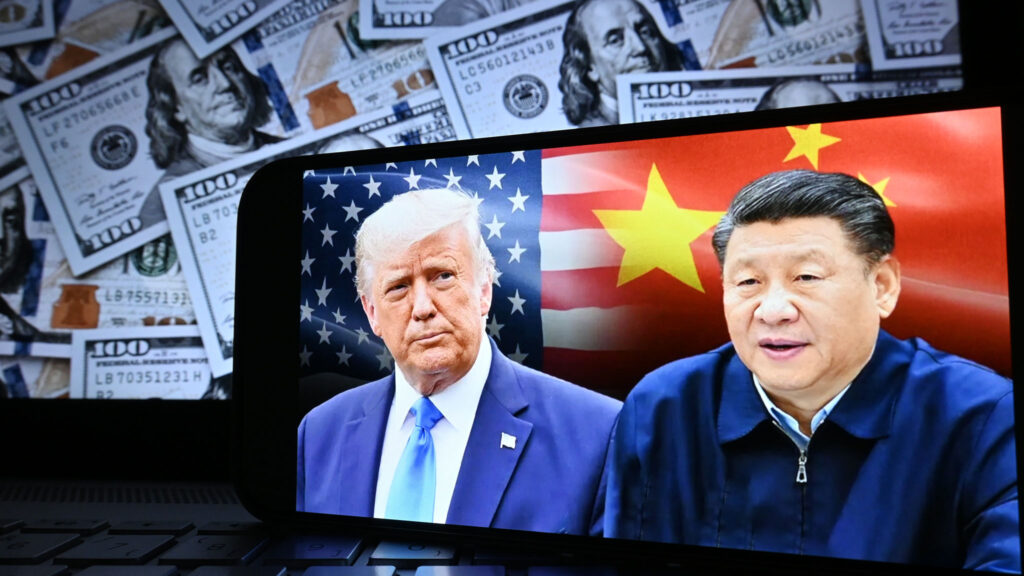
Everything was planned with Chinese precision: a welcome ceremony at Beijing Capital International Airport, two bilateral meetings with Xi Jinping, a state banquet, and ceremonial elements, including a visit to the Temple of Heaven. The entire working part of the visit is expected to last about 2 days. A group of leading American business leaders flew with Trump — Tim Cook from Apple, Elon Musk from Tesla, Jensen Huang from Nvidia, added at the last minute, the CEOs of Boeing and Mastercard, Melania Trump. Just for the presence of this delegation, it’s worth looking at who has what to gain — and who has already played their trump cards.
What Xi can give Trump
Trump’s visit takes place under unusual circumstances. The war with Iran has been ongoing for nearly three months. The Strait of Hormuz, through which one-fifth of the world’s oil flowed, remains practically closed. Tankers are idle, energy prices have risen, and inflationary pressure in the US has become one of the political costs of the war. Trump’s approval ratings are falling. A lasting ceasefire with Iran has not been achieved — the president himself admitted on Monday that previous truces are “being kept alive.” And it is Xi Jinping who is one of the few leaders with real influence over Tehran. Iran sent its foreign minister to Beijing back in April; China played a role in the first ceasefire proposal. Trump — although he assured journalists before his departure that he “doesn’t need China’s help” — will find it difficult not to bring up this topic in discussions.
There’s more on the table too. Beijing can promise purchases of American soybeans and Boeing aircraft, which always plays well rhetorically with Trump’s audience in Iowa and South Carolina. It can open the tap on rare earth metals, which the United States needs in gigantic quantities to rebuild anti-missile stockpiles after the war with Iran. It can help Trump formalize the trade war truce, which both sides agreed to in October 2025, during the leaders’ first meeting at the Busan summit. Each of these things will be a journalistic success for Trump.
What Trump must give Xi
But every transaction has a flip side. Xi is not welcoming Trump with open arms out of love for diplomacy. Beijing has its goals, and today they are — as the “Washington Post” writes — more distinct than ever before. The first goal is Taiwan. Trump informed journalists on Monday that during the visit he would discuss with Xi the already approved $11 billion arms sales package for Taipei. China does not accept this sale; every such transaction is a violation of “one China” for them. The second goal is the so-called “Board of Trade” — a bilateral structure that Trump and Xi want to establish to frame trade between the two countries politically. In the interpretation of some commentators, this would be a formula reminiscent of Trump’s other projects: less based on existing institutions, more on direct leadership action. The third goal is artificial intelligence: both sides are considering joint oversight mechanisms, which for Silicon Valley means a compromise, and for Beijing — recognition of the Chinese voice as equal.
What has changed between 2017 and 2026
In November 2017, Xi Jinping welcomed Trump with state honors and an almost theatrical setting. Years later, Trump recalled that visit as one of the best in his life — “he treated me so wonderfully,” he repeated at meetings with American businesses. Now the roles are different. Xi doesn’t need theater; he is in a stronger position than 9 years ago. China has weathered the first trade war, strengthened control over rare earths, and established itself as a mediator in reserve in case of war in Iran. Trump arrives as the president of a strong America, but in the midst of a crisis — economic and reputational. Dennis Wilder, a former advisor to the George W. Bush administration on China, indicated in interviews with American media that the war with Iran changed the dynamic of the Trump-Xi summit and gave Beijing negotiating cards that the US president did not expect at the beginning of the year.
Poland outside the scope of the transaction
In this game, as is often the case in high-level geopolitical shifts, some topics remain outside the scope of transactions. Poland is one of them. There is no Polish company or Polish-American entrepreneur in the business delegation accompanying Trump. Among the topics publicly mentioned by the White House — Iran, Taiwan, rare earths, soybeans, AI — issues of NATO’s eastern flank do not appear. This is neither a surprise nor an insult: it is simply the logic of a bilateral summit, where what matters most to both sides is discussed. Poland simply is not on the priority list of either Beijing or the White House this particular week.
What does this mean for the Polish diaspora in the USA? First and foremost, a reminder that Trump’s diplomacy operates transactionally — every conversation has its stakes, and both sides of the table set them. Poland does not have an obvious bargaining chip in this particular conversation comparable to what Beijing, Washington, Taiwan, Iran, or American tech business are putting on the table. Another matter is that just four days ago, on Friday, May 8, Trump explicitly allowed for the possibility of moving some American soldiers from Germany to Poland — which Warsaw, through President Karol Nawrocki, Defense Minister Władysław Kosiniak-Kamysz, and Foreign Minister Radosław Sikorski, welcomed with readiness. Only four days passed between that conversation at the White House and today’s handshake with Xi Jinping in Beijing.
And that is the only thing worth remembering from this visit — regardless of what agreements are signed. Trump’s politics move at a speed greater than we remember from previous administrations. Allies are learning the pace at which they need to react. The Polish diaspora is learning with them.
Kamil Brzozowski, editor of poland.us. For more political commentaries by Kamil Brzozowski, please visit poland.us. Polish-American business, institution, and expert directory: PolishPages.com.
📱 Download the PolishPages app:
App Store (iPhone) | Google Play (Android)