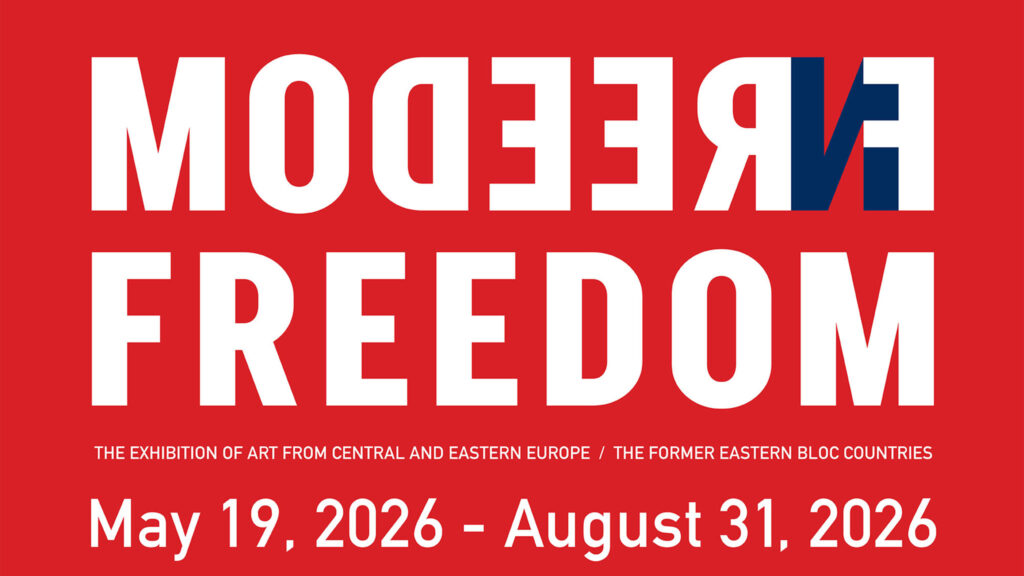
The opening will take place on 19 May 2026 at 6:00 PM, and the exhibition will be available to the public until August 31, 2026, at the newly opened headquarters of the Pilecki Institute USA at 92 Greenwich Street in New York.
Bringing together acclaimed artists with a younger generation of creators from across the region, MODEERN FREEDOM analyzes how experiences of war, totalitarian violence, political pressure, and social transformations continue to shape the identity, culture, and artistic expression of successive generations. The exhibition presents Central and Eastern Europe not as a peripheral area, but as a significant space for reflection, from which new ways of thinking about freedom can emerge.
The exhibition is curated by Piotr Franaszek, Tomáš Koudela, and Wojtek Radtke. The project features artists from Poland, the Czech Republic, Slovakia, Ukraine, Germany, Georgia, Moldova, Lithuania, Bulgaria, Slovenia, Hungary, Romania, Belarus, and other countries in the region. Among them are internationally recognized names such as Jiří Surůvka, Aleksander Tinei, Marek Schovánek, Paweł Althamer, Katarzyna Kozyra, Joanna Rajkowska, Zbigniew Libera, Robert Kuśmirowski, Izabella Gustowska, Kryštof Kintera, Wolfgang Stiller, Zhanna Kadyrova and many others.
Instead of treating art as a closed, unambiguous statement, the exhibition presents works as part of a living, ever-evolving narrative. Through objects, sculptures, installations, drawings, paintings, films, and texts, MODEERN FREEDOM explores the relationships between memory, existential tension, and the pursuit of freedom. The curatorial concept is based on three thematic axes: Memory / Tremor / Freedom.
As Wojtek Radtke, curator of MODEERN FREEDOM, explains:
“In the world of art, the concept of freedom takes on a different dimension. On the one hand, there is the purity of intention stemming from the creative process: intuitive work with the subconscious, a conversation and encounter with oneself. On the other hand – emotions related to public judgment, the temptation to follow trends, verification, and the modes of the ruthless business machine that is the art market, place artists in the difficult role of commentators on the world. Let us therefore appreciate the courage of those who persist in their creative freedom, regardless of the complex consequences of this stance. Let us appreciate this form of freedom. Let us also consider what freedom means to each of us, within ourselves. Let us meet ourselves, provoked to reflection by the translators of an “other language” – artists and their works, which are the fruit of dilemmas, powerlessness, sensitivity, reflection, anger, rebellion, and a deep need to make the world a better place.”
Piotr Franaszek, exhibition curator and director of the Pilecki Institute, adds:
“We value freedom and – drawing on past experiences – we understand that it must be expressed through tolerance. Today, we stand on the threshold of building a modern, global future. At the same time, we observe with concern the return of authoritarian systems, surveillance, and information manipulation. Borders and walls are being rebuilt, and human freedom is once again being restricted. Today, more than ever, we need to understand history – its consequences, tragedies, and warnings. Remembering the past can protect us from repeating its mistakes.”
Tomáš Koudela, curator of MODEERN FREEDOM, emphasizes:
“The exhibition does not present Central Europe as a fixed geographical space, but as a visual testimony – a field of signs where civilizational tensions manifest in gesture, form, surface, and silence. The presented works – both contemporary and historical – are not limited to commenting on local problems. They create layers of meaning in which deeper economic and social processes of recent decades can be observed: changes in the rhythm of work, the perception of the body, regimes of seeing and memory. With proper interpretation, the exhibition can be read as a visual archive of anxiety – and at the same time a clear call for change.”
The exhibition will be accompanied by a program of events, including lectures, discussions, presentations, performances, and other special events, aimed at expanding dialogue and reaching new audiences.
The exhibition is organized by the Pilecki Institute USA and the University of Ostrava, in cooperation with institutional and organizational partners and with the support of the Polish National Foundation.
MODEERN FREEDOM
Pilecki Institute USA
92 Greenwich Street
New York, NY 10006
Exhibition Opening: May 19, 2026 at 6:00 PM
Exhibition Duration: May 19 – August 31, 2026