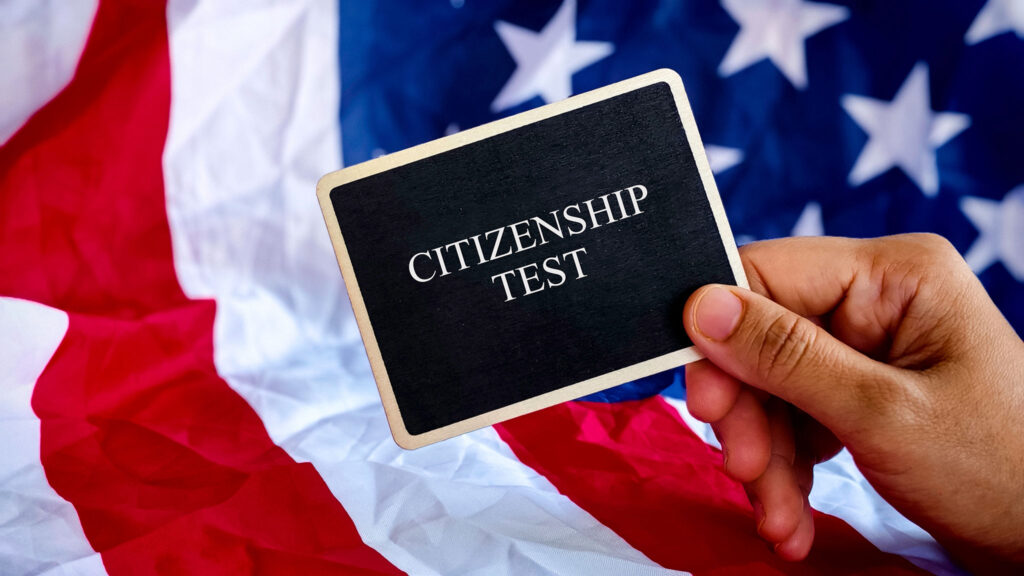
The officer asks up to 20 questions from a pool of 128. You must answer at least 12 correctly. The test ends with 12 correct or 9 incorrect answers. Answers regarding politicians change — check for current updates at uscis.gov/citizenship/testupdates.
AMERICAN GOVERNMENT
A: Principles of American Government
1. What is the form of government of the United States?
What is the form of government of the United States?
* Republic / Republic
* Constitution-based federal republic / Constitution-based federal republic
* Representative democracy / Representative democracy
2. What is the supreme law of the land? ✱
What is the supreme law of the land?
* (U.S.) Constitution / (U.S.) Constitution
3. Name one thing the U.S. Constitution does.
Name one thing the U.S. Constitution does.
* Forms the government / Forms the government
* Defines powers of government / Defines powers of government
* Defines the parts of government / Defines the parts of government
* Protects the rights of the people / Protects the rights of the people
4. The U.S. Constitution starts with the words “We the People.” What does “We the People” mean?
The U.S. Constitution starts with the words “We the People.” What does “We the People” mean?
* Self-government / Self-government
* Popular sovereignty / Popular sovereignty
* Consent of the governed / Consent of the governed
* People should govern themselves / People should govern themselves
* (Example of) social contract / (Example of) social contract
5. How are changes made to the U.S. Constitution?
How are changes made to the U.S. Constitution?
* Amendments / Amendments
* The amendment process / The amendment process
6. What does the Bill of Rights protect?
What does the Bill of Rights protect?
* (The basic) rights of Americans / (The basic) rights of Americans
* (The basic) rights of people living in the United States / (The basic) rights of people living in the United States
7. How many amendments does the U.S. Constitution have? ✱
How many amendments does the U.S. Constitution have?
* Twenty-seven (27) / Twenty-seven (27)
8. Why is the Declaration of Independence important?
Why is the Declaration of Independence important?
* It says America is free from British control. / It says America is free from British control.
* It says all people are created equal. / It says all people are created equal.
* It identifies inherent rights. / It identifies inherent rights.
* It identifies individual freedoms. / It identifies individual freedoms.
9. What founding document said the American colonies were free from Britain?
What founding document said the American colonies were free from Britain?
* Declaration of Independence / Declaration of Independence
10. Name two important ideas from the Declaration of Independence and the U.S. Constitution.
Name two important ideas from the Declaration of Independence and the U.S. Constitution.
* Equality / Equality
* Liberty / Liberty
* Social contract / Social contract
* Natural rights / Natural rights
* Limited government / Limited government
* Self-government / Self-government
11. The words “Life, Liberty, and the pursuit of Happiness” are in what founding document?
The words “Life, Liberty, and the pursuit of Happiness” are in what founding document?
* Declaration of Independence / Declaration of Independence
12. What is the economic system of the United States? ✱
What is the economic system of the United States?
* Capitalism / Capitalism
* Free market economy / Free market economy
13. What is the rule of law?
What is the rule of law?
* Everyone must follow the law. / Everyone must follow the law.
* Leaders must obey the law. / Leaders must obey the law.
* Government must obey the law. / Government must obey the law.
* No one is above the law. / No one is above the law.
14. Many documents influenced the U.S. Constitution. Name one.
Many documents influenced the U.S. Constitution. Name one.
* Declaration of Independence / Declaration of Independence
* Articles of Confederation / Articles of Confederation
* Federalist Papers / Federalist Papers
* Anti-Federalist Papers / Anti-Federalist Papers
* Virginia Declaration of Rights / Virginia Declaration of Rights
* Fundamental Orders of Connecticut / Fundamental Orders of Connecticut
* Mayflower Compact / Mayflower Compact
* Iroquois Great Law of Peace / Iroquois Great Law of Peace
15. There are three branches of government. Why?
There are three branches of government. Why?
* So one part does not become too powerful / So one part does not become too powerful
* Checks and balances / Checks and balances
* Separation of powers / Separation of powers
B: System of Government
16. Name the three branches of government.
Name the three branches of government.
* Legislative, executive, and judicial / Legislative, executive, and judicial
* Congress, president, and the courts / Congress, president, and the courts
17. The President of the United States is in charge of which branch of government?
The President of the United States is in charge of which branch of government?
* Executive branch / Executive branch
18. What part of the federal government writes laws?
What part of the federal government writes laws?
* (U.S.) Congress / (U.S.) Congress
* (U.S. or national) legislature / (U.S. or national) legislature
* Legislative branch / Legislative branch
19. What are the two parts of the U.S. Congress?
What are the two parts of the U.S. Congress?
* Senate and House (of Representatives) / Senate and House (of Representatives)
20. Name one power of the U.S. Congress. ✱
Name one power of the U.S. Congress.
* Writes laws / Writes laws
* Declares war / Declares war
* Makes the federal budget / Makes the federal budget
21. How many U.S. senators are there?
How many U.S. senators are there?
* One hundred (100) / One hundred (100)
22. How long is a term for a U.S. senator?
How long is a term for a U.S. senator?
* Six (6) years / Six (6) years
23. Who is one of your state’s U.S. senators now?
Who is one of your state’s U.S. senators now?
* Answers will vary. [Residents of D.C. and U.S. territories: D.C. (or the given territory) has no U.S. Senators.] Check at uscis.gov/citizenship/testupdates.
24. How many voting members are in the House of Representatives?
How many voting members are in the House of Representatives?
* Four hundred thirty-five (435) / Four hundred thirty-five (435)
25. How long is a term for a member of the House of Representatives?
How long is a term for a member of the House of Representatives?
* Two (2) years / Two (2) years
26. Why do U.S. representatives serve shorter terms than U.S. senators?
Why do U.S. representatives serve shorter terms than U.S. senators?
* To more closely follow public opinion / To more closely follow public opinion
27. How many senators does each state have?
How many senators does each state have?
* Two (2) / Two (2)
28. Why does each state have two senators?
Why does each state have two senators?
* Equal representation (for small states) / Equal representation (for small states)
* The Great Compromise (Connecticut Compromise) / The Great Compromise (Connecticut Compromise)
29. Name your U.S. representative.
Name your U.S. representative.
* Answers will vary. [Residents of territories with nonvoting delegates or resident commissioners may name their delegate or commissioner.]
30. What is the name of the Speaker of the House of Representatives now? ✱
What is the name of the Speaker of the House of Representatives now?
* Check at uscis.gov/citizenship/testupdates.
31. Who does a U.S. senator represent?
Who does a U.S. senator represent?
* Citizens of their state / Citizens of their state
* People of their state / People of their state
32. Who elects U.S. senators?
Who elects U.S. senators?
* Citizens from their state / Citizens from their state
33. Who does a member of the House of Representatives represent?
Who does a member of the House of Representatives represent?
* Citizens in their (congressional) district / Citizens in their (congressional) district
* People in their district / People in their district
34. Who elects members of the House of Representatives?
Who elects members of the House of Representatives?
* Citizens from their (congressional) district / Citizens from their (congressional) district
35. Some states have more representatives than other states. Why?
Some states have more representatives than other states. Why?
* (Because of) the state’s population / (Because of) the state’s population
* (Because) they have more people / (Because) they have more people
* (Because) some states have more people / (Because) some states have more people
36. The President of the United States is elected for how many years? ✱
The President of the United States is elected for how many years?
* Four (4) years / Four (4) years
37. The President of the United States can serve only two terms. Why?
The President of the United States can serve only two terms. Why?
* (Because of) the 22nd Amendment / (Because of) the 22nd Amendment
* To keep the president from becoming too powerful / To keep the president from becoming too powerful
38. What is the name of the President of the United States now? ✱
What is the name of the President of the United States now?
* Check at uscis.gov/citizenship/testupdates.
39. What is the name of the Vice President of the United States now? ✱
What is the name of the Vice President of the United States now?
* Check at uscis.gov/citizenship/testupdates.
40. If the president can no longer serve, who becomes president?
If the president can no longer serve, who becomes president?
* The Vice President (of the United States) / The Vice President (of the United States)
41. Name one power of the president.
Name one power of the president.
* Signs bills into law / Signs bills into law
* Vetoes bills / Vetoes bills
* Enforces laws / Enforces laws
* Commander in Chief (of the military) / Commander in Chief (of the military)
* Chief diplomat / Chief diplomat
* Appoints federal judges / Appoints federal judges
42. Who is Commander in Chief of the U.S. military?
Who is Commander in Chief of the U.S. military?
* The President (of the United States) / The President (of the United States)
43. Who signs bills to become laws?
Who signs bills to become laws?
* The President (of the United States) / The President (of the United States)
44. Who vetoes bills? ✱
Who vetoes bills?
* The President (of the United States) / The President (of the United States)
45. Who appoints federal judges?
Who appoints federal judges?
* The President (of the United States) / The President (of the United States)
46. The executive branch has many parts. Name one.
The executive branch has many parts. Name one.
* President (of the United States) / President (of the United States)
* Cabinet / Cabinet
* Federal departments and agencies / Federal departments and agencies
47. What does the President’s Cabinet do?
What does the President’s Cabinet do?
* Advises the President (of the United States) / Advises the President (of the United States)
48. What are two Cabinet-level positions?
What are two Cabinet-level positions?
* Attorney General / Attorney General
* Secretary of Agriculture / Secretary of Agriculture
* Secretary of Commerce / Secretary of Commerce
* Secretary of Education / Secretary of Education
* Secretary of Energy / Secretary of Energy
* Secretary of Health and Human Services / Secretary of Health and Human Services
* Secretary of Homeland Security / Secretary of Homeland Security
* Secretary of Housing and Urban Development / Secretary of Housing and Urban Development
* Secretary of the Interior / Secretary of the Interior
* Secretary of Labor / Secretary of Labor
* Secretary of State / Secretary of State
* Secretary of Transportation / Secretary of Transportation
* Secretary of the Treasury / Secretary of the Treasury
* Secretary of Veterans Affairs / Secretary of Veterans Affairs
* Secretary of War (Defense) / Secretary of War (Defense)
* Vice-President / Vice-President
* Administrator of the Environmental Protection Agency / Administrator of the Environmental Protection Agency
* Administrator of the Small Business Administration / Administrator of the Small Business Administration
* Director of the Central Intelligence Agency / Director of the Central Intelligence Agency
* Director of the Office of Management and Budget / Director of the Office of Management and Budget
* Director of National Intelligence / Director of National Intelligence
* United States Trade Representative / United States Trade Representative
49. Why is the Electoral College important?
Why is the Electoral College important?
* It decides who is elected president. / It decides who is elected president.
* It provides a compromise between the popular election of the president and congressional selection. / It provides a compromise between the popular election of the president and congressional selection.
50. What is one part of the judicial branch?
What is one part of the judicial branch?
* Supreme Court / Supreme Court
* Federal Courts / Federal Courts
51. What does the judicial branch do?
What does the judicial branch do?
* Reviews laws / Reviews laws
* Explains laws / Explains laws
* Resolves disputes (disagreements) about the law / Resolves disputes (disagreements) about the law
* Decides if a law goes against the (U.S.) Constitution / Decides if a law goes against the (U.S.) Constitution
52. What is the highest court in the United States? ✱
What is the highest court in the United States?
* Supreme Court / Supreme Court
53. How many seats are on the Supreme Court?
How many seats are on the Supreme Court?
* Nine (9) / Nine (9)
54. How many Supreme Court justices are usually needed to decide a case?
How many Supreme Court justices are usually needed to decide a case?
* Five (5) / Five (5)
55. How long do Supreme Court justices serve?
How long do Supreme Court justices serve?
* (For) life / (For) life
* Lifetime appointment / Lifetime appointment
* (Until) retirement / (Until) retirement
56. Supreme Court justices serve for life. Why?
Supreme Court justices serve for life. Why?
* To be independent (of politics) / To be independent (of politics)
* To limit outside (political) influence / To limit outside (political) influence
57. Who is the Chief Justice of the United States now?
Who is the Chief Justice of the United States now?
* Check at uscis.gov/citizenship/testupdates.
58. Name one power that is only for the federal government.
Name one power that is only for the federal government.
* Print paper money / Print paper money
* Mint coins / Mint coins
* Declare war / Declare war
* Create an army / Create an army
* Make treaties / Make treaties
* Set foreign policy / Set foreign policy
59. Name one power that is only for the states.
Name one power that is only for the states.
* Provide schooling and education / Provide schooling and education
* Provide protection (police) / Provide protection (police)
* Provide safety (fire departments) / Provide safety (fire departments)
* Give a driver’s license / Give a driver’s license
* Approve zoning and land use / Approve zoning and land use
60. What is the purpose of the 10th Amendment?
What is the purpose of the 10th Amendment?
* (It states that the) powers not given to the federal government belong to the states or to the people. / (It states that the) powers not given to the federal government belong to the states or to the people.
61. Who is the governor of your state now? ✱
Who is the governor of your state now?
* Answers will vary. [Residents of D.C.: D.C. does not have a governor.]
62. What is the capital of your state?
What is the capital of your state?
* Answers will vary. [Residents of D.C.: D.C. is not a state and does not have a capital. Residents of territories: identify the capital of the territory.]
C: Rights and Responsibilities
63. There are four amendments to the U.S. Constitution about who can vote. Describe one of them.
There are four amendments to the U.S. Constitution about who can vote. Describe one of them.
* Citizens eighteen (18) and older (can vote). / Citizens eighteen (18) and older (can vote).
* You don’t have to pay (a poll tax) to vote. / You don’t have to pay (a poll tax) to vote.
* Any citizen can vote. (Women and men can vote.) / Any citizen can vote. (Women and men can vote.)
* A male citizen of any race (can vote). / A male citizen of any race (can vote).
64. Who can vote in federal elections, run for federal office, and serve on a jury in the United States?
Who can vote in federal elections, run for federal office, and serve on a jury in the United States?
* Citizens / Citizens
* Citizens of the United States / Citizens of the United States
* U.S. citizens / U.S. citizens
65. What are three rights of everyone living in the United States?
What are three rights of everyone living in the United States?
* Freedom of expression / Freedom of expression
* Freedom of speech / Freedom of speech
* Freedom of assembly / Freedom of assembly
* Freedom to petition the government / Freedom to petition the government
* Freedom of religion / Freedom of religion
* The right to bear arms / The right to bear arms
66. What do we show loyalty to when we say the Pledge of Allegiance? ✱
What do we show loyalty to when we say the Pledge of Allegiance?
* The United States / The United States
* The flag / The flag
67. Name two promises that new citizens make in the Oath of Allegiance.
Name two promises that new citizens make in the Oath of Allegiance.
* Give up loyalty to other countries / Give up loyalty to other countries
* Defend the (U.S.) Constitution / Defend the (U.S.) Constitution
* Obey the laws of the United States / Obey the laws of the United States
* Serve in the military (if needed) / Serve in the military (if needed)
* Serve (help, do important work for) the nation (if needed) / Serve (help, do important work for) the nation (if needed)
* Be loyal to the United States / Be loyal to the United States
68. How can people become United States citizens?
How can people become United States citizens?
* Be born in the United States, under the conditions set by the 14th Amendment / Be born in the United States, under the conditions set by the 14th Amendment
* Naturalize / Naturalize
* Derive citizenship (under conditions set by Congress) / Derive citizenship (under conditions set by Congress)
69. What are two examples of civic participation in the United States?
What are two examples of civic participation in the United States?
* Vote / Vote
* Run for office / Run for office
* Join a political party / Join a political party
* Help with a campaign / Help with a campaign
* Join a civic group / Join a civic group
* Join a community group / Join a community group
* Give an elected official your opinion (on an issue) / Give an elected official your opinion (on an issue)
* Contact elected officials / Contact elected officials
* Support or oppose an issue or policy / Support or oppose an issue or policy
* Write to a newspaper / Write to a newspaper
70. What is one way Americans can serve their country?
What is one way Americans can serve their country?
* Vote / Vote
* Pay taxes / Pay taxes
* Obey the law / Obey the law
* Serve in the military / Serve in the military
* Run for office / Run for office
* Work for local, state, or federal government / Work for local, state, or federal government
71. Why is it important to pay federal taxes?
Why is it important to pay federal taxes?
* Required by law / Required by law
* All people pay to fund the federal government / All people pay to fund the federal government
* Required by the (U.S.) Constitution (16th Amendment) / Required by the (U.S.) Constitution (16th Amendment)
* Civic duty / Civic duty
72. It is important for all men age 18 through 25 to register for the Selective Service. Name one reason why.
It is important for all men age 18 through 25 to register for the Selective Service. Name one reason why.
* Required by law / Required by law
* Civic duty / Civic duty
* Makes the draft fair, if needed / Makes the draft fair, if needed
Questions marked ✱ are for the 65/20 exception. You answer in English on the exam.
AMERICAN HISTORY
A: Colonial Period and Independence
73. The colonists came to America for many reasons. Name one.
The colonists came to America for many reasons. Name one.
* Freedom / Freedom
* Political liberty / Political liberty
* Religious freedom / Religious freedom
* Economic opportunity / Economic opportunity
* Escape persecution / Escape persecution
74. Who lived in America before the Europeans arrived? ✱
Who lived in America before the Europeans arrived?
* American Indians / American Indians
* Native Americans / Native Americans
75. What group of people was taken and sold as slaves?
What group of people was taken and sold as slaves?
* Africans / Africans
* People from Africa / People from Africa
76. What war did the Americans fight to win independence from Britain?
What war did the Americans fight to win independence from Britain?
* American Revolution / American Revolution
* The (American) Revolutionary War / The (American) Revolutionary War
* War for (American) Independence / War for (American) Independence
77. Name one reason why the Americans declared independence from Britain.
Name one reason why the Americans declared independence from Britain.
* High taxes / High taxes
* Taxation without representation / Taxation without representation
* British soldiers stayed in Americans’ houses (boarding, quartering) / British soldiers stayed in Americans’ houses (boarding, quartering)
* They did not have self-government / They did not have self-government
* Boston Massacre / Boston Massacre
* Boston Tea Party (Tea Act) / Boston Tea Party (Tea Act)
* Stamp Act / Stamp Act
* Sugar Act / Sugar Act
* Townshend Acts / Townshend Acts
* Intolerable (Coercive) Acts / Intolerable (Coercive) Acts
78. Who wrote the Declaration of Independence? ✱
Who wrote the Declaration of Independence?
* (Thomas) Jefferson
79. When was the Declaration of Independence adopted?
When was the Declaration of Independence adopted?
* July 4, 1776 / July 4, 1776
80. The American Revolution had many important events. Name one.
The American Revolution had many important events. Name one.
* (Battle of) Bunker Hill / (Battle of) Bunker Hill
* Declaration of Independence / Declaration of Independence
* Washington Crossing the Delaware (Battle of Trenton) / Washington Crossing the Delaware (Battle of Trenton)
* (Battle of) Saratoga / (Battle of) Saratoga
* Valley Forge (Encampment) / Valley Forge (Encampment)
* (Battle of) Yorktown (British surrender at Yorktown) / (Battle of) Yorktown (British surrender at Yorktown)
81. There were 13 original states. Name five.
There were 13 original states. Name five.
* New Hampshire, Massachusetts, Rhode Island, Connecticut, New York, New Jersey, Pennsylvania, Delaware, Maryland, Virginia, North Carolina, South Carolina, Georgia
82. What founding document was written in 1787?
What founding document was written in 1787?
* (U.S.) Constitution / (U.S.) Constitution
83. The Federalist Papers supported the passage of the U.S. Constitution. Name one of the writers.
The Federalist Papers supported the passage of the U.S. Constitution. Name one of the writers.
* (James) Madison
* (Alexander) Hamilton
* (John) Jay
* Publius
84. Why were the Federalist Papers important?
Why were the Federalist Papers important?
* They helped people understand the (U.S.) Constitution. / They helped people understand the (U.S.) Constitution.
* They supported passing the (U.S.) Constitution. / They supported passing the (U.S.) Constitution.
85. Benjamin Franklin is famous for many things. Name one.
Benjamin Franklin is famous for many things. Name one.
* Founded the first free public libraries / Founded the first free public libraries
* First Postmaster General of the United States / First Postmaster General of the United States
* Helped write the Declaration of Independence / Helped write the Declaration of Independence
* Inventor / Inventor
* U.S. diplomat / U.S. diplomat
86. George Washington is famous for many things. Name one. ✱
George Washington is famous for many things. Name one.
* “Father of Our Country” / “Father of Our Country”
* First president of the United States / First president of the United States
* General of the Continental Army / General of the Continental Army
* President of the Constitutional Convention / President of the Constitutional Convention
87. Thomas Jefferson is famous for many things. Name one.
Thomas Jefferson is famous for many things. Name one.
* Writer of the Declaration of Independence / Writer of the Declaration of Independence
* Third president of the United States / Third president of the United States
* Doubled the size of the United States (Louisiana Purchase) / Doubled the size of the United States (Louisiana Purchase)
* First Secretary of State / First Secretary of State
* Founded the University of Virginia / Founded the University of Virginia
* Writer of the Virginia Statute on Religious Freedom / Writer of the Virginia Statute on Religious Freedom
88. James Madison is famous for many things. Name one.
James Madison is famous for many things. Name one.
* “Father of the Constitution” / “Father of the Constitution”
* Fourth president of the United States / Fourth president of the United States
* President during the War of 1812 / President during the War of 1812
* One of the writers of the Federalist Papers / One of the writers of the Federalist Papers
89. Alexander Hamilton is famous for many things. Name one.
Alexander Hamilton is famous for many things. Name one.
* First Secretary of the Treasury / First Secretary of the Treasury
* One of the writers of the Federalist Papers / One of the writers of the Federalist Papers
* Helped establish the First Bank of the United States / Helped establish the First Bank of the United States
* Aide to General George Washington / Aide to General George Washington
* Member of the Continental Congress / Member of the Continental Congress
B: 1800s
90. What territory did the United States buy from France in 1803?
What territory did the United States buy from France in 1803?
* Louisiana Territory / Louisiana Territory
* Louisiana / Louisiana
91. Name one war fought by the United States in the 1800s.
Name one war fought by the United States in the 1800s.
* War of 1812 / War of 1812
* Mexican-American War / Mexican-American War
* Civil War / Civil War
* Spanish-American War / Spanish-American War
92. Name the U.S. war between the North and the South.
Name the U.S. war between the North and the South.
* The Civil War / The Civil War
93. The Civil War had many important events. Name one.
The Civil War had many important events. Name one.
* (Battle of) Fort Sumter / (Battle of) Fort Sumter
* Emancipation Proclamation / Emancipation Proclamation
* (Battle of) Vicksburg / (Battle of) Vicksburg
* (Battle of) Gettysburg / (Battle of) Gettysburg
* Sherman’s March / Sherman’s March
* (Surrender at) Appomattox / (Surrender at) Appomattox
* (Battle of) Antietam/Sharpsburg / (Battle of) Antietam/Sharpsburg
* Lincoln was assassinated. / Lincoln was assassinated.
94. Abraham Lincoln is famous for many things. Name one. ✱
Abraham Lincoln is famous for many things. Name one.
* Freed the slaves (Emancipation Proclamation) / Freed the slaves (Emancipation Proclamation)
* Saved (or preserved) the Union / Saved (or preserved) the Union
* Led the United States during the Civil War / Led the United States during the Civil War
* 16th president of the United States / 16th president of the United States
* Delivered the Gettysburg Address / Delivered the Gettysburg Address
95. What did the Emancipation Proclamation do?
What did the Emancipation Proclamation do?
* Freed the slaves / Freed the slaves
* Freed slaves in the Confederacy / Freed slaves in the Confederacy
* Freed slaves in the Confederate states / Freed slaves in the Confederate states
* Freed slaves in most Southern states / Freed slaves in most Southern states
96. What U.S. war ended slavery?
What U.S. war ended slavery?
* The Civil War / The Civil War
97. What amendment says all persons born or naturalized in the United States, and subject to the jurisdiction thereof, are U.S. citizens?
What amendment says all persons born or naturalized in the United States, and subject to the jurisdiction thereof, are U.S. citizens?
* 14th Amendment / 14th Amendment
98. When did all men get the right to vote?
When did all men get the right to vote?
* After the Civil War / After the Civil War
* During Reconstruction / During Reconstruction
* (With the) 15th Amendment / (With the) 15th Amendment
* 1870
99. Name one leader of the women’s rights movement in the 1800s.
Name one leader of the women’s rights movement in the 1800s.
* Susan B. Anthony
* Elizabeth Cady Stanton
* Sojourner Truth
* Harriet Tubman
* Lucretia Mott
* Lucy Stone
C: Recent American History and Other Important Historical Information
100. Name one war fought by the United States in the 1900s.
Name one war fought by the United States in the 1900s.
* World War I / World War I
* World War II / World War II
* Korean War / Korean War
* Vietnam War / Vietnam War
* (Persian) Gulf War / (Persian) Gulf War
101. Why did the United States enter World War I?
Why did the United States enter World War I?
* Because Germany attacked U.S. (civilian) ships / Because Germany attacked U.S. (civilian) ships
* To support the Allied Powers (England, France, Italy, and Russia) / To support the Allied Powers (England, France, Italy, and Russia)
* To oppose the Central Powers (Germany, Austria-Hungary, the Ottoman Empire, and Bulgaria) / To oppose the Central Powers (Germany, Austria-Hungary, the Ottoman Empire, and Bulgaria)
102. When did all women get the right to vote?
When did all women get the right to vote?
* 1920
* After World War I / After World War I
* (With the) 19th Amendment / (With the) 19th Amendment
103. What was the Great Depression?
What was the Great Depression?
* Longest economic recession in modern history / Longest economic recession in modern history
104. When did the Great Depression start?
When did the Great Depression start?
* The Great Crash (1929) / The Great Crash (1929)
* Stock market crash of 1929 / Stock market crash of 1929
105. Who was president during the Great Depression and World War II?
Who was president during the Great Depression and World War II?
* (Franklin) Roosevelt
106. Why did the United States enter World War II?
Why did the United States enter World War II?
* (Bombing of) Pearl Harbor / (Bombing of) Pearl Harbor
* Japanese attacked Pearl Harbor / Japanese attacked Pearl Harbor
* To support the Allied Powers (England, France, and Russia) / To support the Allied Powers (England, France, and Russia)
* To oppose the Axis Powers (Germany, Italy, and Japan) / To oppose the Axis Powers (Germany, Italy, and Japan)
107. Dwight Eisenhower is famous for many things. Name one.
Dwight Eisenhower is famous for many things. Name one.
* General during World War II / General during World War II
* President at the end of (during) the Korean War / President at the end of (during) the Korean War
* 34th president of the United States / 34th president of the United States
* Signed the Federal-Aid Highway Act of 1956 (Created the Interstate System) / Signed the Federal-Aid Highway Act of 1956 (Created the Interstate System)
108. Who was the United States’ main rival during the Cold War?
Who was the United States’ main rival during the Cold War?
* Soviet Union / Soviet Union
* USSR / USSR
* Russia / Russia
109. During the Cold War, what was one main concern of the United States?
During the Cold War, what was one main concern of the United States?
* Communism / Communism
* Nuclear war / Nuclear war
110. Why did the United States enter the Korean War?
Why did the United States enter the Korean War?
* To stop the spread of communism / To stop the spread of communism
111. Why did the United States enter the Vietnam War?
Why did the United States enter the Vietnam War?
* To stop the spread of communism / To stop the spread of communism
112. What did the civil rights movement do?
What did the civil rights movement do?
* Fought to end racial discrimination / Fought to end racial discrimination
113. Martin Luther King, Jr. is famous for many things. Name one. ✱
Martin Luther King, Jr. is famous for many things. Name one.
* Fought for civil rights / Fought for civil rights
* Worked for equality for all Americans / Worked for equality for all Americans
* Worked to ensure that people would “not be judged by the color of their skin, but by the content of their character” / Worked to ensure that people would “not be judged by the color of their skin, but by the content of their character”
114. Why did the United States enter the Persian Gulf War?
Why did the United States enter the Persian Gulf War?
* To force the Iraqi military from Kuwait / To force the Iraqi military from Kuwait
115. What major event happened on September 11, 2001 in the United States? ✱
What major event happened on September 11, 2001 in the United States?
* Terrorists attacked the United States / Terrorists attacked the United States
* Terrorists took over two planes and crashed them into the World Trade Center in New York City / Terrorists took over two planes and crashed them into the World Trade Center in New York City
* Terrorists took over a plane and crashed into the Pentagon in Arlington, Virginia / Terrorists took over a plane and crashed into the Pentagon in Arlington, Virginia
* Terrorists took over a plane originally aimed at Washington, D.C., and crashed in a field in Pennsylvania / Terrorists took over a plane originally aimed at Washington, D.C., and crashed in a field in Pennsylvania
116. Name one U.S. military conflict after the September 11, 2001 attacks.
Name one U.S. military conflict after the September 11, 2001 attacks.
* (Global) War on Terror / (Global) War on Terror
* War in Afghanistan / War in Afghanistan
* War in Iraq / War in Iraq
117. Name one American Indian tribe in the United States.
Name one American Indian tribe in the United States.
* Apache, Blackfeet, Cayuga, Cherokee, Cheyenne, Chippewa, Choctaw, Creek, Crow, Hopi, Huron, Inupiat, Lakota, Mohawk, Mohegan, Navajo, Oneida, Onondaga, Pueblo, Seminole, Seneca, Shawnee, Sioux, Teton, Tuscarora
(Full list at bia.gov — just name one)
118. Name one example of an American innovation.
Name one example of an American innovation.
* Light bulb / Light bulb
* Automobile (cars, internal combustion engine) / Automobile (cars, internal combustion engine)
* Skyscrapers / Skyscrapers
* Airplane / Airplane
* Assembly line / Assembly line
* Landing on the moon / Landing on the moon
* Integrated circuit (IC) / Integrated circuit (IC)
SYMBOLS AND HOLIDAYS
A: Symbols
119. What is the capital of the United States?
What is the capital of the United States?
* Washington, D.C.
120. Where is the Statue of Liberty?
Where is the Statue of Liberty?
* New York (Harbor) / New York (Harbor)
* Liberty Island [Also acceptable: New Jersey, near New York City, on the Hudson (River)]
121. Why does the flag have 13 stripes? ✱
Why does the flag have 13 stripes?
* (Because there were) 13 original colonies / (Because there were) 13 original colonies
* (Because the stripes) represent the original colonies / (Because the stripes) represent the original colonies
122. Why does the flag have 50 stars?
Why does the flag have 50 stars?
* (Because there is) one star for each state / (Because there is) one star for each state
* (Because) each star represents a state / (Because) each star represents a state
* (Because there are) 50 states / (Because there are) 50 states
123. What is the name of the national anthem?
What is the name of the national anthem?
* The Star-Spangled Banner
124. The Nation’s first motto was “E Pluribus Unum.” What does that mean?
The Nation’s first motto was “E Pluribus Unum.” What does that mean?
* Out of many, one / Out of many, one
* We all become one / We all become one
B: Holidays
125. What is Independence Day?
What is Independence Day?
* A holiday to celebrate U.S. independence (from Britain) / A holiday to celebrate U.S. independence (from Britain)
* The country’s birthday / The country’s birthday
126. Name three national U.S. holidays. ✱
Name three national U.S. holidays.
* New Year’s Day / New Year’s Day
* Martin Luther King, Jr. Day / Martin Luther King, Jr. Day
* Presidents Day (Washington’s Birthday) / Presidents Day (Washington’s Birthday)
* Memorial Day / Memorial Day
* Juneteenth
* Independence Day / Independence Day
* Labor Day / Labor Day
* Columbus Day / Columbus Day
* Veterans Day / Veterans Day
* Thanksgiving Day / Thanksgiving Day
* Christmas Day / Christmas Day
127. What is Memorial Day?
What is Memorial Day?
* A holiday to honor soldiers who died in military service / A holiday to honor soldiers who died in military service
128. What is Veterans Day?
What is Veterans Day?
* A holiday to honor people in the (U.S.) military / A holiday to honor people in the (U.S.) military
* A holiday to honor people who have served (in the U.S. military) / A holiday to honor people who have served (in the U.S. military)
Editorial Team, Głos Polonii w USA
Source: Official USCIS document M-1778 (09/25) — “128 Civics Questions and Answers (2025 version)”. Translation: poland.us editorial team. You answer in English on the exam. Answers regarding politicians change — check at uscis.gov/citizenship/testupdates.
Don’t know how to prepare? New questions for the 2025 US citizenship exam — what has changed. Looking for a Polish immigration lawyer? PolishPages.com