Sr. Róża Chrzanowska CSFN – Vatican
“Today I am here at the tomb of John Paul II to thank him for a wonderful cause – for the mission to Russia, to Yekaterinburg,” says Sr. Mirosława Włodarczyk. Her story began in 1992 during the general chapter of the Pallottine Sisters. Bishop Józef Wert, the first Catholic bishop in Russia in 70 years, came to the congregation at that time. Meeting with the sisters, John Paul II asked him about the situation of the Church.
“How many priests do you have there?” the Pope asked. “Three,” the bishop replied. “And how many sisters do you have?” When he heard that there were very few, he also asked about the size of the diocese. “My diocese is forty times the size of Poland,” Bishop Wert replied. Then John Paul II looked at the gathered sisters and said, “Look how many you have here, take them all.” However, the bishop replied, “Holy Father, if I tell them, they won’t come, but if you tell them, they will come.”
“That is how our mission began,” Sr. Mirosława recalls. Six years later, in 1998, she went to Yekaterinburg with two other sisters. They found almost everything had to be built from scratch: without a church, without developed pastoral structures, and with a small community of Catholics. Sr. Mirosława herself began preparing adults for baptism and other sacraments. However, it quickly turned out that the mission would also take on an unexpected dimension. Residents began asking her to teach Polish language courses. A school was established, and the sisters’ activities also expanded into culture: concerts, meetings, and events were organized, through which the residents of Yekaterinburg discovered the Church. “People found the church and came,” she recounts. Today the situation is more difficult, but the mission continues. That is why at the tomb of John Paul II she wanted to say to him, “thank you.”
“To remember our roots”
Sisters whose missionary experiences are connected with Africa also came to Rome. Sr. Dominika Laskowska worked in Rwanda for 18 years, helping malnourished children. In the Democratic Republic of Congo, she dealt with education, feeding programs, and street children, among other things.
She recalls a boy whose parents were killed. The child, left alone in a cemetery, had to start fighting for survival. “Then he thought about it and said: well, I have to take my life into my own hands.” The boy would bring water and wood, receiving a little food in return. When he learned about the center run by the sisters, he came to them. Thanks to their help, he finished vocational school and today is doing well in life on his own.
Sr. Edyta Budynek has 44 years of missionary work behind her. Since 1998, she has been serving in Cameroon, where she runs a school and kindergarten with other sisters. Special care is given to children whose parents cannot afford education and medical treatment. Her missionary life was also marked by the war in Rwanda. In 1994, she was evacuated to France with children from the orphanage she ran. She never returned to Rwanda.
Return to Pallotti
The sisters’ meeting in Rome is part of a spiritual renewal project led by Sr. Monika Cecot. This is already the third group of Pallottine Sisters to come for a retreat “on the path with Pallotti step by step.” “In order to spend time in those places where Pallotti lived, worked, and prayed, to breathe the same air, to return to his texts, to meditate, to think about what Pallotti would say to the Pallottine Sisters today and how we can discover today the signs of the times that are waiting for us to be there,” she explains.
Rome thus becomes for the missionaries not so much a stopover in the middle of their missionary journey as a place to rediscover its source. From Africa, Russia, and other corners of the world, they bring stories of the people they serve. And here – at the tombs of the saints, in places associated with the founder, and in the heart of the universal Church – they remind themselves where they came from and for Whom they undertake their mission.
“God exists”
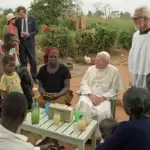
Fr. Adam Pergół, working in Zambia, also speaks about the meaning of the missionary presence. His mission in Mpunde was founded in 1960 by Card. Adam Kozłowiecki SJ. Today it encompasses 27 outreach communities. Some must be reached by car, then on foot, and later by boat.
“Someone would say that this is difficult work, because it is far from home, because of mosquitoes, a different climate, malaria. Yes, but what motivates us is the strong and living faith of these people,” he emphasizes. Despite extreme poverty, the residents are able to strengthen the missionaries themselves. “Father, there is no need to worry. God is, God exists, even if we are poor, God will help us get out of this,” they say.
Fr. Pergół came to Rome precisely to “return to his roots.” “We, missionaries, also need such rooting. To remember our roots, to also give this to our people, that this young Church is strongly rooted in the universal Church,” he points out.