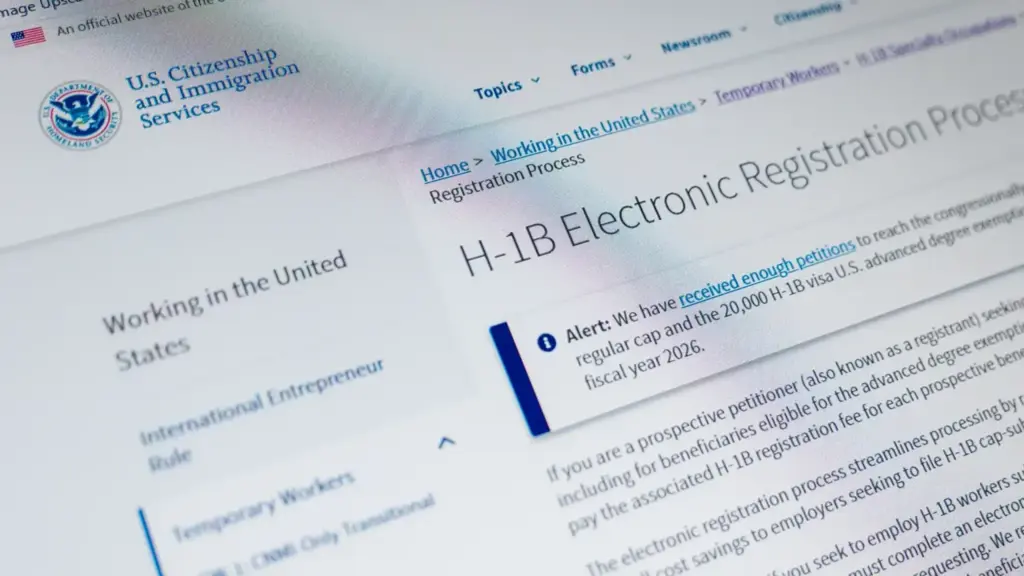
On September 20, 2026, the one-year presidential Proclamation 10973 expires. Since September 21, 2025, this proclamation has imposed a $100,000 fee on certain new H-1B petitions—specifically those requiring consular processing because the employee was outside the United States at the time of filing. For Polish IT specialists, engineers, and physicians applying for jobs in the USA, this is one of the most costly immigration changes in recent years—and so far, one of the most legally contested.
Court Ruled the Fee an Unlawful Tax
On June 8, 2026, Federal Judge Leo Sorokin of the U.S. District Court for the District of Massachusetts struck down the $100,000 fee in the case of California and 19 other states against the administration (California, et al. v. Noem, Case No. 1:25-cv-13829), which was filed on December 12, 2025, by the attorneys general of 20 states, including New York, New Jersey, and Illinois. The judge ruled that the fee is effectively a tax imposed without congressional consent and exceeds executive branch authority. The federal government has filed a motion to stay the judgment pending appeal.
Appellate Court Denied Request to Stay the Ruling
On July 24, 2026, the U.S. Court of Appeals for the First Circuit (in the case of State of California v. Noem) denied the government’s request to stay Judge Sorokin’s ruling. In practice, this means the $100,000 fee cannot currently be enforced—USCIS and the Department of State have no right to require it for contested H-1B petitions. The case is still proceeding on its merits in the appeals court, and the administration may still petition the Supreme Court for an emergency stay of the ruling, which would reinstate the fee.
Not All Courts Agree With Each Other
The California v. Noem case is not the only lawsuit concerning this fee. Concurrently, a dispute involving the Chamber of Commerce against the DHS is underway in a Washington court, where the district court ruled that the fee falls within the president’s authority—this case is now being appealed before the U.S. Court of Appeals for the District of Columbia Circuit. Conflicting rulings in different circuits increase the likelihood that the Supreme Court will ultimately resolve the issue.
September 20 Is Not the End of the Story – The Government May Renew the Proclamation
Regardless of court rulings, Proclamation 10973 itself is valid for one year and expires on September 20, 2026. The administration could extend it or issue a new one under similar conditions—the White House has not yet announced such a decision. For employers and employees, this means the legal status remains fluid: the fee may disappear, return following a higher court’s decision, or be renewed via a new proclamation.
In the Background: A New, Permanent Fee of $103,265 for Every Cap-Subject Petition
Regardless of the proclamation’s fate, the Department of Homeland Security (DHS) published a separate proposed rule on August 25, 2026 (Federal Register, document 2026-17324) that would introduce a permanent fee of $103,265 for every H-1B petition subject to the annual cap—both the regular 65,000 pool and the additional 20,000 pool for individuals with a U.S. master’s degree. Unlike the proclamation fee, the new fee would apply to all cap-subject petitions regardless of the method used to apply for status, though it would not apply to extensions, changes of employer, or cap-exempt employers such as universities or non-profit research organizations. Public comments on this proposal are open until September 24, 2026.
What This Means for Polish Employees and Employers
For Polish citizens participating in the annual H-1B lottery and for American companies employing Polish specialists, it is crucial to monitor both tracks simultaneously: the judicial track (whether the $100,000 fee will return) and the regulatory track (whether the new permanent fee of $103,265 will take effect). Employers planning to file H-1B petitions in the coming months should regularly consult with an immigration attorney—the legal status can change overnight, and decisions regarding who pays the fee and when directly impact recruitment project budgets.
For matters related to employment visas and immigration disputes, Polish attorneys from our directory can help — Polish Pages directory.