
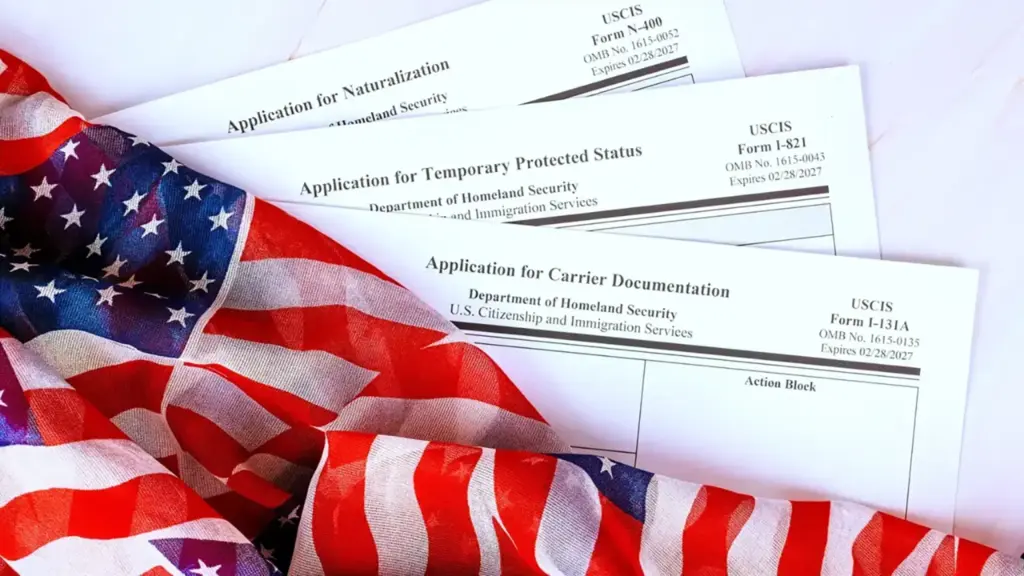
Form I-485, Application to Register Permanent Residence or Adjust Status, is the document that most Poles changing their status in the USA — after marriage, through a family petition, or as part of an employment-based process — use to apply for a green card without leaving the country. Starting September 18, 2026, USCIS will exclusively accept the new edition of the form, dated 09/18/26, replacing the previous one from January 20, 2025.
Where This Change Comes From
The new version of the form is a direct consequence of the final “public charge” rule announced by USCIS in August 2026, which we described in the article Public Charge 2026: New Rules for Green Card Applications. This rule takes effect on the same day — September 18, 2026 — so both changes must be treated together: the new evaluation criteria and the new form on which these criteria are accounted for.
The biggest changes apply to Part 9 of the form, dedicated to “public charge” questions. USCIS combined two previous questions — regarding cash assistance and long-term institutionalization — into a single one: “Have you ever received any means-tested public benefit?” Two separate tables for reporting benefits have been replaced by one, with a new descriptive field “Reason.” The column asking whether the benefit was received during a period exempt from the public charge evaluation has also disappeared.
Fewer Explanations in the Instructions — More Responsibility on the Applicant
The previous version of the form instructions contained several pages of explanations: what counts as a public benefit, who makes up the applicant’s household, and explicitly listed benefits not considered in the public charge assessment (including SNAP, WIC, Medicaid for children — CHIP, disaster relief, school lunch subsidies, housing assistance, and childcare). In the new edition, these detailed explanations are gone — the applicant is referred to general materials on the USCIS website. Instead, the form directly asks about family status, household income, assets, liabilities, education, and professional skills — the previous question about the number of people in the household has been replaced by a request for a descriptive overview of the family situation. Because the structure of Part 9 has changed, the numbering of questions in the rest of the form has also shifted.
USCIS stipulates that applicants generally do not need to attach additional evidence regarding public charge unless the agency requests it — and if it deems the data insufficient, it may issue a Request for Evidence (RFE).
Zero Transition Period — How It Works in Practice
The rule is identical to the September replacement of forms I-539 and I-765, which we wrote about earlier — and just as unforgiving for those who are late:
- An application filed before September 18, 2026, must be on the previous edition dated January 20, 2025. A new edition filed before this date will also be rejected.
- An application filed on or after September 18, 2026, must be on the new edition dated 09/18/26. An old edition filed after this date will be rejected.
As with previous form changes, the postmark date (for paper applications) or the electronic filing date (for online applications) is what matters — not the date the document physically arrives at the agency. USCIS provided a preview of the new form edition in advance precisely because there is no grace period for completing applications on the old form.
Who This Affects and What to Do Right Now
The change applies to everyone planning to file Form I-485 during this period as part of a status adjustment to permanent residency — whether through a family petition (marriage, parents, children) or an employment-based process. For those whose filing deadline falls around September 18, we advise not leaving it to the last minute and carefully checking the form edition date on the USCIS website before sending — filing on the wrong form means the application will be rejected, no matter how well prepared it is substantively. It is worth consulting an immigration attorney, especially since Part 9 of the form changes substantively, not just cosmetically.
This material is for informational purposes only and does not constitute legal advice. Every case should be consulted individually with an immigration attorney before filing an application.
When compiling your green card application and assessing how the new public charge rules affect your specific case, Polish immigration attorneys from the Polish Pages directory can help.