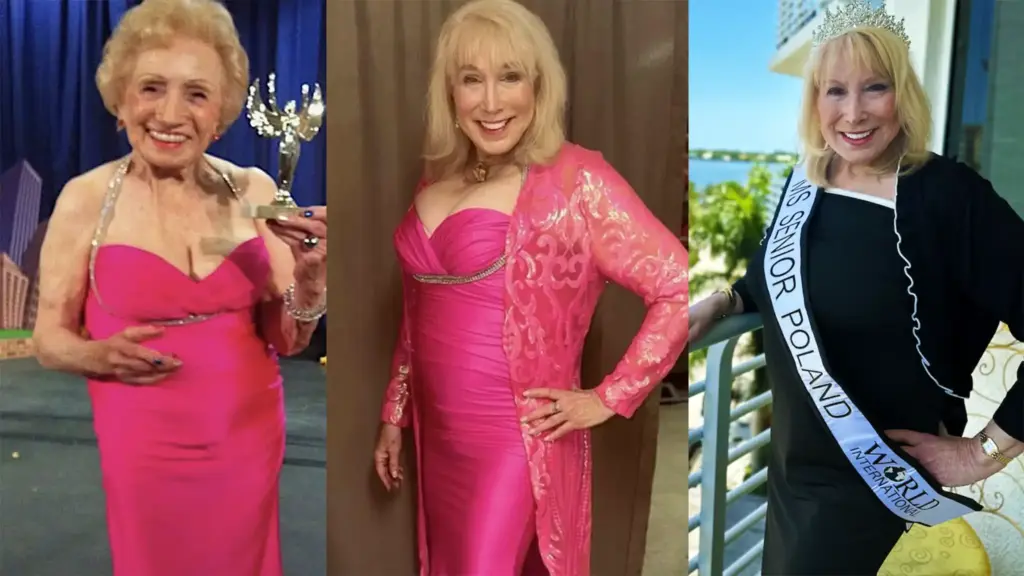
Her mother, Rosalee Glass, was born in Warsaw as Raisla Talerman. She survived the war and deportation to Siberia, where two of her children died. She came to America in 1951, built a drapery business, and in her nineties was crowned Sr. Ms. California, Ms. Congeniality, in that dress. She died in 2019 at 102.
She never knew her daughter would wear it.
We asked Dr. Glass if her mother knew that this would eventually happen.
“No. My mom passed away before I was selected as Senior Ms. Poland, so she never knew that I would have the honor of representing Poland on the international stage,” she replies. “That is why wearing her dress means so much to me. It’s my way of keeping her close. I truly feel that a part of her spirit will walk across that stage with me. She would have been thrilled that we are sharing a dress in a beauty pageant.”
Glass was born in the United States and both of parents were born in Warsaw. She is an author and documentary filmmaker whose Reinventing Rosalee, about her mother, has won 57 festival awards. In 2025 won the Senior Ms. America, Community Service title. The Senior Ms. Poland title was awarded by Ms. World International, a separate organization from the Miss World Organization. She says she hopes to screen Reinventing Rosalee for schools and Holocaust remembrance programs after the pageant.
“Poland lives in my heart”
We asked her what Poland means to her as a second-generation Pole born in America.
“Poland is a part of my identity,” she says. “Although I was born in the United States and am a first-generation American, Poland lives in my heart because it is the homeland of my parents, grandparents, and ancestors.”
She states that one of the most meaningful experiences of her life was traveling to Poland with her mother. “That trip changed my life. Mom often referred to Warsaw as the ‘City of Flowers.’ She loved Poland deeply, and through her eyes, I fell in love with it too.”
She also describes a pre-war Poland that gave her mother room to work. As a teenager in Warsaw, Rosalee designed and sewed men’s shirts for shops, eventually running a workshop with ten employees. “Poland gave her the freedom and the opportunity to become a successful businesswoman at a very young age,” she says. “Unfortunately, all of that ended when World War II broke out.”
Why Queen Jadwiga
In the national costume competition Glass will appear as Queen Jadwiga, crowned in 1384, in white and red with red poppies. She will carry the Polish flag in the Parade of Nations. “She was the first and only female king of Poland,” Glass says. “She believed in the importance of education, dedicated herself to helping the poor, and was a talented diplomat who united Poland and Lithuania.”
Her costume carries the White Eagle for Polish soldiers killed defending the country, the Star of David for Polish Jews murdered in the Holocaust, and butterflies, two of them red on her shoes, for children and young women whose lives ended in the war.
“All of them died on Polish soil,” she says, “and it is them I honor.”
Questions by Arthur Skok. Dr. Lillian Glass provided her answers to the Poland.us editorial team in writing. Translation from English by the editorial staff. Photo courtesy of Dr. Lillian Glass.