
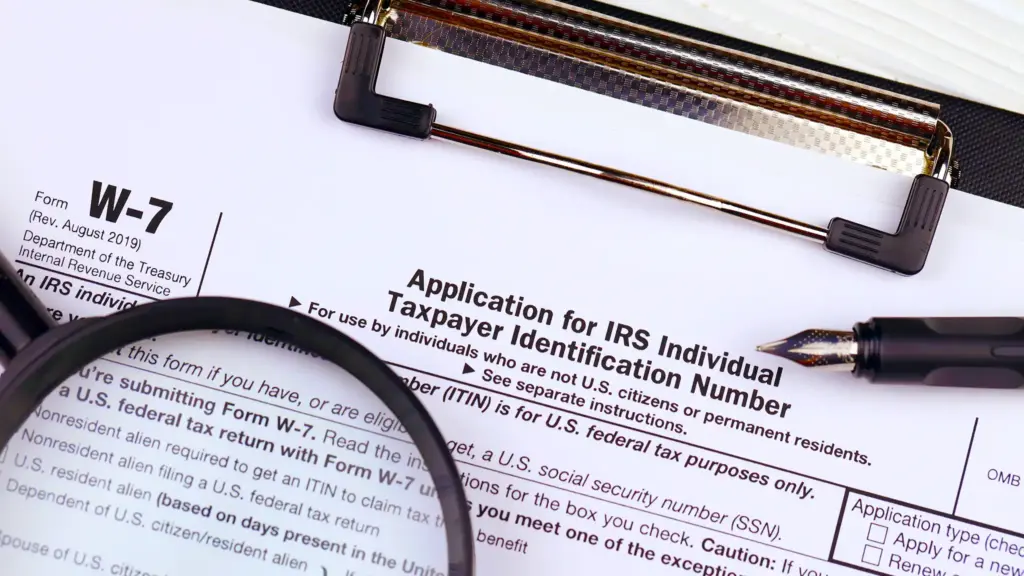
Many Poles in the States – spouses of working individuals, investors, people without work authorization, and sometimes children claimed as dependents – at some point hear: “You need an ITIN.” This number is often confused with an SSN and is subject to misunderstandings, such as the belief that it grants the right to work or that it’s related to immigration. It doesn’t grant and isn’t related. Below, we explain what an ITIN truly is, who needs it, how to obtain it, and when it expires.
What is an ITIN and how does it differ from an SSN?
An ITIN is a number issued by the U.S. tax authority (IRS) solely to help individuals who are not eligible for a Social Security number meet their tax obligations. It has 9 digits and uses the same format as an SSN (XXX-XX-XXXX), but it always begins with the digit 9. This is a key difference: an SSN is issued by the Social Security Administration to individuals with work authorization, while an ITIN is issued by the IRS to those who do not qualify for an SSN but have tax matters in the U.S.
The most important thing to remember is this: an ITIN is a “tax filing number,” not an immigration document. It does not change immigration status, legalize residency, or constitute work authorization.
Who needs an ITIN?
An ITIN is required by an individual with a federal tax purpose who cannot obtain an SSN. In practice, this most often applies to several situations: an individual who is legally obligated to file a U.S. tax return, wants to claim a tax refund or an eligible credit, or is to be listed as a spouse or dependent on a return that grants a credit. An ITIN is also sometimes required when a tax identification number must be provided for another federal tax purpose – for example, for rental income or investments in the U.S.
A typical scenario in the Polish community? One spouse works legally and has an SSN, while the other does not have work authorization – in this case, for a joint tax return, the spouse without an SSN needs an ITIN. If you are unsure whether this applies to you, it is worth consulting with an accountant before tax season.
What an ITIN is for – and what it is not
An ITIN primarily allows you to file a tax return, claim an overpayment refund, and, in certain cases, benefit from some tax credits. In practice, this number is also sometimes accepted when opening a bank account – many large banks accept an ITIN in place of an SSN.
However, it must be equally clear what an ITIN does not provide. It does not authorize employment in the U.S. It does not change immigration status. It does not entitle you to Social Security benefits. Nor is it an identity document in the colloquial sense. In other words: it is a tax tool, nothing more – but in its scope, very necessary.
How to apply – Form W-7 (three ways)
An ITIN application is submitted using Form W-7. There are three ways to do this:
- By mail, along with your tax return. The completed Form W-7 is attached to your federal tax return and sent to the IRS along with the required documents. This is the most common method, but it involves mailing original documents.
- Through an authorized agent (CAA). A Certifying Acceptance Agent is an individual or firm authorized by the IRS to verify the authenticity of documents, which usually means you don’t have to send your original passport to the IRS.
- At a Taxpayer Assistance Center (TAC). You can schedule an appointment at a local IRS Taxpayer Assistance Center and submit your application in person.
For many people, the most convenient and safest way is through a CAA – you don’t have to part with your passport for many weeks, and the agent helps you avoid errors that can cause an application to be rejected.
What documents to prepare
For the W-7 application, you must attach documents confirming both your identity and foreign status. In practice, the simplest option is a valid passport, since it is the only document accepted on its own and confirms both at once. If you do not have a passport, the IRS allows a combination of other documents, such as a photo ID and a birth certificate. Documents must be originals or copies certified by the issuing agency.
Since an ITIN is usually filed with a tax return, it is worth preparing the return documents at the same time. This saves time and reduces the risk of omissions.
When does an ITIN expire and how do you renew it?
An ITIN is not “forever.” Numbers that have not been used on a tax return for 3 consecutive years expire. According to the rule in effect in 2026, ITINs not used on tax returns for tax years 2023, 2024, and 2025 will expire on December 31, 2026. An expired number must be renewed before you file your return again; otherwise, the IRS may delay your refund and reject certain credits.
Renewal works the same way as an initial application: fill out Form W-7 and check the “Renew an existing ITIN” box. If you know you will be filing a return and your ITIN may have expired, it is better to renew it in advance rather than during peak season.
A Polish-speaking accountant or an authorized agent (CAA) can help with filling out Form W-7, compiling documents, and the entire tax filing process—you can find such specialists for the Polish community in the directory on PolishPages.com.
In a nutshell
- What it is: a nine-digit IRS tax identification number (starts with 9) for individuals not eligible for an SSN.
- Who: e.g., spouses and dependents on a tax return, individuals without work authorization but with a tax obligation, and investors.
- What it’s for: tax return, refund, certain credits, often a bank account. NOT: work, immigration status, Social Security benefits.
- How: Form W-7—by mail with tax return, through a CAA agent, or at an IRS center (TAC).
- Validity: ITINs not used on tax returns for years 2023–2025 expire on December 31, 2026; they are renewed by re-submitting Form W-7.
An ITIN sounds daunting, but it’s simply a number that allows an individual without an SSN to settle their accounts with the U.S. tax authorities honestly. Once obtained and validated, it ceases to be a problem.
This material is for informational purposes only and does not constitute tax advice. Rules, forms, and deadlines change – you can check current information on the IRS website (irs.gov), and it is best to consult a licensed accountant or authorized agent (CAA) for your individual situation.
Based on official Internal Revenue Service (IRS) materials regarding ITIN and Form W-7.
📱 Download the PolishPages app:
App Store (iPhone) | Google Play (Android)
Author: Bartosz Karczmarski · Poland.us / Głos Polonii · July 8, 2026