
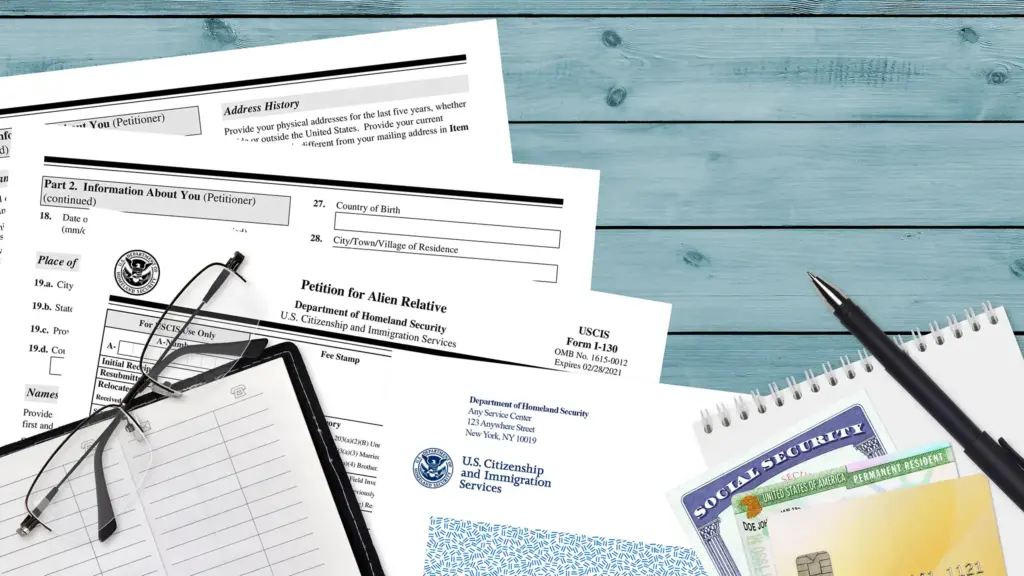
The citizen’s immediate relatives do not wait in line – the process usually takes 12–22 months. Other relatives fall into categories F1–F4, with the priority date determining the pace. Start: Form I-130.
For many Polish families separated by an ocean, this is one of the most important questions: can I bring my wife, husband, child, or parents to the States? And if so, how long will it take and where do I start? The family reunification system can be unintuitive, as the order is determined not by “how much someone needs it” but by rigid kinship categories and the sponsoring person’s status. Below, we explain this step by step without jargon.
Who Can Sponsor Whom
Your own status is the starting point. A U.S. citizen has different options than a green card holder.
A U.S. citizen can file a petition for: a spouse, their own children (of any age, including adult and married), parents (if the citizen is 21 years old or older), and siblings (also if the citizen is 21 years old or older).
A resident, or green card holder, has a narrower circle: they can sponsor a spouse and unmarried children. They cannot bring parents or siblings this way – this is a privilege reserved for citizens. Therefore, naturalization often genuinely accelerates family reunification.
Two Paths: “Immediate Relatives” and Preference Categories
This distinction determines everything – primarily the waiting time.
Immediate relatives (of a U.S. citizen) include the spouse, parents, and unmarried children under 21 years of age of the citizen. This group has an unlimited number of visas – there are no annual limits or numerical queues. However, this does not mean the case is handled “immediately” – the administrative procedure itself usually takes from several months to about twenty-two months, depending on the office’s workload and whether the person is already in the U.S. or abroad.
Preference categories (F1–F4) cover extended family and are subject to annual limits. Approximately 226,000 visas are granted annually across the entire United States in these categories, with no country receiving more than 7 percent of the quota. These limits create queues that sometimes last many years.
The categories are as follows:
- F1 – unmarried adult children (21+) of a U.S. citizen.
- F2A – spouses and minor children of a green card holder.
- F2B – unmarried adult children (21+) of a green card holder.
- F3 – married children of a U.S. citizen.
- F4 – siblings of a U.S. citizen.
Priority Date and Visa Bulletin – Your Case’s Clock
In preference categories, one concept is key: priority date. This is the date on which the office (USCIS) received your I-130 petition. This date becomes your “number in line” and does not change throughout the years of waiting.
Each month, the Department of State publishes the Visa Bulletin. This table shows the latest priority date for visas in a given category and country that are currently available. When your priority date becomes “current” (i.e., earlier than the date in the bulletin for your category), you can proceed to the next stage. Tracking this table is a basic habit for anyone waiting in a preference queue.
How Long Are the Queues in 2026
The differences between categories are enormous. Below is an approximate picture for mid-2026 – final dates are always confirmed by the current Visa Bulletin.
Immediate relatives – no numerical queue; mainly processing time matters (from several months to about twenty-two months).
F2A (spouse and unmarried children of a resident) – this is the fastest preference category; in mid-2026, it is practically “current,” meaning without a numerical queue, for almost all countries, including Poland. In this case, the processing time of the petition itself, not the priority date, is the main factor.
F4 (siblings of a citizen) – the longest queue in the entire system. For countries with the largest influx, waiting times can reach several years, and in Mexico, even over 25 years. Petitions filed around the turn of the nineties and two thousand are only now becoming “current.”
For Polish families, there is good news: Poland is not among the countries with the longest backlogs (such as Mexico, the Philippines, or India). This means that in many categories, Polish applicants wait noticeably shorter than applicants from those countries. However, specific dates must always be checked in the current bulletin for the category and country of birth.
It is also worth noting the broader context: according to data from mid-2026, the total number of pending cases at USCIS exceeds 11 million. The agency’s backlogs affect the processing speed of practically all immigration applications.
How It Starts: I-130 and I-864
The formal start is almost always Form I-130 (Petition for Alien Relative). This is a petition in which the sponsor confirms kinship with the person they wish to bring. A separate I-130 is filed for each relative. The date it is received is your priority date.
The second pillar of the process is I-864 (Affidavit of Support) – a statement of financial support. In it, the sponsor commits that the arriving person will not become a “public charge” and demonstrates adequate income. This security often determines the success of the case, so it is worth preparing financial documentation in advance.
Further, the path branches depending on where the sponsored person resides: if they are already legally in the U.S., an adjustment of status is usually possible; if they are abroad, the case goes through the consulate (consular processing).
In a Nutshell
- A U.S. citizen sponsors a spouse, children, parents, and siblings; a resident – only a spouse and unmarried children.
- Immediate relatives of a citizen do not wait in a numerical queue; the process usually takes from several months to about twenty-two months.
- Extended family falls into F1–F4 categories with annual limits; here, the pace is determined by the priority date and the Visa Bulletin.
- F2A is practically “current” (without a numerical queue) in mid-2026; F4 (siblings) is the slowest category, with over 25 years of waiting for Mexico.
- Poland is not among the countries with the longest backlogs, which usually shortens waiting times compared to Mexico or the Philippines.
- The process starts with Form I-130; financially, the case is “closed” with I-864 (Affidavit of Support).
Family reunification cases can be multi-stage, and one error in a petition can set the entire case back by several months. If you plan to bring loved ones to the U.S., a good first step is to consult with a Polish-speaking immigration lawyer – you can find trusted specialists in the directory on PolishPages.com.
This material is for informational purposes only and does not constitute legal advice. Terms, limits, and requirements change – current data can be checked on the USCIS websites and in the current Department of State Visa Bulletin, and individual cases are best consulted with a licensed immigration lawyer.
Based on official USCIS materials (family categories, Forms I-130 and I-864) and the U.S. Department of State Visa Bulletin (July 2026).
📱 Download the PolishPages app:
App Store (iPhone) | Google Play (Android)
Author: Bartosz Karczmarski · Poland.us / Głos Polonii · July 6, 2026