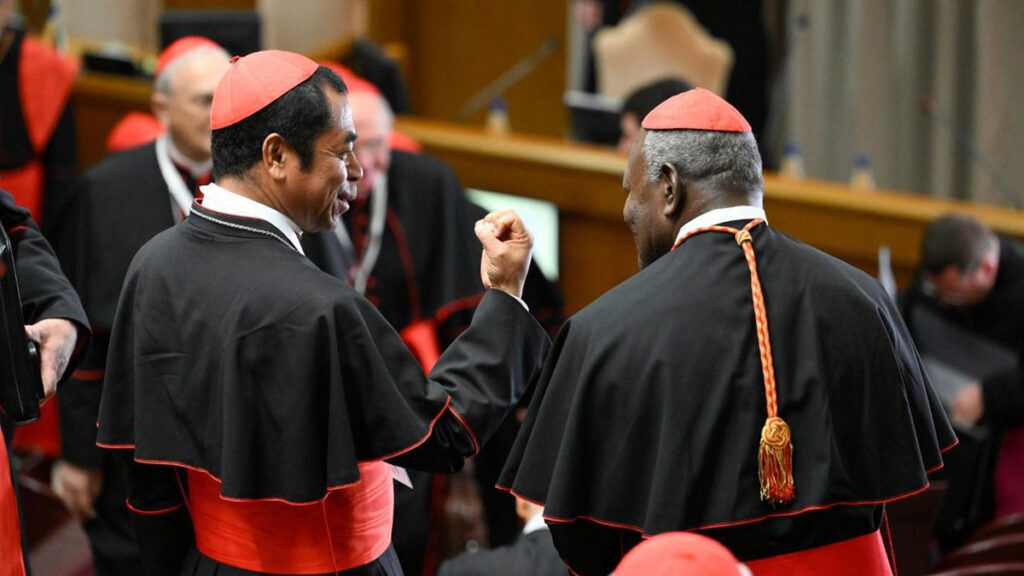
Among the 135 cardinals eligible to elect the 267th Successor of St. Peter are representatives from 71 countries across 5 continents. They represent 17 countries from Africa, 15 from both Americas, 17 Asian countries, 18 European, and 4 belonging to Oceania.
The Church from 12 countries will also be represented for the first time by cardinals who are their native inhabitants. These are Cardinal Chibly Langlois from Haiti, Cardinal Arlindo Furtado Gomes from Cape Verde, Cardinal Dieudonné Nzapalainga from the Central African Republic, Cardinal John Ribat from Papua New Guinea, Cardinal Sebastian Francis from Malaysia, Cardinal Anders Arborelius from Sweden, Cardinal Jean-Claude Hollerich from Luxembourg, Cardinal Virgilio do Carmo da Silva from East Timor, Cardinal William Seng Chye Goh from Singapore, Cardinal Adalberto Martínez Flores from Paraguay, Cardinal Stephen Ameyu Martin Mulla from South Sudan, and Cardinal Ladislav Nemet from Serbia.
In total, among the electors are 53 European cardinals, 37 from both Americas (16 North American, 4 from Central America, and 17 from South America), 23 Asians, 18 from African countries, and 4 from Oceania.
Electors created by the last three popes
The youngest among the electors is 45-year-old Cardinal Mykola Bychok, a Greek Catholic serving in Australia. The oldest is the Spanish prelate Cardinal Carlos Osoro Sierra, who has turned 79. As many as 13 cardinals were born in 1947. Only Cardinal Baldasser Reina was born in 1970, only Cardinal Leo Frank in 1971, and the only one from the 1972 cohort is Cardinal Rolandas Makrickas.
Among the electors are still 5 cardinals created by St. John Paul II: the French prelate Cardinal Philippe Barbarin, the Croatian Cardinal Josip Bozanić, the Hungarian Cardinal Péter Erdő, Cardinal Vinco Pulić from Bosnia and Herzegovina, and Cardinal Peter Turkson from Ghana. There are 22 cardinal electors created by Benedict XVI, and 108 who joined the College of Cardinals by the will of Pope Francis.
Cardinal religious
33 of the cardinal electors are members of religious congregations. The most, five of them, are Salesians (Cardinal Charles Maung Bo, Cardinal Virgilio Do Carmo da Silva, Cardinal Ángel Fernández Artime, Cardinal Cristóbal López Romero, Cardinal Daniel Sturla Berhouet). Four are members of the Order of Friars Minor, i.e., Franciscans (Cardinals Luis Cabrera Herrera, Pierbattista Pizzaballa, Jaime Spengler, and Leonardo Steiner). Four are also Jesuits (Cardinals Stephen Chow Sau-yan, Micheal Czerny, Jean-Claude Höllerich, and Ángel Rossi). Three cardinals are Conventual Franciscans (Cardinal François-Xavier Bustillo, Cardinal Mauro Gambetti, and Cardinal Dominique Mathieu).
Among those who will elect the future pope are also two Redemptorists (Cardinal Mykola Bychok and Cardinal Joseph Tobin) and two Verbists (Cardinal Tarcisio Kikuchu and Cardinal Ladislav Nemet). Dominicans are Cardinals Timothy Peter Joseph Radcliffe and Jean-Paul Vesco. Cardinal Robert Prevost is an Augustinian, Cardinal Fridolin Ambongo Besungu is a Capuchin, Cardinal Anders Arborelius is a Discalced Carmelite. Cardinal Orani João Tempesta is a Cistercian, Cardinal Vicente Bokalic Iglic and Cardinal Berhaneyesus Demerew Souraphiel belong to the Congregation of the Mission, Gérald Lacroix to the Secular Institute of Pius X. Cardinal Giorgio Marengo is a Missionary of Our Lady Consolata, and Cardinal John Ribat is a Missionary of the Sacred Heart of Jesus. Cardinal Fabio Baggio is a Scalabrinian, and Cardinal Dieudonné Nzapalainga belongs to the Congregation of the Holy Spirit.
It is known that two cardinal electors will not attend the conclave for health reasons. This information was conveyed by the Press Office of the Holy See after today’s general congregation.