
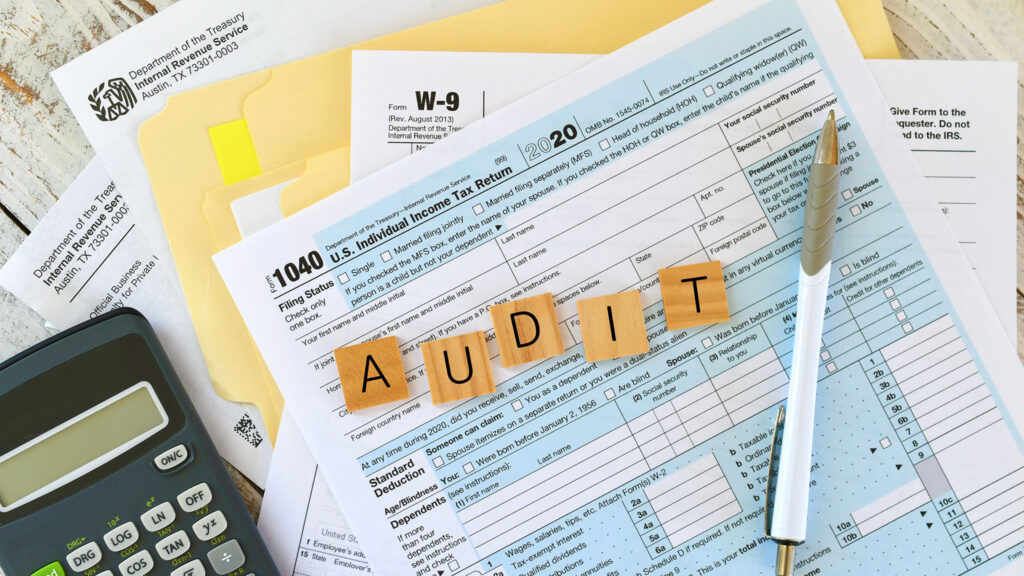
How does a tax audit work in the USA?
A tax audit is not necessarily a summons to the carpet. The most common type is a correspondence audit, where the IRS points out an error in the tax return, calculates the tax, and asks for payment. An example might be if you overlooked one of the 1099-INT forms for bank interest. The IRS receives copies of these forms from financial institutions and compares them with taxpayer declarations.
If the problem is more complex, you may be invited to come to a local IRS office to discuss the ambiguities and to bring specific documents. The last resort is a field audit – the IRS may visit a taxpayer’s business or home to conduct a more detailed analysis of financial documentation. Audits are random or result from specific signals indicating errors or irregularities in the tax return.
Errors in the tax return
Entering incorrect information on a tax return is one of the most common reasons the IRS might flag your return. Typos, Social Security number errors, or incorrect mathematical calculations are typical examples that can result in a request for clarification. To avoid problems, it’s worth using tax preparation software, such as TurboTax, or online services. You need to carefully check documents before submitting them. If your situation is complicated, you should use the services of a professional tax advisor.
Omission of certain income
All payers in the United States are required to prepare reports on amounts paid and taxes withheld at the end of the year. Employers send W-2 forms, and financial institutions send 1099-INT forms (summarizing interest), 1099-DIV forms (total dividends), etc. One copy is sent to the client, and the other to the IRS.
If your return does not match the information from payers, there is a risk of an audit. Reporting all income, even seemingly small amounts, is very important because it is easy to detect.
Extremely high deductions
Tax deductions are a useful tool that allows you to reduce your taxable income, but using them excessively can raise suspicion. If your deductions seem unusually high compared to people with similar income, the IRS may request detailed explanations. An example might be declaring charitable donations that exceed a significant portion of your annual income.
Income from irregular sources
Self-employment, running a small business, or occasional projects can introduce a greater risk of irregularities in tax returns. The IRS is aware that such sources of income are less transparent than standard employment, so it monitors them more closely. Maintaining precision and reliability in reporting self-employment income is crucial.
Round numbers
A certain Polish-American tax specialist annually reported an income of exactly $9,000 for a client who actually earned about ten times more. The client owned a house and four cars. The round numbers attracted the attention of the IRS, and he was called in for an audit.
Round numbers in a tax return, such as $1,000, $5,000, or $10,000, can raise suspicion with the IRS because they appear to be estimates rather than exact figures. Such practices may suggest a lack of precision or an attempt to inflate expenses. The IRS expects detailed and precise information in tax returns. If the numbers seem too “perfect,” the system may flag them for closer inspection.
Money abroad
It is permissible to have money abroad, but it must be “clean,” declared, and the income from it taxed in the United States. The IRS pays close attention to foreign transactions, income, and assets. Here are some key areas that may provoke a tax audit:
- Foreign income. If you receive income from Poland or another country, such as a pension from ZUS, you are obliged to report it in your American tax returns. The IRS requires taxpayers to declare all sources of income, regardless of their location.
- Holding foreign bank accounts. The IRS is particularly interested in foreign bank accounts, especially if their value exceeds $10,000 at any point during the tax year. In such a case, you must file an FBAR (Foreign Bank Account Report). Failure to report a foreign account that meets FBAR criteria can result in financial penalties.
- Foreign investments and assets. You may own a house or apartment in Poland. As long as they do not generate rent, you do not declare them. But when you sell property in Poland, the regulations require reporting this transaction as if it took place in the USA and paying capital gains tax.
- International financial transactions. Unusual transfers between the USA and Poland (e.g., sending money to family) can also attract the attention of the IRS, especially if the amounts are significant. Although such actions may comply with regulations, failure to report them can lead to problems. Read more in the book “How to Hide Money from the Tax Authorities.”
Improper use of tax credits
Improper application of tax credits, such as the Earned Income Tax Credit (EITC), is another red flag for the IRS. It is important to thoroughly understand the rules for using credits to avoid accidental errors.
Summary
Tax filing in the USA is based on the principle of honesty and transparency. Taxpayers should report all income, accurately complete forms, and adhere to applicable regulations. It is important to avoid rounding numbers, maintain documentation to support expenses, and use tax credits in a legally compliant manner. A proactive and diligent approach to tax filing minimizes the risk of an IRS audit.