Paolo Ondarza – Vatican City
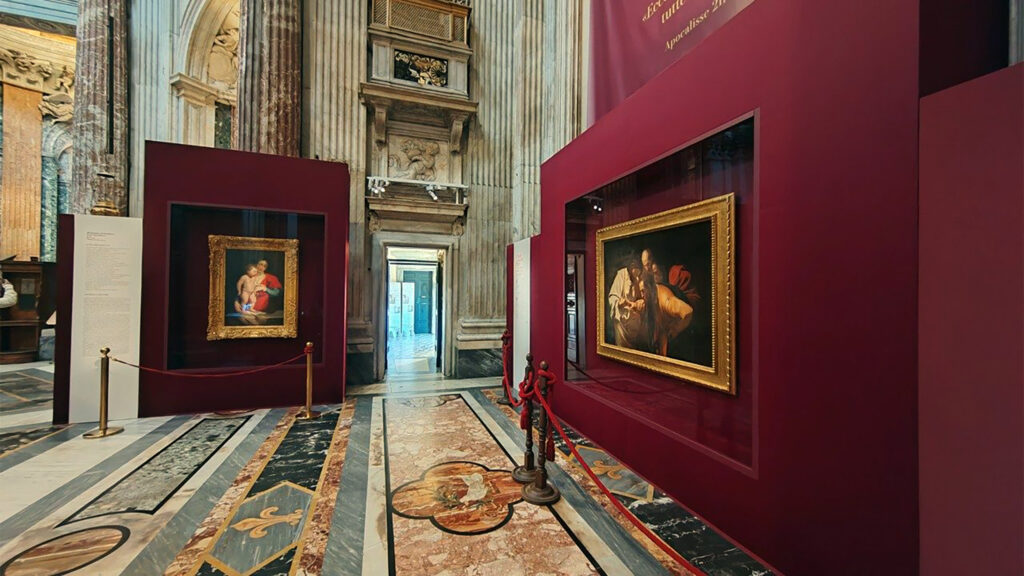
The beauty of the Jubilee continues to live in the hearts of those who experienced the Holy Year under the sign of hope. A concrete testimony to this “persistence” is the magnificent exhibition organized in the Church of Sant’Agnese in Agone in Piazza Navona, Rome, open daily from 9:00 AM to 7:00 PM. Admission is free.
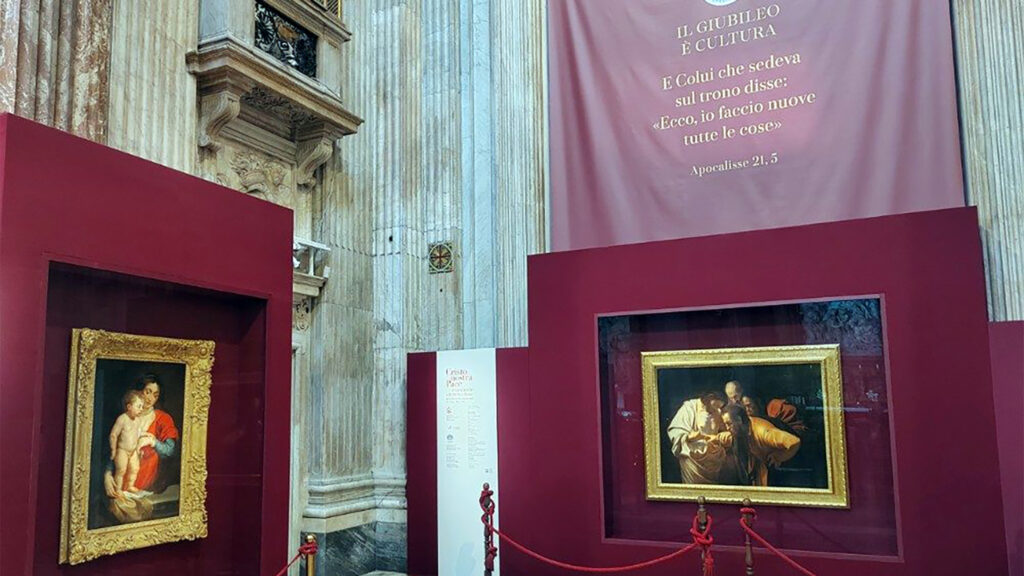
Two Masterpieces Side by Side
Two 17th-century masterpieces are displayed within the enchanting Baroque church, situated opposite Gian Lorenzo Bernini’s Fountain of Four Rivers.
The first is the Madonna and Child, painted in oil on canvas by Peter Paul Rubens between 1617 and 1618, from a private collection in Switzerland.
The second is one of three versions of the famous Incredulity of Saint Thomas by Michelangelo Merisi, known as Caravaggio, painted in collaboration with Prospero Orsi between 1602 and 1607. This is also an oil on canvas, currently in a private Austrian collection in Florence.
Catechesis Through Art
The Incarnation, Death, and Resurrection of the Son of God are the themes of the catechesis expressed in these two works of art, created by some of the greatest masters in the history of painting, closely linked to the Roman environment.
Caravaggio painted his work during his stay in the Eternal City, starting from the last months of the Jubilee of 1600. Rubens, on the other hand, created his composition after a visit to Rome,
From Disbelief to Certainty
Light and the human dimension of the Gospel scene are – as always – the protagonists of Caravaggio’s powerful work, which depicts the moment when the Risen Christ, after appearing to the women, Peter, the disciples of Emmaus, and the apostles gathered in the Upper Room, finally also appears to Thomas, who had not seen Him since His death on the cross.
“Put your finger here, and see my hands. Bring your hand here and put it into my side, and do not be unbelieving, but believing!” says the Risen One, according to the account of St. John (Jn 20:27).
“My Lord and my God!” replies the astonished apostle, moving from disbelief to faith (Jn 20:28).
A Work of Two Hands
The first authorial version of this painting is in a private collection in Switzerland. Caravaggio painted it for Cardinal Gerolamo Mattei between 1600 and 1601, and it was soon after given to the Massimo princes.
The work so captivated Giustiniani that he asked the artist for a second, almost identical version – now in Potsdam, Germany.
Unlike these two earlier paintings, the version currently on display in Rome shows the Savior with a covered leg and, as scientific studies have shown, bears the marks of two authors: the first was Caravaggio, the second most likely his close collaborator, Prospero Orsi, who completed the painting after Merisi’s flight from Rome, caused by the murder of Ranuccio Tomassoni.
Witnesses to the Gospel Event
Approaching the canvas, we feel drawn into the scene – as if we were one of the apostles, witnesses to this event: the figures are indeed the same size as our actual bodies. Thomas’s gaze immediately catches our attention, his furrowed brow, his finger plunging into Jesus’ body.
Only later do we notice an incredibly moving detail: Thomas’s hand is grasped and guided by Christ’s hand. It is the Lord Himself who takes the initiative and invites each of us to
The Destiny of the Child
In Rubens’ painting, Mary gently holds and presents the Child – He stands naked on a cloth spread over a stone beam. Jesus looks to the right. This painting reproduces the iconography of a side panel of a triptych made by Rubens in 1617. At the center of the polyptych was the scene of the Deposition from the Cross. Thus, even as a tiny child, the Son of God is shown as the one who will give His life for humanity, to redeem it from sin and death. In this light, the cloth brings to mind the shroud in the empty tomb.
Artistic Inspirations
A Calvinist by birth, Rubens converted to Catholicism at the age of 14 and was very devoted to Mary.
In the face of the Child Jesus, he immortalized little Albert – one of his nine children.
Shaped by a classical education in Antwerp, under the tutelage of master Jan Brueghel the Elder, in 1600 he embarked on an eight-year journey through Italy. During this intense period, he frequented courts and admired art collections in Venice, Mantua, Rome, and Genoa, befriended Cardinals Del Monte and Scipione Borghese, and often visited the construction of the Farnese Palace, where Annibale Carracci worked. Contact with Italian artists resulted in the richness of his pictorial language – a synthesis of Flemish fantasy, Venetian colorism, and Michelangelo’s monumentalism.
The painting presented in the Church of Sant’Agnese seems to allude to the Madonna del Parto, sculpted by Jacopo del Tatti, known as Sansovino, for the Basilica of Sant’Agostino in Campo Marzio in Rome in 1516.
The Exhibition
The exhibition, titled “Christ Our Peace,” part of the “Jubilee is Culture” series promoted by the Dicastery for Evangelization, was curated by Father Alessio Geretti.