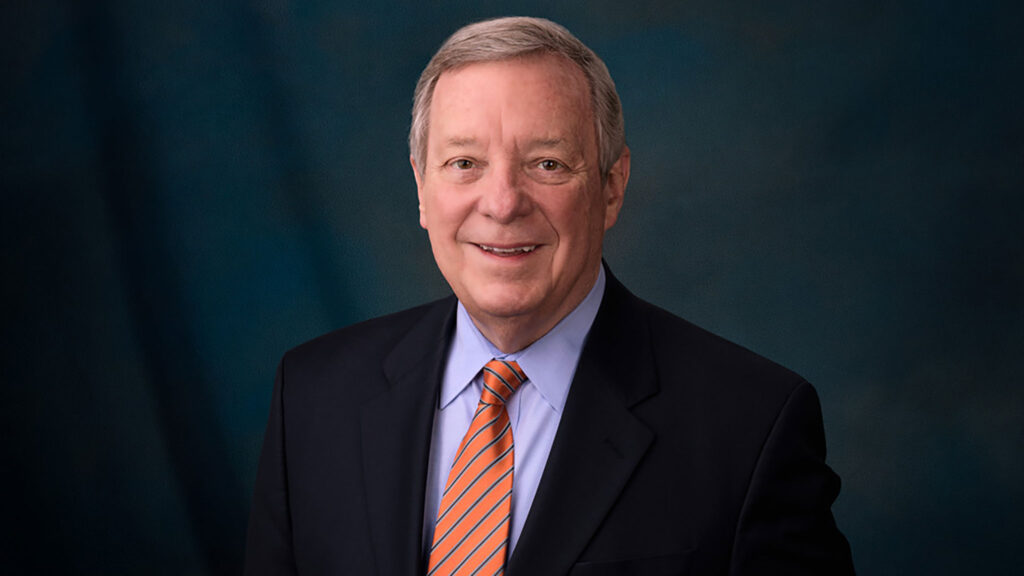
According to CBS News estimates, voter turnout approached the level of the 2020 presidential primaries — an unprecedented situation for a primary in a congressional election year in decades. The stakes were enormous: after thirty years, Senator Dick Durbin is stepping down, five Chicago congressmen are not running for re-election, and names that should interest every Pole in America appeared on the ballots.
Senate: Stratton wins, Krishnamoorthi’s $29 million not enough
The main race of the evening was the Democratic contest for Durbin’s Senate seat. Juliana Stratton — Illinois Lieutenant Governor and long-time political partner of Governor JB Pritzker — won it with 39.4% of the votes. Congressman Raja Krishnamoorthi came in second with 33.6%, and Congresswoman Robin Kelly closed the podium with 18.4%. The remaining seven candidates did not cross the ten percent threshold.
The result is all the more telling given that Krishnamoorthi spent an astronomical $29 million on his advertising campaign — starting to air spots as early as July, nine months before the primary. Stratton responded with a late but effective sprint: a strong performance in the January debate and millions from a super PAC funded by Governor Pritzker. On the other side of the barricade, the pro-cryptocurrency super PAC Fairshake — funded mainly by the crypto industry, including Silicon Valley billionaires Marc Andreessen and Ben Horowitz — spent over $5.5 million on ads attacking Stratton. Fairshake, which supported candidates from both parties in previous election cycles, focused on weakening Pritzker’s favorite in this race. Total spending by external committees in the Senate race alone exceeded $16.85 million.
Stratton is now the clear favorite in the general election in November — Illinois is one of the most Democratic states in the country. If she wins, she will become the fourth Black senator in Illinois history and the sixth Black woman to serve in the current Senate. Her Republican rival will likely be Don Tracy, former chairman of the state Republican party.
At the election night event at Chicago’s CineCity studio, Stratton left no doubt about the direction. According to the Chicago Sun-Times, she announced a fight for universal healthcare, immigration policy reform, including the abolition of ICE, and an increase in the minimum wage. “Courage inspired me to run. Courage fueled this campaign, and courage will take this fight straight to Donald Trump’s door,” she told her gathered supporters.
Governor: Pritzker vs. Bailey — a rematch from 2022
The second big story of the evening is the rerun of the gubernatorial race. JB Pritzker, who ran unopposed in the Democratic primary, will face Darren Bailey again in November — the former state senator who won the Republican primary with 49.6%. In 2022, Pritzker defeated Bailey by a thirteen-point margin (55% to 42%). Republicans hope that the changed political climate — Trump in the White House, growing dissatisfaction with the cost of living — will allow Bailey to narrow that gap.
In second place among Republicans, with 31.7%, was Ted Dabrowski — former president of the conservative think tank Wirepoints, known for his sharp criticism of Illinois’ fiscal policy. A Polish name on the ballot for governor is a rarity — and although Dabrowski did not win, he garnered almost one in three Republican votes. For Chicago’s Polonia, this is a signal that Polish names still carry political weight in Illinois.
Congress: new faces from Chicago
The primaries brought a generational change to Chicago’s congressional delegation. Five long-serving congressmen are leaving or running for the Senate, opening races Chicago hasn’t seen in years.
In the 9th district, after the departure of Jan Schakowsky (who served in Congress since 1999), Daniel Biss — mayor of Evanston — won among fifteen candidates, defeating, among others, influencer and journalist Kat Abughazaleh, who campaigned as an uncompromising progressive. In the 8th district, vacated by Krishnamoorthi (who ran for senator), Melissa Bean won. In the 7th district, La Shawn Ford won.
In all these races, the Democratic primary winner is virtually assured of victory in November — these districts are deeply Democratic.
Turnout: like in presidential elections
Turnout data surprised analysts. In Chicago alone, over 339,000 votes were cast by 5:00 PM, resulting in a turnout of almost 22%. According to CBS News estimates, statewide, between 1.5 and 1.6 million Democrats and about one million Republicans voted — numbers comparable to the 2020 presidential primaries. “For a midterm to approach presidential levels — that’s truly extraordinary,” said Anthony Salvanto, director of CBS News’ elections unit. The highest frequency among Chicago suburbs was recorded in Oak Park, River Forest, and Evanston.
Polish accents on the ballots
For Chicago’s Polonia — the largest Polish community in America — these primaries had an additional dimension. Several Polish names appeared on the ballots.
Ted Dabrowski, as mentioned, garnered 31.7% in the Republican gubernatorial primary — a solid result that positions him as a recognizable voice of the conservative opposition in Illinois. Walter Adamczyk ran in the Republican primary for Secretary of State. Casey Chlebek ran in the Republican primary for senator.
None of these candidates won, but the mere appearance of Polish names on state ballots is significant in the context of Polonia’s political presence. Chicago was once a city where Polish names on election lists were the norm — from local aldermen to congressmen. Those times have largely passed. Every Polish name that appears on the ballot in 2026 is a signal that Polonia still exists politically — even if its strength has shifted from city offices to the suburbs and the business sphere.
What’s next — and why it matters
The Illinois primaries are the first serious test of sentiment before the congressional elections in November 2026. The result says several things at once: money does not guarantee victory (Krishnamoorthi spent record amounts and lost), the governor’s endorsement still carries weight (Pritzker helped Stratton win), and turnout shows that Americans — including Polish-American voters — are taking these elections seriously.
For Polonia across the United States, the key question for November is: who will sit in the Senate and Congress when the fate of aid to Ukraine, the future of NATO, defense spending, and immigration policy are at stake. Illinois has just provided the first answer.
Daily analyses for Polonia at poland.us. Looking for Polish businesses and services in the USA? Check PolishPages.com — hundreds of verified businesses in 15 categories.