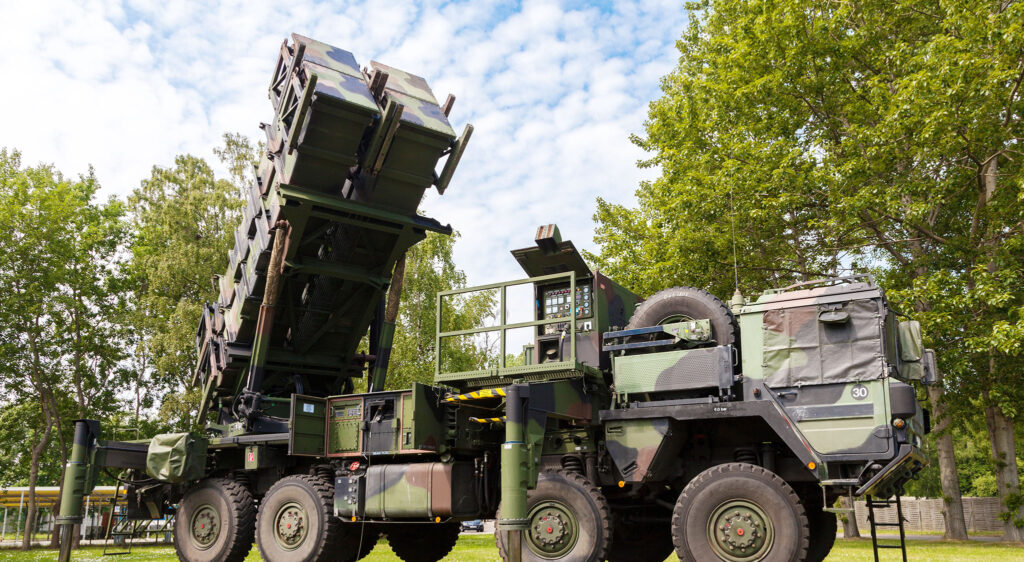
The United States informally asked Poland to transfer one of its two Polish Patriot missile batteries to the Middle East — along with PAC-3 MSE interceptor missiles, which are already in the Polish army’s arsenal. Defense Minister Władysław Kosiniak-Kamysz refused the same day. “Our Patriot batteries and their armament serve to protect Polish skies and NATO’s eastern flank. Nothing changes in this regard, and we do not plan to move them anywhere,” he wrote on platform X on March 31, 2026. For the Polish diaspora in America, this is a topic that affects both homelands simultaneously.
What Washington is asking for
According to the daily “Rzeczpospolita,” which first revealed the talks, the United States proposed that Poland transfer one full Patriot battery — i.e., eight launchers — and part of its stock of modern PAC-3 MSE interceptor missiles. This is the latest version of Patriot missiles, the only one capable of effectively shooting down ballistic missiles at long distances. Without the Patriot PAC-3 MSE system, the Patriot system can combat drones and aircraft, but it loses its ability to defend against what Iran most frequently launches — ballistic missiles.
The reason for the request is a dramatic shortage of interceptor missiles in the Middle East. According to estimates by London’s Royal United Services Institute (RUSI), the United States and Gulf states used approximately 1,500 PAC-3 missiles in just sixteen days of conflict with Iran. Part of this consumption is due to Gulf forces using the most expensive missiles to shoot down cheap Iranian Shahed drones — which is like shooting sparrows with a golden cannon, but in combat conditions, there was no other option.
Lockheed Martin, the manufacturer of PAC-3 MSE, produced about six hundred missiles in 2025. At this rate of production, it would take over two years to replenish what was used in the first two weeks of the war. Achieving an annual production of two thousand units is a prospect of seven years. Hence the desperate search for missiles among allies — including Poland.
Why Poland refused
Poland has two Patriot batteries — purchased for billions of dollars as part of the Wisła program, forming the foundation of Poland’s anti-missile defense. For a country located on NATO’s eastern flank, three hundred kilometers from Kaliningrad and the border with Belarus, giving up half of its anti-missile defense system is politically and militarily unacceptable. Minister Kosiniak-Kamysz left no room for interpretation: “Poland’s security is an absolute priority. Our allies know and understand well how important our tasks are here.”
Poland’s refusal is part of a broader trend — European NATO allies are increasingly making it clear that they will not allow their own defenses to be weakened for the sake of American operations in the Middle East. This is the same question that Ukrainian President Volodymyr Zelenskyy asked: would shifting US resources from Europe to the Middle East not encourage Russia to take more aggressive actions on the eastern flank?
What this means for the Polish diaspora
For millions of Poles in America, this dispute has a dual dimension. On the one hand — the United States, the country where they live and pay taxes, is waging a war that requires resources. On the other hand — Poland, the country of their ancestors, refuses America to protect its own sky. This is not a dispute between enemies — it is a tension within an alliance where both sides are right, but resources are not enough for everyone.
At the same time, Poland signed a contract yesterday — March 30, 2026 — for the construction of a service and production center for CAMM-ER missiles (British-Italian technology) at Wojskowe Zakłady Elektroniczne in Zielonka near Warsaw. This is a signal that Warsaw is not only refusing to give up what it has but is actively building its own production capabilities to avoid dependence on supplies from Washington in the future.
Editorial Staff, Głos Polonii w USA
Read more at poland.us — daily new information for the Polish diaspora in America. Looking for a Polish business in the USA? PolishPages.com.