
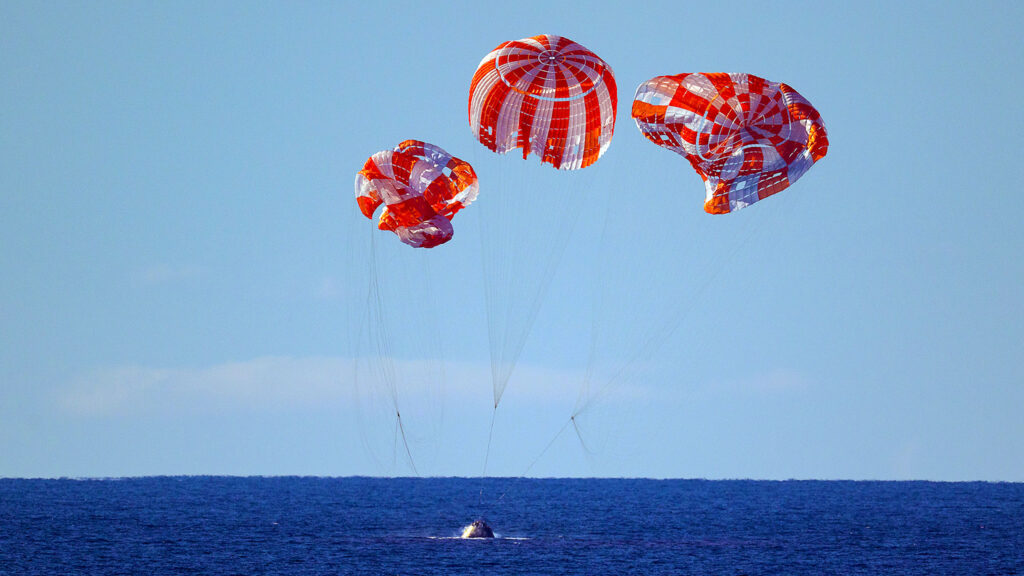
Four astronauts — Reid Wiseman, Victor Glover, Christina Koch, and Jeremy Hansen — have returned to Earth after ten days in space, breaking the record for distance from Earth (252,756 miles) and completing the first crewed flight around the Moon in fifty-three years. Mission Control in Houston called the landing a “bullseye.” But many people — in America and Poland — are asking: if they didn’t land on the Moon, why did they fly?
Test Flight — Like a Car’s First Drive Before a Race
Artemis II was not meant to be a landing mission. It was a test flight — the most expensive, riskiest, and most important test drive in the history of space exploration. Imagine building a new race car. Before sending it to the track at full speed, you need to check if the engine works, if the brakes respond, if the steering wheel doesn’t fall off on a turn. You don’t send a driver to a race in a car that has never had a test drive.
The Orion capsule had only flown once before — Artemis I in 2022 — but without people on board. This time, for the first time in history, four living people sat inside a capsule that flew twenty-five thousand miles per hour, heated up to five thousand degrees Fahrenheit upon atmospheric re-entry, and had to land at seventeen miles per hour at a precisely designated point in the Pacific. Every system — from air filters to parachutes — had to work. Because if it doesn’t work with people on board, there’s no second chance.
What Exactly They Were Testing
For ten days, the astronauts checked systems that will determine the lives of future crews landing on the Moon. Life support systems — CO2 filters, water circulation, temperature regulation, space toilet. Deep space navigation — far from GPS and the space station, where there is no room for error. Communication with Earth — with a delay increasing with every thousand miles. Manual control of the capsule, in case automation failed. And finally — the heat shield, that critical part of the capsule which had known flaws after Artemis I and which this time had to prove it wouldn’t disintegrate with people inside.
Everything worked. “Perfect landing,” they said in Houston. But behind those two words lie a thousand tests, each of which could have ended in tragedy.
Distance Record — 252,756 Miles
On April 6, the Orion capsule reached its farthest point from Earth — 252,756 miles. That’s over four thousand miles farther than Apollo 13, which held that record in 1970. The difference is that Apollo 13 found itself in such a distant place due to a malfunction — the astronauts were fighting for their lives. Artemis II broke this record intentionally, as planned, and safely.
The astronauts saw a solar eclipse behind the Moon — a sight no human had witnessed in over half a century. Victor Glover said it was “one of the greatest gifts of the mission.” They also saw the far side of the Moon up close — a side we can never see from Earth.
Why This Is Important for Ordinary People
Artemis II is not a mission for scientists and engineers. It’s a mission that opens the door to something that will change the lives of ordinary people — though not immediately and not tomorrow.
The next step is Artemis III — planned for 2028 — which will land humans on the Moon’s surface for the first time since 1972. But Artemis doesn’t end at the Moon. NASA plans a lunar base from which future missions to Mars will launch. Technologies developed for these missions — from water filtration to materials resistant to extreme temperatures — find their way into everyday life. Your home water filter, the foam in your mattress, digital cameras in your phone — these are all technologies that started with NASA’s space programs.
But there’s something else. Artemis II showed that humanity can return to things it once did — and do them better. Fifty-three years ago, we abandoned the Moon. Now we’re returning. With the first woman. With the first Black astronaut. With the first Canadian beyond low Earth orbit. This is not a repeat of Apollo — it’s a new chapter.
Return Home
At 7:53 PM ET, the Orion capsule struck Earth’s atmosphere at an altitude of 400,000 feet, traveling thirty-five times the speed of sound. For six minutes, there was a radio blackout — the plasma surrounding the capsule cut off communication with Houston. In mission control, as flight director Rick Henfling said, “if you weren’t anxious, you probably weren’t breathing.” Then the parachutes opened — eleven in sequence — slowing the capsule from three hundred miles per hour to seventeen. At 8:07 PM, Orion touched down in the water. “Bullseye,” Houston said. The crew is doing well.
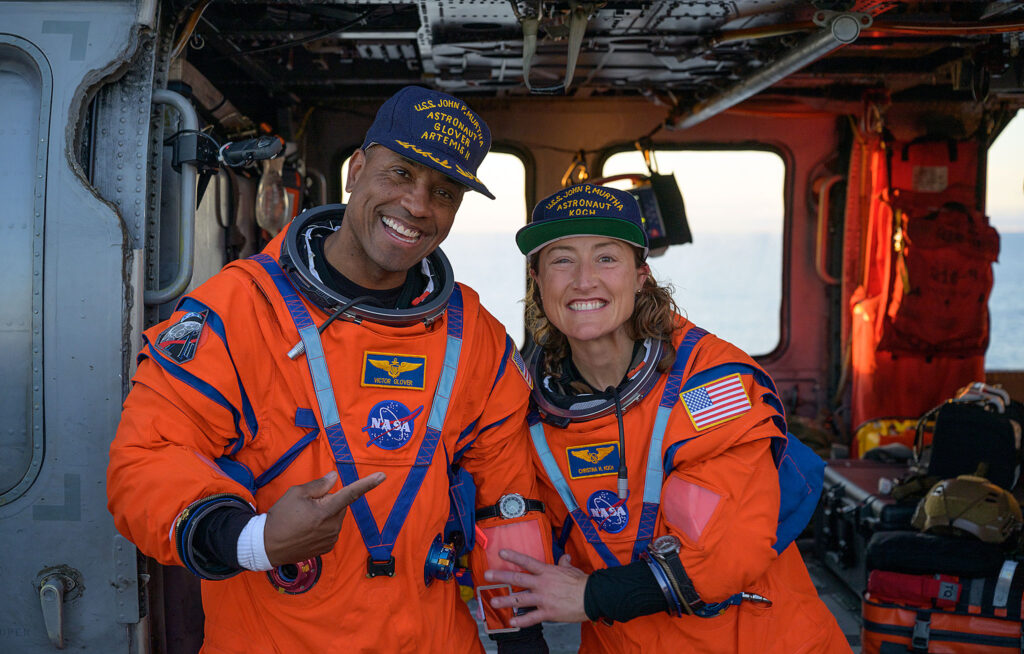
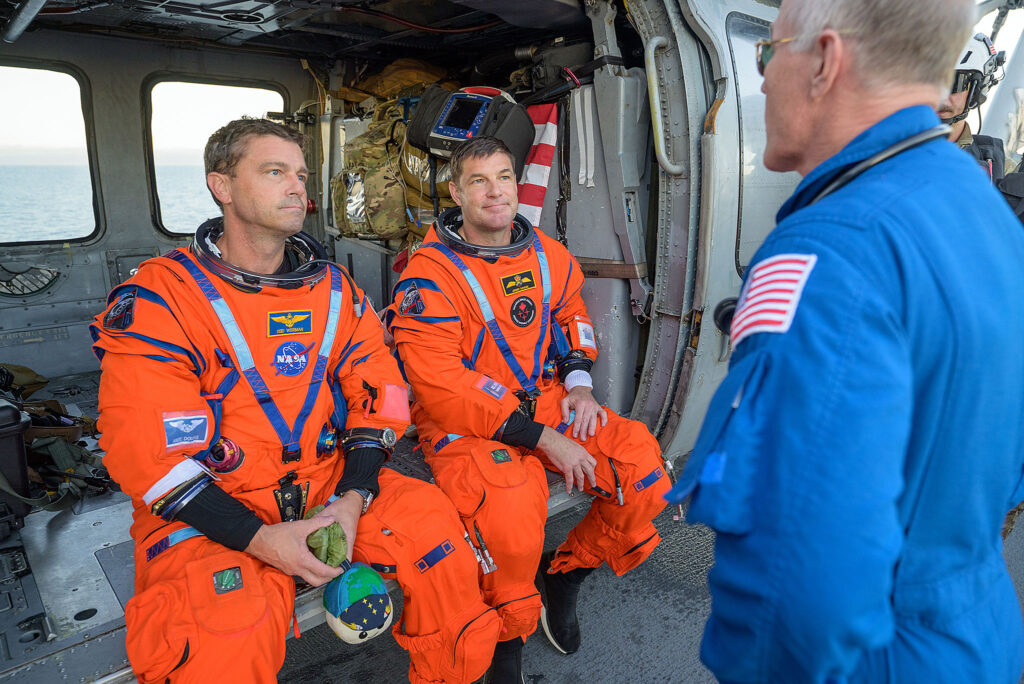
The astronauts were extracted from the capsule, transported by helicopter to the USS John P. Murtha, and underwent medical examinations. They will fly to Houston, to the Johnson Space Center. And the Orion capsule — hit, heated, descended — will be pulled from the water, disassembled, and analyzed screw by screw. Because what they learn from it will determine whether Artemis III flies to the Moon’s surface with humans.
They didn’t land on the Moon. But they proved that the machine that will take them there works. And that’s more important than a boot print in the dust — because without this test drive, there would be no print at all.
Three Things You Didn’t Know
They changed the landing plan at the last minute. For years, NASA planned for Orion to re-enter the atmosphere in a maneuver called “skip reentry” — the capsule was supposed to bounce off the upper layers of the atmosphere like a stone skipped across water, to shed speed and cool down. But after Artemis I in 2022, engineers discovered alarming wear on the heat shield — and abandoned that plan. They chose a steeper, direct entry profile. That’s why Houston was so anxious during the six minutes of radio blackout — the capsule was entering the atmosphere at a different angle than originally designed.
The first stop on Earth was a rubber “Front Porch.” After splashdown, the astronauts didn’t immediately board the helicopter. First, they exited through the hatch onto a special inflatable raft attached around the capsule, which NASA engineers call the “Front Porch.” For a few minutes, they sat on the rubber raft in the middle of the Pacific, breathing the ocean air after ten days in space. Only then did the Navy pick them up.
They were woken up by a song about a lonesome drifter. Following a tradition dating back to the Gemini program, Mission Control in Houston wakes astronauts with music. On their last morning in space — one hundred forty-seven thousand miles from home — the crew was woken by Charley Crockett’s song “Lonesome Drifter.” Lonesome drifters hurtling through the void of space. It’s hard to imagine a better choice.
Arthur Skok, poland.us
Artemis II | Launch: April 1, 2026, 6:35 PM ET | Splashdown: April 10, 2026, 8:07 PM ET | Distance Record: 252,756 miles (April 6) | Duration: ~10 days | Capsule: Orion “Integrity” | Crew: Wiseman, Glover, Koch, Hansen | Photo: NASA