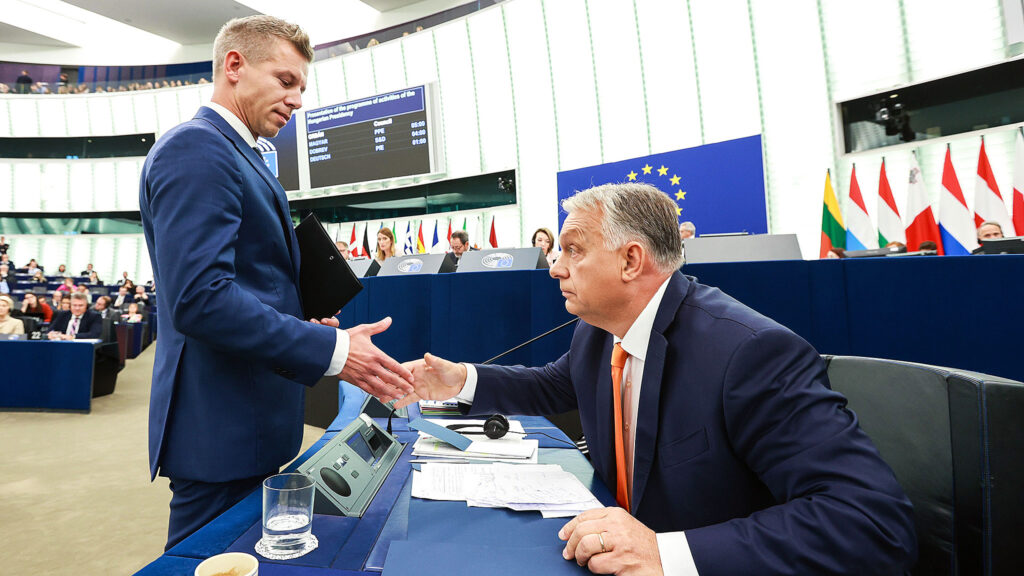
Magyar met with President Tamás Sulyok, demanded his resignation, announced the suspension of state media, and declared that a new government could take power as early as May 5. First foreign visit? Warsaw.
138 seats — a record Orbán didn’t foresee
When polling stations closed on Sunday, April 12, preliminary results gave Tisza about 135 seats. A week later — after counting postal and diaspora votes — the final result was 138. Fidesz dropped to 55 seats. The only other party in the new parliament is the far-right Our Homeland with six seats. Voter turnout was 79.6% — the highest since the system change in 1990.
This is not an ordinary change of government. Magyar has a constitutional supermajority — the right to change the constitution, organic laws, and the entire institutional infrastructure that Orbán built over sixteen years. And from the initial announcements, it appears he intends to exercise this right.
“Unworthy of representing the unity of the nation”
On Wednesday, April 15, Magyar met with President Tamás Sulyok at Sándor Palace in Budapest. The meeting was brief. After leaving, Magyar told reporters that he had demanded Sulyok’s resignation after the new government is sworn in. “He is unworthy of embodying the unity of the Hungarian nation,” he wrote on platform X. “He is incapable of serving as a guardian of the rule of law. He is unfit to be a moral authority or a role model.”
Sulyok said he would “consider” the request. Magyar added that if the president does not resign voluntarily, the new government will introduce constitutional changes to remove him — “along with all other puppets that the Orbán system installed.”
Government from May 5
According to Hungarian law, the inaugural session of the new parliament must take place by May 12. Magyar is pushing for acceleration — according to his statements after the meeting with Sulyok, the new government could take power as early as the first week of May. He called on the Orbán government to serve solely as a technical cabinet in the final weeks and not to make any decisions that could harm Hungary’s interests or hinder the work of the new government.
What Magyar announces
The list of reforms is long and ambitious. Magyar announced Hungary’s return to the European Public Prosecutor’s Office — the EU body responsible for prosecuting financial crimes, from which Orbán withdrew Hungary in 2020. This means that European investigators will be able to investigate corruption from the Fidesz era. He also announced the restoration of judicial independence, which under Orbán had been subordinated to the ruling party.
State media — which Magyar calls a “factory of lies” — are to be suspended until a new media law is passed and an independent oversight body is appointed. “Every Hungarian deserves public media that tells the truth,” he said in a radio interview.
In energy policy, Magyar announced a departure from Russian oil and gas. Hungary is one of the last EU countries still dependent on the Druzhba pipeline and contracts with Gazprom. Nuclear power plants rely on Russia’s Rosatom. The EU wants to end Russian gas imports by the end of 2027 — Magyar admits that this is too early for Hungary, but aims for a complete cut-off by 2035.
First visit: Warsaw
In his election night speech, Magyar said that his first foreign visit as prime minister would lead to Warsaw, then to Vienna and Brussels. “Hungary will once again be a strong ally of the European Union and NATO,” he promised the crowds along the Danube.
For Poland, this is a signal that is hard to overstate. For years, Orbán was a thorn in the side of Polish European policy — blocking aid to Ukraine, torpedoing sanctions against Russia, and maintaining communication channels with the Kremlin while Poland built an anti-missile shield on its eastern flank. Magyar’s visit to Warsaw as a first step — before Brussels, before Paris — is a clear declaration: the Warsaw-Budapest axis is returning, but on completely different terms than under PiS and Fidesz.
What this means for the Polish diaspora
At first glance — nothing specific. Hungary is not America and not Greenpoint. But the change in Hungary affects something that directly impacts the Polish diaspora: Poland’s position in Europe. If frozen EU funds for Hungary are unblocked, and the 90 billion euro loan package for Ukraine moves forward without a Hungarian veto, then Poland gains a stronger ally in the region and a more stable Central Europe. And a stable Central Europe means a better negotiating position for Poles seeking jobs, passports, and a future on both sides of the Atlantic.
A 24-year-old law student from Budapest told CNN on election night: “Part of me still doesn’t believe it. I have to check my phone tomorrow morning and see that the Prime Minister of Hungary is no longer Viktor Orbán.” His peer Arnold, 29, added that he was happy to “close the door on a terrible period.” Along the Danube, they chanted: “Europe! Europe!”
The doors have closed. New ones are opening. First stop: Warsaw.
Kamil Brzozowski, poland.us
Hungary after the 2026 elections | Tisza: 138/199 seats (53.6%) | Fidesz: 55 seats (37.8%) | Our Homeland: 6 seats | Turnout: 79.6% | New government: ~May 5, 2026 | First foreign visit: Warsaw | Sources: Bloomberg, Foreign Policy, Euronews, Al Jazeera, CNN, LSE, Cambridge
Read also: Orbán lost — full report from election night
Read more at poland.us.