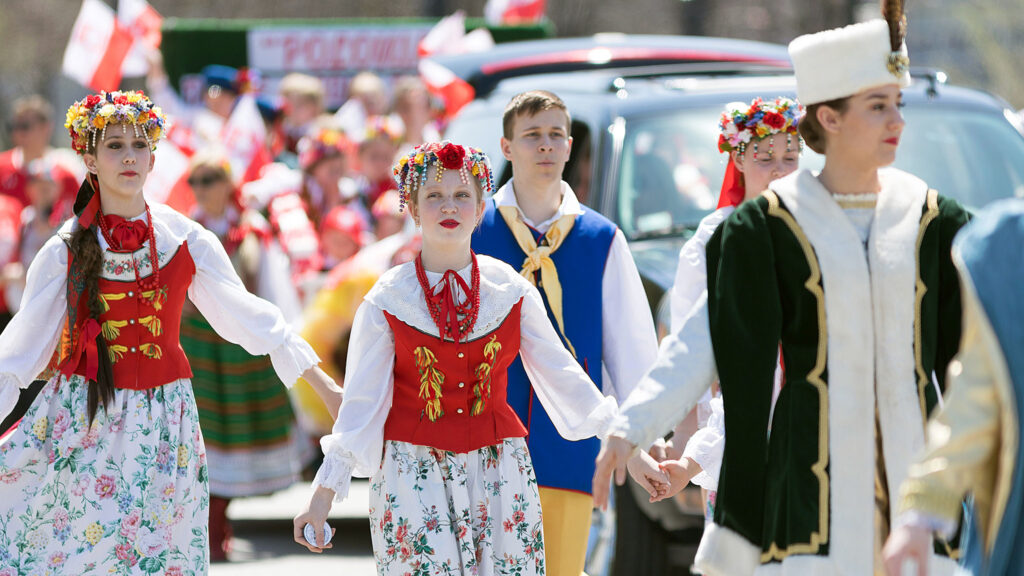
One of the oldest Polish schools in the metropolis celebrates its 75th anniversary. Polish has become the second most popular foreign language among high school students in Illinois applying for the “Seal of Biliteracy.” A solemn mass was held at St. Hyacinth Basilica for the victims of Katyn and Smoleńsk. A Polish extreme runner crossed America from coast to coast. And in two weeks, on May 3rd, the Mazowsze ensemble will perform at the 135th Constitution Day Parade. Chicago is alive. Just different from Greenpoint.
75 Years of the Pulaski School
On April 11, 2026, at the Allegra banquet hall near Chicago, nearly 300 people gathered at tables to celebrate the diamond jubilee of the General Casimir Pulaski Polish Saturday School. The school was founded in 1951 — when Poland was still under the Soviet boot, when the first wave of post-war emigrants tried to build a new life in a new country while not forgetting where they came from. Today, 75 years later, it is one of the two oldest Polish educational institutions in the Chicago metropolitan area.
The evening was hosted by Wioletta Pietrzak and Tomasz Popławski. They began with a dance performance by the school’s Orzeł group. Then came the memories — decade by decade. Every year, the Pulaski School graduates another group of young people who live in two cultures and, as it was put in the hall, “can choose the best from each.” In the Chicago metropolitan area, there are now over thirty Polish schools with several thousand students of Polish descent. Several hundred Polish teachers. Matura exams, certificates, proms — in January, 650 high school graduates from 40 Polish schools celebrated the traditional Prom 2026 in Oakbrook Terrace.
For New York, where the Pulaski Supplementary Polish School in Brooklyn celebrated its 20th anniversary in 2013 and is still active. This is a point of reference. Polish community schools in America are not a relic of nostalgia — they are an infrastructure that produces bilingual children with dual passports and dual perspectives. Each graduating class is an investment whose effect is only visible after 20 years.
Polish is Illinois’ Second Language
Illinois runs the “Seal of Biliteracy” program — a seal of biliteracy on the high school diploma. In 2026, a record number of students in the state will receive this seal. And Polish ranked second in popularity — right after Spanish. Surpassing Mandarin, Arabic, Korean, Vietnamese, and all others. This is official confirmation of something that has long been said in Polish families in Chicago: our children learn Polish, they learn it seriously, and they are measurably good at it.
Someone might say: well, in Illinois, that’s logical, there are so many Poles here. True — Chicago is the second largest Polish community in the world after Warsaw. But the fact that Polish kids pass Polish exams in the American education system so massively that their language ranks higher than Arabic or Mandarin — that’s not obvious. It’s the result of those thirty schools, those several hundred teachers, those Saturday mornings when parents wake up at seven in the morning and drive their children to Niles or Schaumburg instead of to the swimming pool.
Katyn and Smoleńsk — Mass at St. Hyacinth Basilica
April 12, the 16th anniversary of the Smoleńsk catastrophe and the 86th anniversary of the Katyn massacre, a solemn mass at St. Hyacinth Basilica. It was organized by the Committee for the Care of the Katyn Monument and Smoleńsk Plaque at the Association of Polish Clubs. The motto inscribed on the invitations: “A nation that loses its memory loses its conscience.” Anyone who has been to St. Hyacinth Basilica knows that this is not a phrase from a brochure — it is precisely what has kept Polish parishes in Chicago alive for over a hundred years.
Katyn and Smoleńsk combined in one mass is a gesture that still evokes political tension in Poland. In Polish Chicago — no longer. These two events from two different eras have merged into a single experience of Polish memory of what the Russian state did to Poles. One can argue about the political context, but not about the fact that both tragedies irreversibly affected Polish families.
Sobania Ran Across America
Tomasz Sobania, a Polish extreme runner, started from New York on September 15, 2024. Less than five months later — in early February 2025 — he reached San Diego. He ran across the United States from coast to coast. A distance equal to one hundred twenty-five marathons, on his own feet, as the first Pole in history.
The route through deserts, the Rocky Mountains, cornfields, cities, and towns. Kilometers, pounds lost, shoes worn out, knees aching. Sobania ran solo, with the support of a small crew who assisted him along the way. The Polish community along the way came out to meet him with flags and thermoses of coffee.
Although this story is a year old, Polish Chicago is revisiting it now — because full reports and interviews with the runner have only recently been published, and the feat itself is still the most spectacular Polish sporting success in America in recent years. Such a story won’t make it to CNN or The New York Times. But in a Polish cafe in Jackowo, it’s still being talked about. And rightly so. Because Polish pride doesn’t always have to be institutional — sometimes it’s enough for one person to do something impossible.
May 2 — 135th Constitution Day Parade in Chicago
On Saturday, May 2, 2026, the 135th Constitution Day Parade — one of the largest Polish community demonstrations in America — will march through downtown Chicago. The parade traditionally takes place on the weekend closest to the May 3rd anniversary to facilitate access for the Polish community from across the Midwest. The special guest will be the “Mazowsze” Song and Dance Ensemble — one of the most important Polish folk ensembles, whose performance in Chicago is an event that people travel from Detroit, Milwaukee, and Minneapolis to see.
The parade is still what it was 135 years ago — a demonstration of Polish presence in the heart of America. The parade floats change, the sponsors change, the generations change. But the street full of Polish flags, pierogi sold from carts, and grandparents explaining to their grandchildren what the May 3rd Constitution was — that remains.
Something Else Worth Knowing
In April, the “Most Beautiful Pole in America 2026” gala took place at the Des Plaines Theatre — the title was won by Karolina Lisztwan. The Consulate General of the Republic of Poland in Chicago honored Michael Kutza — a man who for years built the Polish community film scene in America. Patrick Gruszka, a Polish rally driver, is preparing for the Olympus Rally in California. On April 25 and 26, at the PaSO Music Academy on North Lawler Avenue, Ania Włoch will sing Magda Umer’s songs in the show “But I Was…” — tickets are $55.
Chicago is not shrinking. Chicago has dispersed — to Niles, Park Ridge, Schaumburg, and McHenry. But still, when Saturday morning comes, kids get in cars and go to Polish school. Still, when May 3rd comes, the streets are full of flags. Still, when a loved one dies — you go to a Polish mass. That’s enough to say: we are alive.
Editorial Staff, Voice of Polonia in the USA
Chicago Polonia — April 2026 | April 11: 75th Anniversary of Pulaski School (Allegra banquet, ~300 people) | April 12: Mass for Katyn and Smoleńsk victims (St. Hyacinth Basilica) | April 16: Polish #2 among Illinois students with “Seal of Biliteracy” | Tomasz Sobania: USA run September 15, 2024 – early February 2025 | Saturday, May 2, 2026: 135th Constitution Day Parade with Mazowsze | Based on materials from Dziennik Związkowy, Deon24, Polski FM, szkolapulaskiego.org
Looking for something? You’ll find it: PolishPages.com. Read more at poland.us