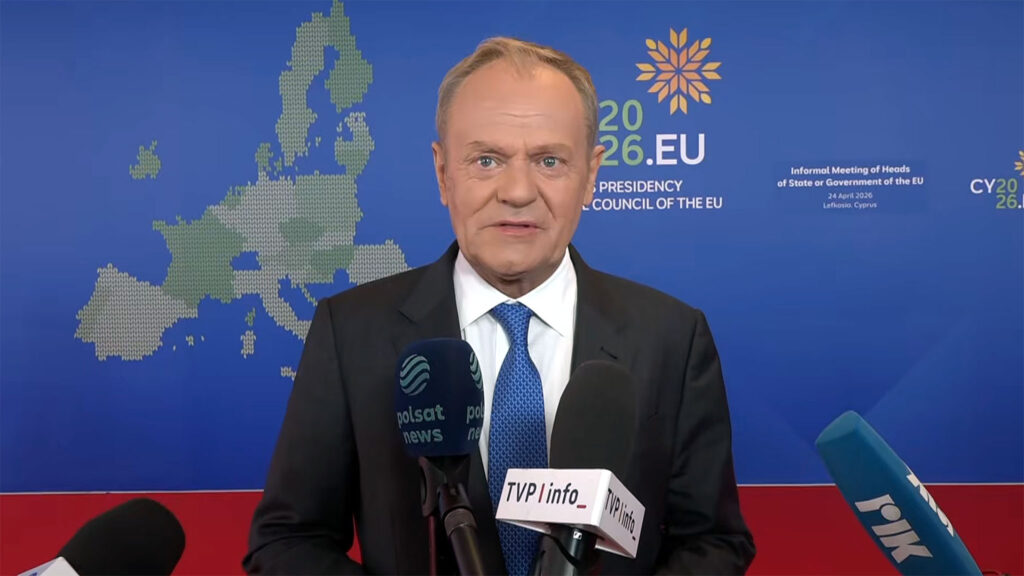
Donald Tusk, the Polish Prime Minister, summed it up with a single sentence that is making headlines across Europe today: “For the first time in years, there were no Russians in the room. You know what I mean.” The summit concluded with two decisions that Budapest had blocked just a month ago: the approval of the twentieth package of sanctions against Russia and a loan of 90 billion euros for Ukraine. Meanwhile, Polish President Karol Nawrocki – who visited Orbán in Budapest just before the Hungarian elections – still claims it was not a visit of support.
What Tusk Said and Why It Matters
The quote came in the morning, as the Polish Prime Minister was getting out of his car in front of the summit building. It wasn’t a prepared speech – just a sentence thrown to journalists, in a style Poles know from Tusk’s years in Poland. One of those sentences carefully chosen, though pretending to be spontaneous. “For the first time in years, there were no Russians in the room. You know what I mean” – that’s all. AFP, Reuters, and Politico journalists reported it immediately. By noon, the quote was on the front pages of European news outlets.
What Tusk meant was clear. In the final weeks of the Hungarian election campaign, documents leaked showing the extent of Orbán’s cabinet’s cooperation with Moscow. The worst of them: a transcript of a phone conversation in which Hungarian Foreign Minister Péter Szijjártó reported to his Russian counterpart, Sergey Lavrov, on the course of discussions at EU summits, additionally offering to share confidential documents. The Washington Post wrote about it at the end of March. Politico in early April. In European capitals, things were boiling at the time.
Tusk said aloud what his EU colleagues had been saying privately for months. That Orbán was a Trojan horse. That every important European Council meeting was simultaneously a meeting of Russian intelligence. That when 26 countries discussed aid to Ukraine, in the 27th, Putin read the transcript of that conversation the next morning. After the elections in Hungary – in which Péter Magyar’s Tisza party won 138 seats and a parliamentary majority – that era came to an end. And that’s exactly what Tusk publicly signaled.
90 Billion Euros for Kyiv
But the summit wasn’t just about Orbán. The second big news from Ayia Napa was the approval of a 90 billion euro loan for Ukraine – the largest financing package the European Union has organized since the start of the Russian invasion. The money comes mainly from frozen Russian assets held in European banks. The loan is intended to help Kyiv survive the coming years of the war – without relying on American money, which has become uncertain during the Trump presidency.
The loan had been blocked by Hungary for over a year. Orbán used all available tools: vetoes, procedural delays, public attacks on the European Commission. After the electoral defeat and loss of political legitimacy – Budapest quietly withdrew its veto. Twenty-seven countries voted unanimously in Cyprus. No arguments, no drama. “All it took was for one man to lose an election, and suddenly Europe can act together,” said one anonymous diplomat quoted by Politico.
Along with the loan, EU leaders approved the twentieth package of sanctions against Russia. The package targets Russian shadow fleet tankers, the financial network facilitating the circumvention of earlier restrictions, and new names of oligarchs closely linked to the Kremlin. Moscow’s reaction was immediate. Maria Zakharova, spokeswoman for the Russian Foreign Ministry, stated that “Brussels is harming itself.” Leonid Slutsky, head of the State Duma’s foreign affairs committee, called it “Macron’s neo-Napoleonic illusions” – which first confirms that Macron is now the main European adversary in Moscow, and second shows how nervously Russia is reacting to what just happened in Ayia Napa.
And Where is Nawrocki?
Polish President Karol Nawrocki did not participate in the summit – because informal European Council summits are meetings of heads of government, not heads of state. But Nawrocki has recently been in the memory of European journalists for another reason. In mid-March 2026, a few weeks before the Hungarian elections, the Polish president traveled to Budapest and met with Orbán. The meeting was a gesture – photographs of both politicians circulated in Hungarian and Polish media, and commentators wrote directly: Nawrocki supports Orbán because they share a common denominator: dislike for Brussels.
After Orbán’s defeat, the Presidential Palace began to explain that “it was not a visit of support.” That it was “talks about Polish-Hungarian regional cooperation.” That Nawrocki “did not interfere in Hungary’s internal affairs.” This sounds rather clumsy, especially when contrasted with the facts: Tusk congratulated Magyar immediately after the elections, called him, publicly laughed at Orbán, and wrote in Hungarian on X “Ruszkik haza” – “Russians go home” – quoting the famous slogan from 1956. Nawrocki, on the other hand, remained silent for two weeks, and when he finally spoke, it was a vague statement about “respecting the choice of Hungarian citizens.” This contrast is seen by the entire Polish diaspora in the United States. And all of Europe.
Context: Europe Moves Away from Trump
The summit in Cyprus took place in the shadow of something bigger. Europe is doing things it wouldn’t have done a year ago – because back then it could count on America. The 90 billion euro loan for Ukraine from frozen Russian assets is a gesture that was originally supposed to be undertaken jointly with the US. Now it is being done without them. The twentieth package of sanctions is to be harmonized with the American package. Today, Washington observes this from a distance – Trump pursues his own policy towards Iran, Russia, and China, in which Europe is at best a secondary actor.
Politico published a report on Tuesday that sums it up well: after Orbán’s departure, when European unity suddenly became easy, EU leaders “were confronted with the enormity of everything else they have to do.” It’s no longer about convincing Budapest. It’s about convincing themselves. Because the problem of Ukraine will not disappear. Because Putin will not disappear. Because Trump will not return to Biden’s policy. Europe must, very quickly, learn to be safe without America.
Tusk, in an interview with the Financial Times on the same day, warned that Russia could attack European NATO countries “even before 2030.” Four years. For a state that for twenty years built its security policy around the assumption that America would always come to its aid – four years is very little.
What This Means for the Polish Diaspora
From the perspective of the Polish diaspora in the USA, this is a moment worth noting. Firstly: Poland – the country of our parents and grandparents – is now participating in the creation of a new, independent European security. For the first time in decades, Warsaw is not just following Washington, but co-creating European strategic decisions together with Paris and Berlin. This is a change of the century.
Secondly: for the Polish diaspora in America, who pay taxes to NATO, this moment has a concrete dimension. If Europe truly takes responsibility for its security, American taxpayers – including hundreds of thousands of Poles with dual citizenship – will stop financing NATO’s eastern flank at the current level. The money that currently goes to bases in Poland and Germany will return to the United States. This is not bad. It is natural.
Thirdly: for the Polish diaspora in Chicago, New York, and Detroit, who for generations remember what Russia did to Poland – the sight of Tusk laughing at Orbán’s absence has an emotional dimension. Tusk said aloud what Poles have been saying at the dinner table for generations. “Ruszkik haza” – Russians go home. That Poland – small, Central European Poland, which the Polish diaspora remembers as an enslaved, poor, subordinate state – is suddenly the state that, in the European Council, signals the end of the Russian Trojan horse.
This is a moment our grandparents did not live to see. And our children will no longer have to remember it – because for them, it will simply be Europe. Our Europe. Without Russians in the room.
Kamil Brzozowski, poland.us
EU Summit in Ayia Napa, Cyprus – April 23–24, 2026 | Format: Informal European Council summit | Host: President of Cyprus Nikos Christodoulides | Absent: Viktor Orbán (Hungary) | Quote of the week: Donald Tusk – “For the first time in years, there were no Russians in the room” | Decisions: 20th package of sanctions against Russia + 90 billion euro loan for Ukraine from frozen Russian assets | Other guest: Volodymyr Zelenskyy | Context: After Orbán’s electoral defeat (April 12, Péter Magyar’s Tisza party, 138 seats) Hungary lifted its veto on the aid package for Ukraine | Polish President Nawrocki: visited Orbán in Budapest in mid-March 2026, today denies it was support | Based on materials from AFP, Politico, Yahoo News UK, RTÉ, The Journal, Spotmedia, Ukrainska Pravda, and Donald Tusk’s posts on X (April 24, 2026)
Read also: Magyar builds new government in Hungary – first visit to Warsaw | Tusk and Macron in Gdańsk – Poland builds Plan B
Read more at Poland.us.