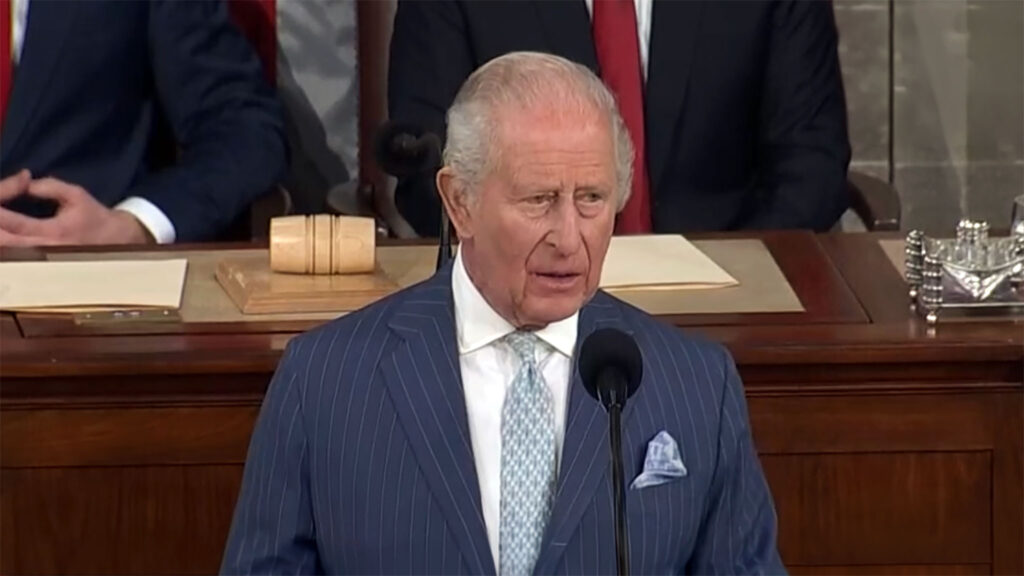
The speech, which some commentators interpreted as a subtle signal to the Donald Trump administration, concerned NATO, Article 5, the defense of Ukraine against “unprovoked aggression,” multilateralism, democracy, and threats to Earth’s natural systems. Foreign Policy read the speech as containing “clear signals” to the White House. In the evening, at a state dinner at the White House, Donald Trump revealed a fragment of a private conversation with the King about Iran – which puts Charles III in a position no British monarch has wanted to be in for a hundred years.
What Charles said – and how
The speech began formally. Charles thanked the congressmen for the invitation, honored the memory of the victims of September 11, 2001, and announced that he and Camilla would pay tribute to them on Wednesday in New York. In the very first minute, he clearly alluded to Saturday’s incident at the Washington Hilton hotel: “We also meet in the aftermath of an incident near this great building, which aimed to harm the leaders of your Nation and incite broader fear and division,” he said. Standing ovation.
Then the actual speech began. Charles spoke of the “intertwined destinies” of the States and Great Britain. Of the 250th anniversary of American independence. Of how the history of both countries is a story “of reconciliation, renewal, and extraordinary partnership.” Of wars in which British soldiers died alongside American ones. Of the common roots of democratic institutions. All of this was expected.
What was unexpected was how Charles chose his words. He praised NATO – an organization Trump had repeatedly criticized, suggesting that Article 5 of the North Atlantic Treaty could be “negotiable.” Charles also praised multilateral institutions – a concept that practically doesn’t exist in Trump’s vocabulary. He spoke of the importance of increased British defense spending – but in a tone of cooperation, not subordination. He mentioned environmental protection, melting ice caps, and how the “breakdown of key natural systems” threatens prosperity and security. Trump, in his first days in office, withdrew the US from the Paris Agreement, backed out of plans to invest in renewable energy sources, and openly mocked climate scientists. Charles knew this – and said it anyway.
Foreign Policy, in an analysis published an hour after the speech, wrote that Charles III could have delivered “a clipped, curatorially cautious speech that would not have ruffled Washington’s feathers.” He did not. He delivered a thirty-minute address with numerous signals to the White House. A British monarch speaking about climate and NATO in a chamber where most Republicans are climate skeptics, and Trump recently suggested suspending aid to Ukraine – this was not a random list of topics.
Ovations and political reactions
Charles received several standing ovations during his speech. The first – after mentioning Saturday’s shooting. The second – after the passage about 9/11. The third – after words about British and American soldiers who died in common wars. The entire chamber also stood at the end. The bipartisan nature of the reactions was so clear that Trump himself joked at the state dinner that Charles had managed to get Democrats to stand up.
Trump commented on the speech in the evening during the state dinner at the White House. “He made a great speech. I was very jealous,” he said, pointing his finger at Charles. This sounded like a compliment, but after hours of analysis in right-wing American media, many commentators pointed out something else. Trump did not go into the details of the speech. He did not comment on the parts about NATO. He did not comment on climate. He simply praised the speech as a whole – in the way a politician compliments the rhetoric of an opponent he does not want to directly criticize. Subtle, but clear.
The evening and the moment the Palace did not want
The state dinner in the East Room of the White House began at 7:30 PM. Dress code: white tie. The first such dinner at the White House for a British monarch in nineteen years – the last was in 2007, when George W. Bush hosted Charles’s mother, Elizabeth II. One hundred twenty people, an exclusive menu, official toasts. Melania Trump wore a pale delphinium pink gown by Christian Dior Haute Couture.
And then Trump said something the Palace in London did not want to hear. In a conversation with journalists before the dinner, Trump revealed a private conversation with Charles about Iran. “Charles agrees with me even more than I do. We will never allow this adversary to have nuclear weapons,” he said, referring to Iran. This statement immediately exploded in the British media. Because a British monarch – by constitution, by tradition, by definition of his role – does not express his own political views. He can represent Great Britain as a country, but not its government. He has no role in saying whether he agrees with Trump on Iran.
Buckingham Palace will never confirm the actual content of the conversation. Because the rule is that private conversations between the monarch and heads of other states are confidential. The Palace framed the situation within British non-proliferation policy – the UK has long officially opposed Iran’s possession of nuclear weapons, so the thesis “Charles agrees” can be interpreted in this context as alignment with His Majesty’s government’s line, not a personal declaration. But the fact that Trump revealed a private conversation is in itself problematic. The British government of Keir Starmer openly opposed US-Israeli military actions in Iran in February 2026. Charles III, as a constitutional monarch, acts on the advice of his government. Trump publicly suggests that the King privately agrees with the US president, while the British government has a different stance. This puts the Palace in an awkward diplomatic position. What has already been said at the White House tables cannot be unsaid.
Why this speech was more important than expected
In the British-American context, Charles III’s speech was a breakthrough moment. Firstly: it revealed that Buckingham Palace is not afraid to subtly criticize the White House’s line. This is a change from the principle of “we don’t politicize.” Charles probably did not use the word “Trump,” did not name policies, but everyone who listened knew what “the importance of multilateralism” meant in the context of a president who had just withdrawn from talks with Iran in Islamabad. Secondly: it showed that the British monarchy, though symbolic, has a voice in global politics. Three decades after Elizabeth II in 1991, Charles spoke to a different America – and told it things his mother did not have to say.
Thirdly – and perhaps most importantly – the speech was a message to Europe. The British monarchy, despite Brexit, despite Iran, despite Trump, says: we are still part of the same family of democratic nations as you. For Poland, for Germany, for France – this is a reassuring signal. Charles stands by European values, even when Trump does not share them. The British monarchy, whose political significance many commentators regularly declared to be over, today showed that it can be relevant. Perhaps not in decisions, but in signals.
Polonia in Congress, Polonia on both sides
The Polish-American context of this speech is not obvious, but it is worth noting. Marcy Kaptur, a congresswoman from Toledo, of Polish descent, the longest-serving woman in the history of the US House of Representatives, listened to Charles from a seat near the Speaker. Kaptur has served in Congress since 1982 – in 2026, it will be her 44th year of service. When Elizabeth II spoke in 1991, Kaptur had only been there for nine years, serving her fifth term. Between these two speeches by British monarchs, Poland joined NATO and the European Union. Today, when Charles spoke about NATO, about climate, about multilateralism – Kaptur probably knew that this concerned Poland as much as Great Britain. Poland is today one of the countries that most strongly support Ukraine against Russia, and that most strongly fear Trump’s departure from NATO’s Article 5. Charles III, speaking to the US Congress, was also speaking – indirectly – to Poland.
This is a moment worth remembering. A British monarch speaks to a Congress where Polonia once had many of its own – Rostenkowski, Nowak, Kaptur. Today, only Kaptur remains. Thirty-five years pass quickly..
What’s next
On Wednesday, Charles and Camilla fly to New York. The 9/11 Memorial, a community project in Harlem, celebrations of Winnie the Pooh’s centenary. On Thursday, they return to Washington for a farewell ceremony. Charles then continues his journey to Bermuda, where on May 1 and 2 he will visit the British Overseas Territory as monarch. The state visit to the USA concludes.
But the speech Charles delivered on Tuesday afternoon will be remembered. Not because it was revolutionary. But because it was surprisingly strong. The British monarch, whom critics accused of excessive caution, said in the US Congress chamber – in a coded but clear way – that some things are more important than a temporary political arrangement. NATO. Climate. Multilateralism. Democracy. These are not partisan slogans. These are values. And that is what Charles III spoke about for 30 minutes. Also – though not in a single direct word – to Trump.
Kamil Brzozowski, poland.us
Charles III before the US Congress – Tuesday, April 28, 2026, analysis | Speech: approx. 30 minutes, around 3:00 PM EDT | Second time in history a British monarch addressed Congress (after Elizabeth II in 1991) | Main topics confirmed in the official Buckingham Palace transcript: 250th anniversary of US independence, “intertwined destinies,” “reconciliation, renewal, and extraordinary partnership,” 9/11, NATO and Article 5, defense of Ukraine against “unprovoked aggression,” multilateralism, democracy, environmental protection and “breakdown of key natural systems,” British defense spending | Standing ovations: several, including after mention of Saturday’s shooting and after the 9/11 passage | Commentators’ interpretation: according to Foreign Policy, the speech contained “clear signals” to the Trump administration | State dinner in the East Room: white tie, first such dinner for a British monarch at the White House since Elizabeth II’s visit to G.W. Bush in 2007, 120 guests | Trump at dinner: “He made a great speech. I was very jealous”; also revealed a private conversation with Charles about Iran (“Charles agrees with me even more than I do”) – Buckingham Palace never confirms private conversations of the monarch, but British non-proliferation policy is consistent with the line on not allowing Iran to have nuclear weapons | Melania Trump: pale delphinium pink Christian Dior Haute Couture gown | Further in the program: Wednesday New York (9/11 Memorial, Harlem, Winnie the Pooh centenary), Thursday farewell and Charles’s continued journey to Bermuda (May 1–2, first visit to a British Overseas Territory as monarch) | Polish-American context: Marcy Kaptur (D-OH) – in Congress since 1982, of Polish descent, longest-serving woman in the history of the US House of Representatives | Based on materials from AP, CNN, Foreign Policy, ITV News, Today, US News, C-SPAN, The Guardian and official transcripts of Congress and Buckingham Palace
Read also: Preview: Charles III speaks in Congress today | British monarch visits descendants of rebellious subjects | Shots fired at the White House Correspondents’ Dinner
Read more on Poland.us.