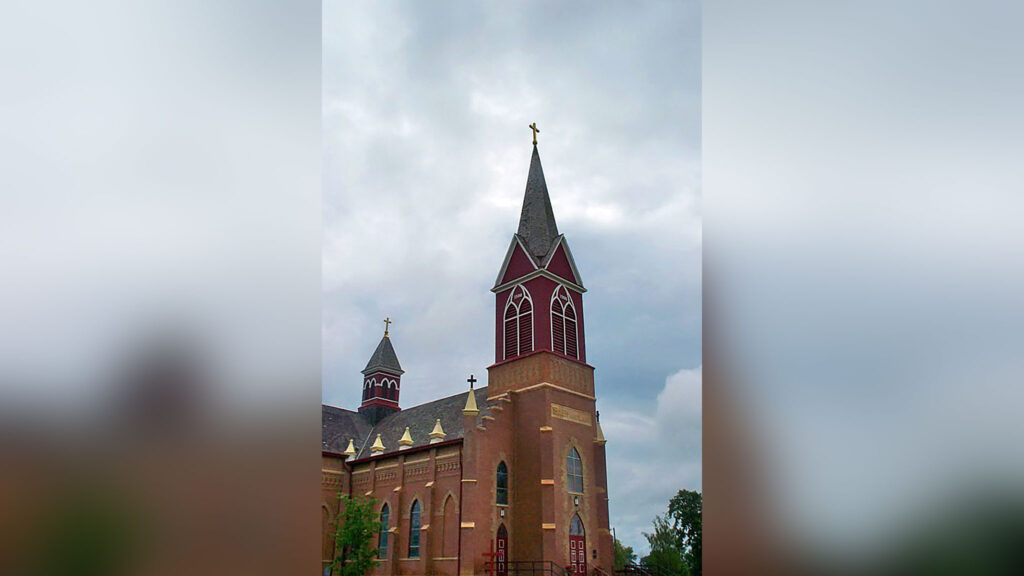
It is called Saint Stanislaus. The parish dates back to 1878–1883, when Polish settlers built the first modest church; the current monumental Gothic temple, designed by John W. Ross, was consecrated in 1901. The town where it stands is called Warsaw – in honor of the capital of Poland. A few dozen kilometers further lie Poland, Minto, and Ardoch (also Ardock in older sources) – other Polish settlements. This is the heart of Polonia, which you rarely hear about in the Polish-American press from Chicago, Detroit, or New York. A Polonia that emerged right on the border of the States and Canada, in a state where Poles were never numerous, but left traces that still cannot be erased. Only today, almost no one is looking for these traces anymore.
How Poles Reached the End of the World
It all started with two things: the Homestead Act of 1862 and the Northern Pacific Railroad. Lincoln’s act promised every settler 160 acres of land for free if they cultivated it for 5 years. The railroad provided transport. Between 1870 and 1900, thousands of immigrants from Scandinavia, Germany, Bohemia, Ukraine, and – in smaller but noticeable numbers – from Poland, flocked to North Dakota. Polish settlers in North Dakota never constituted a large number compared to Wisconsin or Pennsylvania. According to a 1911 report by the Immigration Commission, three Midwestern states – Michigan, Minnesota, and Wisconsin – accounted for sixty-three percent of all first-generation Polish farmers. But North Dakota was listed along with Iowa, Nebraska, and Arkansas as a place where Polish farmers “were pioneers”.
Most arrived in the 1880s, mainly from the Prussian partition lands – especially from Pomerania, Kashubia, and West Prussia. Some reached Dakota through earlier Polish settlements in Minnesota and Wisconsin, as part of chain migration. Many spoke the Kashubian or Pomeranian dialect; they were also bilingual in German. In Poland, they worked on the lord’s land; in Dakota, for the first time in their lives, they had their own land. The climate was harsher than in Wisconsin – freezing winters, short summers, winds blowing across the prairies incessantly. But the soil was dark, fertile, yielding wheat. After years of work, it turned out that Poles from Dakota lived better than their cousins in the factories of Chicago and Milwaukee. The Immigration Commission report cited by a Polonia researcher in 1911 summarized it bluntly: “No group of citizens, whether immigrants or descendants of immigrants, could demand greater material progress, better buildings, homes, churches, schools, and municipal buildings, than the Polish settlements around Warsaw, Poland, Minto, and Ardock in Walsh County, North Dakota.”
Saint Stanislaus, Cathedral of the Prairie
The heart of Polish Dakota became the Church of St. Stanislaus in Warsaw, Walsh County. The parish was founded between 1878 and 1883, when a group of Polish farmers erected the first modest wooden church. Over the next two decades, as the community grew and prospered, parishioners began to dream of something bigger. In 1901, a monumental Gothic temple, designed by architect John W. Ross, was consecrated. Its grandeur – for a Polish parish in the middle of the American prairie – was unexpected. The surrounding Protestant communities began to speak of it with a mixture of admiration and irony: “the cathedral on the prairie.” The name stuck. To this day, Saint Stanislaus in Warsaw, North Dakota, is officially called “Cathedral of the Prairie” in local tourist documentation.
Saint Stanislaus was just one of about ten Polish churches founded in the Red River Valley of the North, running along the North Dakota and Minnesota border. Polish immigrants established parishes around Warsaw, Poland (yes, the town of Poland in Dakota!), Minto, Ardock, Florian, Stanisławowo. Some of these names disappeared from maps within a few decades. Others still exist, though their Polish origins are known only to local historians. Some churches were closed when descendants of Polish settlers began to migrate to cities. Saint Stanislaus, however, still exists and operates as a parish. Masses are still held there – though almost exclusively in English now.
Sienkiewicz on the Great Plains
One of the most surprising Polish figures to pass through the American West was Henryk Sienkiewicz – future Nobel laureate in literature, author of “The Trilogy,” “Quo Vadis,” and “In Desert and Wilderness.” Between 1876 and 1878, Sienkiewicz traveled through the United States as a young journalist for “Gazeta Polska.” From this journey, he wrote “Letters from a Journey to America,” in which he reported on the American West, the conflict over the Black Hills, the situation of the Sioux, and the U.S. government’s policy towards indigenous peoples. Sienkiewicz was not part of the Polish colony in Dakota, and there is no evidence that he personally reached the Polish settlements on the Red River. But his letters show something important: a Polish perspective on the American West emerged earlier than the large urban Polonia. Sienkiewicz wrote about Native Americans with an empathy rarely found in the American press of the time.
Earlier, much earlier, Karol Radzimiński – a Polish officer of the November Uprising of 1830 – reached the prairies of this part of America. After the defeat of the uprising, he fled to the United States. He joined the American army and fought in the Mexican-American War. After the war, he served on the Texas frontier and participated in the work related to demarcating the US-Mexican border. Camp Radziminski – a military outpost in present-day Oklahoma – was named after him. Poles were on the western frontiers of America before most of Polonia heard of Chicago.
What Remains Today
Polonia in North Dakota was never numerous compared to Wisconsin or Pennsylvania. Contemporary American Community Survey data indicate that about fifteen thousand North Dakota residents declare Polish ancestry – less than 2% of the state’s population. However, their presence is still visible. The Encyclopedia of the Great Plains notes that a distinctive Polish-American culture “remains vibrant in some larger settlement clusters,” which is confirmed by “active Polish fraternal societies in North Dakota.” Polish societies still meet. They still organize social events, and they still maintain contact with parishes.
Saint Stanislaus still stands and is still a point on North Dakota’s tourist maps. The cemetery next to the church is full of Polish and Kashubian names – great-grandfathers, grandfathers, fathers, sons repeating through generations. Over a hundred years of Polish presence inscribed on gravestones. The Polish language in homes and churches persisted in Dakota at least until the mid-twentieth century, as noted by the Encyclopedia of the Great Plains. Today, less frequently. But the names have not disappeared. Polish Dakota still exists – in the church, in the cemetery, in societies, in town names.
Why We Write About This So Rarely
Here is a question worth asking: why does the Polish-American press in the States – in Chicago, in New York, in Detroit – so rarely write about Polonia in North Dakota? Why are there no articles, programs, or books written for a broad Polish-American audience about this history? The answer is simple and sad. Polonia in the United States is divided into two layers: the visible one – metropolitan, institutional, political, in Chicago and New York, in Greenpoint and Hamtramck – and the invisible one. This invisible one is on Wisconsin farms, in small towns of Pennsylvania, in Panna Maria, Texas, in North Dakota.
The invisible Polonia rarely speaks Polish anymore. Its third and fourth generations have assimilated more deeply. They don’t vote for Polonia – they vote for themselves, as Americans of Polish descent, for whom Poland is grandma’s pierogi recipe, a wedding photograph from 1934, a Polish surname in the second row of gravestones at Saint Stanislaus. Polish-American institutions, such as parishes, fraternal organizations, Polish Saturday schools, bi-weekly editorial offices – all were established in large cities. Where there was a critical mass. In Dakota, there was no such mass. And today, there is no one to tell this story.
And the history is important. Because it is the history of Poles who – just like Poles in Boston, Chicago, Pittsburgh, or Detroit – left Poland not out of greed, but out of necessity. Prussian partitions, land poverty, religious pressure. They came to the States with nothing. They built churches. They started families. They left names. Their descendants are still here. Only no one writes about them because they don’t shout about themselves. Because North Dakota doesn’t have a Polish-American newspaper, and in Polish-American newspapers from Chicago and New York, North Dakota is so far away that it’s easier to write about Poland.
What Should Be Done
This is the moment for the Polish-American community from big cities – and we, “Głos Polonii w USA” (Voice of Polonia in the USA), fully aware of this statement – to remember that Polonia is not just Greenpoint, Hamtramck, and Niles. That Polonia also has its roots among the wheat fields of Walsh County, on the streets of a town named Warsaw, in the shadow of the “Cathedral of the Prairie.” Poles from North Dakota do not need our attention to exist – they have been there for five generations and will remain. But we need them to understand who we are. Metropolitan Polonia without rural Polonia is a half-story. We lack those who are not seen. And yet they are there.
Saint Stanislaus, the “Cathedral of the Prairie,” is one of the most beautiful Polish churches in America. Few of us have heard of it. Maybe it’s time to start listening.
Ewelina Modrzejewska, poland.us
Polonia in North Dakota – a forgotten chapter of American Polonia | Main Polish settlements: Warsaw (Walsh County), Poland, Minto, Ardock (Ardock in older sources), Florian, Stanisławowo | First settlers: 1870–1880s, mainly from Prussian partition lands – Pomerania, Kashubia, West Prussia; some arrived as part of chain migration through earlier Polish settlements in Minnesota and Wisconsin | Migration mechanism: Homestead Act 1862 + Northern Pacific Railroad | Main church: St. Stanislaus in Warsaw, ND – parish founded 1878–1883 (first wooden church from 1883), current Gothic temple designed by John W. Ross, consecrated in 1901, known as “Cathedral of the Prairie” | Number of parishes: about 10 in the Red River North valley (on both sides of the ND/MN border) | Current population: approx. 15,000 people of Polish descent in the state (less than 2% of ND population) according to American Community Survey | Major contextual name: Henryk Sienkiewicz – traveled in the US 1876–1878, wrote “Letters from a Journey to America” for “Gazeta Polska,” including about the Black Hills conflict and the Sioux; not confirmed that he reached Polish settlements in Dakota | Earlier Polish presence: Karol Radzimiński – refugee of the November Uprising 1830, officer in the Mexican-American War, served in demarcating the US-Mexico border; Camp Radziminski in present-day Oklahoma was named after him | Still alive: active Polish fraternal societies in ND, masses at Saint Stanislaus, Polish and Kashubian names in the parish cemetery | Based on materials from Encyclopedia of the Great Plains (UNL), North Dakota Studies, Walsh County Historical Society, Prairie Public Broadcasting, Polish Roots, MNopedia, U.S. Census ACS, and the official website of St. Stanislaus / Sacred Heart parish
Read more at Poland.us.